



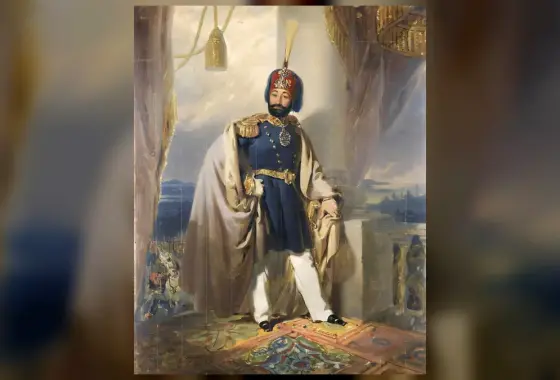
Mahmud was the son of Abdul Hamid I. After his reforming cousin Selim III was deposed in 1807 by the Janissaries and the revolt of Kabakçı Mustafa, he came to the throne in 1808 with the backing of Alemdar Mustafa Pasha. The Charter of Alliance (Sened-i İttifak) signed with provincial notables that year tried to regulate relations between the sultan and provincial powers.
Abolishing the Janissaries
After building up his strength for years, Mahmud II in 1826 crushed the Janissaries, who had revolted against his decision to create a new military unit, and abolished the Janissary corps. After this event, known in Ottoman history as the Auspicious Incident, a new army named the “Asakir-i Mansure-i Muhammediye” was created.
Reforms
Ministries replaced the old imperial council; the first official newspaper, Takvim-i Vekayi (1831), was published; and a census was taken in 1831. The fez and Western-style dress became compulsory for officials. Permanent embassies were opened in European capitals, schools of medicine and military science were founded, and a postal service was set up.
External problems
The Greek revolt that began in 1821 ended with European intervention and the Battle of Navarino in 1827; Greece became independent in 1830. The Russo-Turkish war of 1828–1829 ended with the Treaty of Edirne. During the revolt of Muhammad Ali Pasha of Egypt, the Treaty of Hünkâr İskelesi (1833) was signed with Russia.
Death
Mahmud II died in Istanbul in 1839 and was buried in his tomb on Divanyolu. The Tanzimat Edict, proclaimed a few months later under his son Abdülmecid, continued the reforms he had begun.
Building central authority: the notables and the Deed of Agreement
When Mahmud II came to the throne, local powers in the provinces known as the ayan were acting independently in practice, while the centre was shaken by Janissary uprisings. The Deed of Agreement of 1808 was prepared as a compromise text between the sultan and the notables. The notables would recognise the sultan’s authority, and the sultan would respect the notables’ provincial rights within certain limits.
The document did not last long; the uprising in which Alemdar Mustafa Pasha was killed by the Janissaries showed how fragile the new order was. Mahmud then chose a more patient path: he weakened the notables one by one or through diplomacy and tied them to the centre. The abolition of the corps was the most visible result of this long preparation.
The Egyptian question and Mehmed Ali Pasha
One of Mahmud II’s heaviest political problems was the conflict with the governor of Egypt, Mehmed Ali Pasha. Mehmed Ali had sent ships and troops to the Ottomans during the Greek revolt but had not received the positions he expected in return. In 1831 the Egyptian army under his son Ibrahim Pasha entered Syria and advanced into the interior of Anatolia; in 1832 the Ottoman army was defeated at Konya.
Unable to obtain help from Europe, the sultan had to turn to Russia. In 1833 Russian troops landed near Istanbul and the Treaty of Hünkâr İskelesi was signed. This troubled the European powers, particularly Britain, and showed that the fate of the Ottomans was bound up with great-power rivalry.
Education, health and state organisation
Some of the reforms were in education and health. In 1827 the School of Medicine was opened within the Imperial Medical Establishment; in the following years new departments were added to schools such as the War College and the Engineering School. Young officers and officials were sent to Europe to study. In 1838 a quarantine system was established, and health inspection began at borders and ports against the spread of contagious diseases.
Changes were also made in administration. The powers of the grand vizier were limited and ministries were created; the Supreme Council of Judicial Ordinances, founded in 1838, became a centre where legal regulations were prepared. Mahmud emphasised the idea of merit and regular salaries in appointing officials. These practices were part of the preparation for the legal and administrative framework of the Tanzimat.
Final years, Nizip and legacy
In Mahmud’s final years the Egyptian question flared up again. In 1838 the Anglo-Ottoman Commercial Convention of Balta Limanı was signed; it liberalised trade in the Ottoman Empire but also brought a structure that increased the burden on local production. On 24 June 1839 the Ottoman army was defeated at Nizip by the Egyptian army under Ibrahim Pasha. The sultan died on 1 July 1839 and did not see the defeat’s consequences.
Under his son and successor Abdulmejid, the Gülhane Edict prepared by Mustafa Reshid Pasha was proclaimed the same year and the Tanzimat era began. Mahmud II’s legacy is debated: some historians regard him as the founder of the modern state, others as the starter of the period in which the Ottomans opened up to foreign debt and European intervention.
Dress, daily life and social reactions
Mahmud II’s dress reform became one of his most debated measures because of its symbolic weight. The fez and Western-style jacket and trousers were made compulsory for officials and soldiers in place of the turban and kavuk. The measure also aimed to end the old clothing rules that made distinctions among subjects visible.
Reactions in society varied. Some scholars and tradesmen found the change contrary to tradition, while Mahmud also built a new image as a ruler by having his portraits hung in government offices. This visible change in daily life symbolises the tension that the reforms created between state and society.
Press, communications and finance
The Takvîm-i Vekâyi, published in 1831, was the first official Ottoman gazette and aimed to announce state decisions to the public. A postal organisation was set up, and the communications network spread from Istanbul to the provinces. These developments increased the bureaucracy’s capacity for supervision from the centre.
In finance, the falling value of money and war spending were a constant problem. Reducing the silver content of coins fuelled inflation and provoked public reaction. Mahmud’s effort to raise the revenue needed for the new army and administration also made visible the structural problems of Ottoman finance.
The new army and military training
The Asakir-i Mansure-i Muhammediyye, formed after the abolition of the Janissary corps, was designed as a regular army trained in the European manner. The French and Prussian officers who trained Mehmed Ali Pasha’s army in Egypt served as examples, and from the 1830s the Prussian officer Helmuth von Moltke also advised the Ottoman army.
A system resembling conscription by lot was tried for recruitment, but regular military service took root slowly and with difficulty over the years. The strength of the new army was tested by the defeats against the Egyptian army, and the cost and delays of the reform became clearly visible.
Sources and further reading
- Türkiye Diyanet Vakfı İslâm Ansiklopedisi, “Mahmud II”.
- Bernard Lewis, The Emergence of Modern Turkey.
- Encyclopaedia Britannica, “Mahmud II”.
- Stanford J. Shaw & Ezel Kural Shaw – History of the Ottoman Empire and Modern Turkey, vol. 2
- Erik J. Zürcher – Turkey: A Modern History
- Türkiye Diyanet Foundation Encyclopaedia of Islam – “Mahmud II” entry
- Stanford J. Shaw & Ezel Kural Shaw – History of the Ottoman Empire and Modern Turkey, vol. 2
- Erik J. Zürcher – Turkey: A Modern History
- Türkiye Diyanet Foundation Encyclopaedia of Islam – “Mahmud II” entry
People also ask
Who was Mahmud II? Mahmud II reigned over the Ottoman Empire from 1808 to 1839.
When and where was Mahmud II born? Born: 20 July 1785, Istanbul.
When did Mahmud II reign? Reign: 1808 – 1839.
When did Mahmud II die? Died: 1 July 1839, Istanbul.
Leave a comment
Your email address will not be published. Required fields are marked *