



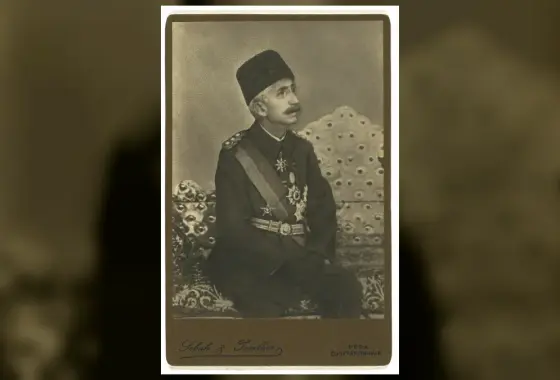
Vahideddin was the youngest son of Sultan Abdülmecid. He came to the throne aged 57 on the death of his brother Mehmed V Reşad in July 1918.
Mudros and occupation
When the alliance the Ottomans belonged to was defeated in the First World War, the Armistice of Mudros was signed on 30 October 1918. Istanbul and many parts of Anatolia were then occupied by the Allied powers. In December 1918 Vahideddin dissolved the Chamber of Deputies.
The National Struggle
In May 1919 Mustafa Kemal Pasha was sent to Samsun as inspector of the Ninth Army and became leader of the national resistance that began in Anatolia. Historians interpret the purpose of this appointment and the sultan’s attitude in different ways. Relations between the Istanbul government and the Grand National Assembly opened in Ankara (23 April 1920) became hostile over time. The Treaty of Sèvres, signed by Istanbul government delegates in August 1920, never came into force.
Abolition of the sultanate
After the War of Independence was won, the Grand National Assembly abolished the sultanate on 1 November 1922. Vahideddin left Istanbul on a British warship on 17 November 1922, ending more than 600 years of Ottoman rule; the Republic of Turkey was proclaimed on 29 October 1923.
Death
After spending time in Malta and the Hejaz, Vahideddin settled in San Remo, Italy, where he died in 1926. He was buried in the cemetery of the Sultan Selim (Süleymaniye) complex in Damascus.
The Istanbul governments and the split with Ankara
Throughout Vahdeddin’s reign the governments in Istanbul changed frequently. Damat Ferid Pasha served as grand vizier in 1919 and 1920; his government favoured reaching an understanding with the Entente powers against the national movement in Anatolia. On 16 March 1920 Istanbul was formally occupied, and on 11 April the Ottoman parliament was dissolved by the sultan.
In this period fatwas issued from Istanbul and units known as the Kuva-yi Inzibatiye were used against the resistance in Anatolia. In May 1920 the court-martial in Istanbul sentenced Mustafa Kemal and his companions to death in absentia. In reply, the mufti and clergy in Ankara declared that the sultan was a captive and that the fatwa should be regarded as invalid. The tension between the two centres thus became not only a political question but a legal and religious one.
From Sèvres to the invitation to Lausanne
The Treaty of Sèvres, signed on 10 August 1920, largely divided up Ottoman territory; however, the treaty was not recognised by the assembly in Ankara and never came into force. As the military results of the War of Independence became clear, the Entente powers accepted that a new peace negotiation was needed.
In October 1922, after the Armistice of Mudanya, the question arose of inviting both the Istanbul and Ankara governments to Lausanne for the peace conference. This led the assembly, which wished to present Ankara as the only body representing the country, to treat the sultanate as a separate question. On 1 November 1922 the Grand National Assembly decided to abolish the sultanate and to keep the caliphate within the dynasty, in a person to be chosen by the Assembly. This decision ended Vahdeddin’s rule as sultan.
Departure and the years in exile
On 17 November 1922 Vahdeddin left Istanbul aboard the British warship HMS Malaya and went to Malta. A day later, on 18 November, the Grand National Assembly elected Abdulmejid as caliph. Vahdeddin stayed in Malta for a time, then at the invitation of King Hussein of the Hejaz visited Mecca and Medina, and afterwards settled in Italy.
With the abolition of the caliphate in 1924, the Ottoman dynasty was expelled from Turkey. Vahdeddin spent his years in exile in San Remo on a limited budget. He died there on 16 May 1926, and his funeral had to wait for a time because of his debts. He was finally buried in the cemetery of the Süleymaniye complex in Damascus. These details show that the last sultan of the empire spent the final part of his life in material difficulty and political isolation.
Assessment in historical writing
In Turkey Vahdeddin was long remembered as a “traitor to the homeland”; textbooks and official accounts placed him in opposition to the National Struggle. Academic work in recent years, however, deals in more detail with the conditions of the period, the sultan’s limited room for manoeuvre and the difficulty of governing in an occupied capital. Even so, these studies continue to examine critically the policies of the Damat Ferid governments and the fatwas of 1920.
A historian’s assessment should be reasoned and sourced: Atatürk’s Nutuk, the memoirs of the time, British Foreign Office papers and the Ottoman archives offer different perspectives. For readers the healthiest course is to compare these documents with one another instead of treating the conclusion of a single source as final. The case of Vahdeddin shows that decisions taken in the last years of a state need to be read within the constraints of their day and together with the narrative of the side that won.
The years before his reign and his character
For many years Vahdeddin lived as a prince far from the likelihood of accession. Throughout the reigns of his brothers Abdulhamid II and Mehmed V Reşad he led a quiet life at the palace and in his mansion at Çengelköy. Sources describe him as devout, cautious and keeping away from politics.
When he took the throne in 1918 he was 57. Coming to power at that age and near the end of the war meant being caught unprepared for one of the state’s hardest tests. Historians note that this is a background to keep in mind when trying to understand his later decisions.
The Allied occupation and daily life in Istanbul
After 1918 Istanbul became a city under the control of British, French and Italian forces. In the capital, foreign military commissions, occupation authorities and the Ottoman government operated side by side. Refugees arriving during and after the war, food shortages and housing problems made everyday life hard.
In this environment the sultan’s room for manoeuvre remained narrow. The decisions of the palace and the government often depended on the approval of the Allied high commissioners. The press and memoirs of the period show that the city had both circles favouring resistance and circles favouring an understanding with the Entente powers.
Sources and further reading
- Türkiye Diyanet Vakfı İslâm Ansiklopedisi, “Mehmed VI”.
- Turkish Historical Society (TTK) publications on the War of Independence.
- Encyclopaedia Britannica, “Mehmed VI”.
- Erik J. Zürcher – Turkey: A Modern History
- Encyclopaedia Britannica – Mehmed VI
- Türkiye Diyanet Foundation Encyclopaedia of Islam – “Mehmed VI” entry
- Erik J. Zürcher – Turkey: A Modern History
- Encyclopaedia Britannica – Mehmed VI
- Türkiye Diyanet Foundation Encyclopaedia of Islam – “Mehmed VI” entry
People also ask
Who was Mehmed VI Vahideddin? Mehmed VI Vahideddin was the thirty-sixth and last Ottoman sultan, reigning from 1918 to 1922.
When and where was Mehmed VI Vahideddin born? Born: 14 January 1861, Istanbul.
When did Mehmed VI Vahideddin reign? Reign: 4 July 1918 – 1 November 1922.
When did Mehmed VI Vahideddin die? Died: 16 May 1926, San Remo (Italy).






Leave a comment
Your email address will not be published. Required fields are marked *