



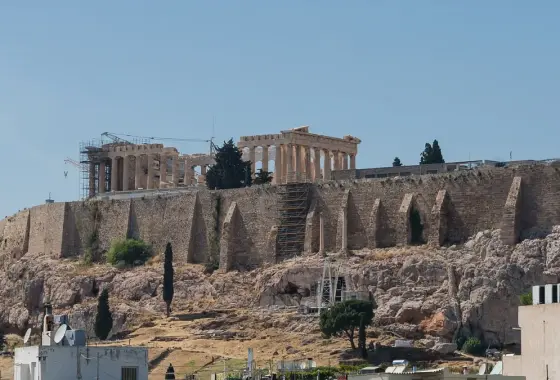
Athens was an ancient Greek city on the Attic peninsula. In the 6th century BC, after the laws of Solon and the rule of tyrants, Cleisthenes laid the foundations of democracy in 508/507 BC with reforms that reorganised citizens into new districts. Adult male citizens could vote directly in the assembly, while women, slaves and foreigners had no political rights.
The Persian Wars
The Athenians defeated the Persian army at Marathon in 490 BC. Although the Persian king Xerxes burned Athens in 480 BC, the Greek fleet led by Themistocles won at Salamis. After the war Athens built a naval empire in the Aegean as leader of the Delian League.
Pericles and the golden age
Under Pericles the Acropolis was rebuilt and the Parthenon, dedicated to the goddess Athena, was constructed. The tragedies of Aeschylus, Sophocles and Euripides and the comedies of Aristophanes were staged, and Herodotus and Thucydides wrote history. The Acropolis is now on the UNESCO World Heritage List.
The Peloponnesian War and philosophy
The Peloponnesian War with Sparta, which began in 431 BC, ended with Athens’s defeat in 404 BC. In this period and after, Socrates (executed in 399 BC), his pupil Plato and Plato’s pupil Aristotle laid the foundations of Western philosophy.
The Macedonian era
Defeated by Philip II of Macedon at Chaeronea in 338 BC, Athens largely lost its independence. With defeat in the Lamian War after Alexander the Great’s death, democracy ended in 322 BC. Athens remained a centre of philosophy and education in later centuries.
Sources and further reading
- Thucydides, History of the Peloponnesian War.
- Aristotle (attributed), The Constitution of the Athenians.
- UNESCO World Heritage, “Acropolis, Athens”.
People also ask
What was Ancient Athens? Ancient Athens was the city-state that gained a democratic government with the reforms of Cleisthenes in 508 BC and became the cultural centre of the Greek world in the 5th century BC.
When was Ancient Athens’s golden age? Golden age: Age of Pericles (461 – 429 BC).




Leave a comment
Your email address will not be published. Required fields are marked *