



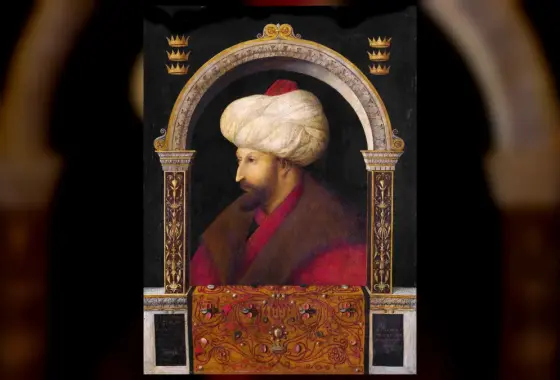
Mehmed II was the son of Ottoman sultan Murad II. His father handed him the throne in 1444, but because of his youth and the crises of the time Murad returned to the throne in 1446. Mehmed became sultan for the second time, and for good, after his father’s death in 1451.
The conquest of Constantinople
Mehmed immediately prepared to take Constantinople. He built the fortress of Rumelihisarı on the European shore of the Bosphorus and had the largest cannons of the age cast. The siege began on 6 April 1453. Hauling ships overland into the Golden Horn to bypass the chain that closed it is one of its most famous episodes. The city fell on 29 May 1453, and the last Byzantine emperor, Constantine XI, died in its defence. Mehmed became known as “Fatih”, the Conqueror.
Expanding the state
He added Serbia, the Morea, the Empire of Trebizond (1461) and Bosnia to Ottoman lands. In 1475 the Crimean Khanate came under Ottoman suzerainty, and in 1473 he defeated the Aq Qoyunlu ruler Uzun Hasan at Otlukbeli. In the last year of his life Otranto in Italy was taken.
Culture and government
Mehmed issued law codes organising the state, rebuilt Istanbul and had the Fatih Mosque complex and the first buildings of Topkapı Palace constructed. He is known to have spoken several languages, taken an interest in science and the arts, and sat for the Venetian painter Gentile Bellini.
Death
Mehmed died in 1481 near Gebze while setting out on a new campaign and was buried in his tomb beside the Fatih Mosque in Istanbul. His son Bayezid II succeeded him.
How was Istanbul rebuilt after the conquest?
After the conquest, Mehmed settled Muslim, Greek, Armenian and Jewish families from Anatolia and the Balkans in Istanbul to revive a city whose population had fallen sharply. Immediately after the conquest he granted the Genoese of Galata a charter guaranteeing their rights. In January 1454 he appointed the scholar Gennadios Scholarios as the Greek Orthodox patriarch. These arrangements laid the foundation for the city's different communities to live with their own religious institutions.
The law code and the order of the state
The organisational law code prepared in Mehmed's reign regulated the officials, ranks and ceremonies of the palace and the state. The position of the grand vizier as the highest official of the state became clearly defined in this period. The code contains a provision stating that, for the sake of the order of the world, the prince who takes the throne may put his brothers to death. Whether this clause was an original part of the text, and how it should be interpreted, is debated among historians.
His circle of science and art
Mehmed founded the eight madrasas known as the Sahn-i Seman within the Fatih Complex; for a long time these were the highest institutions of Ottoman learning. He invited the astronomer and mathematician Ali Qushji, who had come from Samarkand, to Istanbul and arranged for him to teach at the Hagia Sophia madrasa. Gentile Bellini's portrait of Mehmed, dated 1480, is today in the National Gallery in London. Mehmed also had a library made up of Greek and Latin works.
The sieges that failed
Not all of Mehmed's campaigns ended in success. In 1456 he besieged Belgrade; the siege failed because of the defence led by the Hungarian commander John Hunyadi, and Mehmed was wounded. The siege mounted against the Knights of Rhodes in 1480 also came to nothing. These failures meant that both goals were achieved only in the reign of his great-grandson: Belgrade was taken in 1521 and Rhodes in 1522 by Suleyman the Magnificent.
Why is the cause of his death debated?
The cause of Mehmed's death on 3 May 1481 is not known for certain. Some contemporary sources write that he had long suffered from gout and similar ailments. Other accounts claim that he was poisoned, and suspicion falls on the palace physicians. Historians stress that the information available is not enough to confirm either view. After his death, a struggle for the throne began between his sons Bayezid and Cem.
Frequently asked questions
How old was Mehmed when he took Constantinople? He was 21.
Sources and further reading
- Türkiye Diyanet Vakfı İslâm Ansiklopedisi, “Mehmed II”.
- Halil İnalcık, Fatih Devri Üzerinde Tetkikler ve Vesikalar, Turkish Historical Society.
- Encyclopaedia Britannica, “Mehmed II”.
- Franz Babinger – Mehmed the Conqueror and His Time (Princeton University Press, 1978)
- The National Gallery, London – Gentile Bellini, “The Sultan Mehmet II” (1480)
People also ask
Who was Mehmed the Conqueror? Mehmed II, known as Fatih (the Conqueror), was Ottoman sultan from 1451 to 1481.
When and where was Mehmed the Conqueror born? Born: 30 March 1432, Edirne.
When did Mehmed the Conqueror reign? Reign: 1444–1446 and 1451–1481.
When did Mehmed the Conqueror die? Died: 3 May 1481, near Gebze.



Leave a comment
Your email address will not be published. Required fields are marked *