



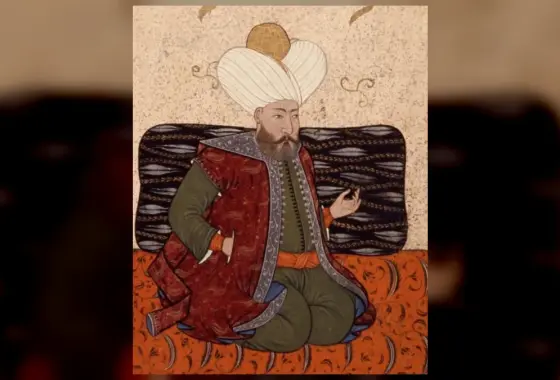
Murad was the son of Orhan Gazi and Nilüfer Hatun. He became heir after the early death of his elder brother Süleyman Pasha and came to the throne on his father’s death in 1362.
Balkan conquests
Early in his reign Adrianople (Edirne) was taken and soon made the capital (the exact date of its conquest is debated). In 1371 Serbian forces were defeated at the Battle of the Maritsa (Chernomen). Most of Macedonia, Sofia (1385) and Niš (1386) then came under Ottoman rule.
Building the state
Under Murad I the Janissary corps was established, based on the principle of taking one fifth of prisoners of war for the state (pençik). The province of Rumelia was created to govern the Balkan lands and the timar system was expanded. The sources record him as the first Ottoman ruler to use the title “sultan”.
The Battle of Kosovo
On 15 June 1389 on the plain of Kosovo the Balkan coalition led by Prince Lazar of Serbia was defeated. At the end of the battle Murad I was stabbed to death by the Serbian noble Miloš Obilić, who rose from among the fallen. His internal organs were buried in a tomb on the battlefield and his body in his tomb in Bursa. He was succeeded by his son Bayezid I.
Marriage, purchase and war in Anatolia
While advancing in the Balkans, Murad I also expanded his borders in Anatolia; however, he often did so through diplomacy rather than war. When his son Bayezid married Devlet Hatun, the daughter of the bey of Germiyan, Kütahya and its surroundings passed to the Ottomans as her dowry. Some towns were also added to Ottoman lands by purchase from the Hamidids.
This expansion led to conflict with the Karamanids. In a battle fought near Konya in 1386–1387, Alaeddin Ali Bey of Karaman was defeated; however, the Karamanid beylik survived and remained the Ottomans' strongest rival in Anatolia.
The court and the institutions of state
- The office of kazasker: The office of military judge was created to hear cases within the army; the first person appointed to it was Çandarlı Kara Halil Hayreddin.
- The vizierate: The long influence of the Çandarlı family in the government of the state began in this period.
- Relations with Byzantium: The Byzantine emperor John V agreed to pay tribute to the Ottomans and to send soldiers in times of campaign.
- The revolt of Savcı Bey: Murad's son Savcı Bey rebelled together with the Byzantine prince Andronikos; the revolt was suppressed.
The Hüdavendigâr Mosque in Bursa
The Hüdavendigâr Mosque that Murad I built in Çekirge, Bursa, is a building without parallel in Ottoman architecture. Its lower floor is arranged as a mosque and zawiya, and its upper floor as a madrasa. This two-storey plan shows how religious, educational and social functions were brought together in a single building in the early Ottoman period. The building is part of the UNESCO-listed site "Bursa and Cumalıkızık".
The memory of Kosovo
The Battle of Kosovo left deep marks in both Ottoman and Serbian historiography. On the Ottoman side, Murad I's tomb on the battlefield, under the name Meşhed-i Hüdavendigâr, became a place of visitation maintained for centuries; the tomb can be visited today near Pristina.
In Serbian culture, meanwhile, the battle became a narrative of heroism and sacrifice through the folk epics formed around Prince Lazar and Miloš Obilić. Vidovdan (St Vitus' Day), the day on which the battle was fought, remains an important day of remembrance in Serbian national memory today. That the same event is remembered in such different ways in two societies requires historians to separate epic from document with care.
The epithet "Hüdavendigâr"
The word "hüdavendigâr", of Persian origin, means "sovereign, lord". The epithet became so closely identified with Murad I that the administrative region centred on Bursa was known for centuries as the Sanjak of Hüdavendigâr and, in the late Ottoman period, as the Province of Hüdavendigâr.
Sources and further reading
- Türkiye Diyanet Vakfı İslâm Ansiklopedisi, “Murad I”.
- Halil İnalcık, The Ottoman Empire: The Classical Age 1300–1600.
- Encyclopaedia Britannica, “Murad I”.
- Türkiye Diyanet Vakfı İslâm Ansiklopedisi – "Hüdâvendigâr Külliyesi" (Turkish)
- UNESCO World Heritage – "Bursa and Cumalıkızık: the Birth of the Ottoman Empire" (2014)
- Noel Malcolm – Kosovo: A Short History (Macmillan, 1998)
People also ask
Who was Murad I (Hüdavendigar)? Murad I, the third Ottoman ruler, reigned from 1362 to 1389.
When and where was Murad I (Hüdavendigar) born? Born: c. 1326, Bursa.
When did Murad I (Hüdavendigar) reign? Reign: 1362 – 1389.
When did Murad I (Hüdavendigar) die? Died: 15 June 1389, Kosovo.


Leave a comment
Your email address will not be published. Required fields are marked *