



In the early 19th century BC the city of Babylon became the seat of a dynasty of Amorite origin. Its sixth king, Hammurabi, unified most of Mesopotamia and made Babylon the leading power of the region.
The Code of Hammurabi
The laws drawn up under Hammurabi, 282 provisions in all, were carved in cuneiform on a basalt stele. Including the principle of “an eye for an eye, a tooth for a tooth”, they regulate trade, family, inheritance and punishment. The stele, found at Susa in Iran in 1901, is displayed in the Louvre in Paris.
The dark centuries
Around 1595 BC the Hittite king Mursili I sacked Babylon. The Kassites then ruled Babylon for a long period. In the early 1st millennium BC Babylon came largely under Assyrian domination.
The Neo-Babylonian Empire
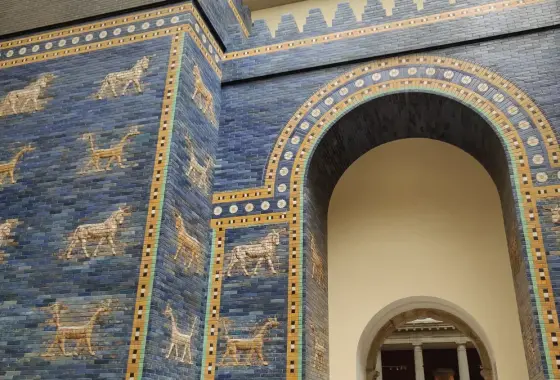
In 626 BC King Nabopolassar regained independence and, together with the Medes, destroyed the Assyrian capital Nineveh in 612 BC. His son Nebuchadnezzar II took Jerusalem in 587/586 BC and deported part of its population to Babylon. In his reign the Ishtar Gate, decorated with blue-glazed bricks (now in the Pergamon Museum in Berlin), and the great ziggurat Etemenanki were built. The existence of the “Hanging Gardens of Babylon” described by ancient writers has not been confirmed archaeologically.
End
In 539 BC the Persian king Cyrus the Great took Babylon without meeting great resistance. The city remained important in later centuries; Alexander the Great died there in 323 BC. The ruins of Babylon were added to the UNESCO World Heritage List in 2019.
Sources and further reading
- Louvre Museum, “Code of Hammurabi” collection record.
- UNESCO World Heritage, “Babylon”.
- Encyclopaedia Britannica, “Babylonia”.
People also ask
What was Babylon? Babylon was a city and kingdom on the Euphrates and one of the most important centres of Mesopotamia from the 2nd millennium BC to the 6th century BC.
When did Babylon end? End: 539 BC, Cyrus the Great.

Leave a comment
Your email address will not be published. Required fields are marked *