



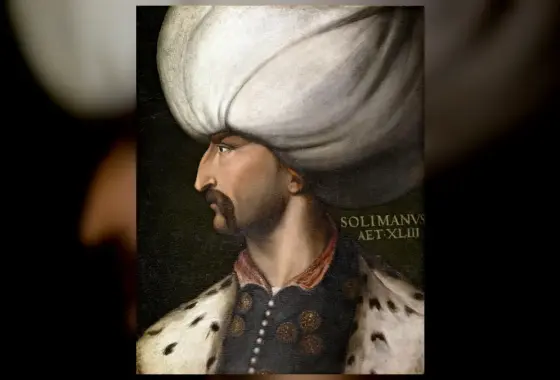
This article is part 13 of the series “How Did the Turks Shape World History?”.
The reign of Suleiman I is regarded as the period in which Ottoman political, military and cultural power reached its peak. In his time Ottoman lands stretched from Hungary to the Persian Gulf and from Algeria to the Caucasus. Europe called him “the Magnificent” for his splendour; his own people gave him the name “Kanuni”, the Lawgiver, for his justice and his laws.
Accession and first victories
Suleiman was born in 1494 in Trabzon, where his father Selim I was then governor. He gained experience of government as a young provincial governor in Caffa and Manisa, and came to the throne on his father’s death in 1520. On his first great campaign he took Belgrade, regarded as the gateway to Europe, in 1521. In 1522, after a long siege, he received the surrender of Rhodes from the Knights of St John, allowing the knights to leave the island with honour.
Mohács and Vienna
On 29 August 1526 on the plain of Mohács the Hungarian army was defeated in a pitched battle lasting less than two hours; the Hungarian King Louis II drowned while fleeing. The victory changed the political balance of Central Europe and brought the Ottomans face to face with the Habsburgs. In 1529 the Ottoman army besieged Vienna, but the lateness of the season and the difficulty of moving heavy artillery forced it to lift the siege. The siege of Vienna became the Ottomans’ furthest advance into Central Europe.
Alliance with France
Defeated and captured at Pavia in 1525 by the Habsburg Emperor Charles V, King Francis I of France asked Suleiman for help. This was the start of an alliance between a Christian kingdom and a Muslim empire that changed European politics. In 1536 French merchants were granted wide trading privileges. In 1543 the fleet of Barbarossa Hayreddin Pasha besieged Nice together with the French and spent the winter in the French port of Toulon. The alliance is regarded as one of the first examples of the idea of a “balance of power” in Europe.
The East and the seas
Suleiman led three great campaigns against the Safavids; in 1534 Baghdad and Iraq were added to Ottoman lands, and the Treaty of Amasya in 1555 brought the first formal peace between the two states. In the Mediterranean the Ottoman navy established supremacy with Barbarossa’s victory at Preveza in 1538. In the Indian Ocean campaigns were launched against the Portuguese, and seafarers such as Piri Reis and Seydi Ali Reis recorded the maritime knowledge of the age in their maps and travel writings.
“Kanuni”: law and the order of the state
Suleiman’s name became identified with the law codes (kanunname) that regulated customs and practices in the different regions of the empire. Land tenure, taxes, penal provisions and state organisation were set down in written rules in this period. The most important figure in this work was Ebussuud Efendi, who served as Shaykh al-Islam for thirty years. Ebussuud sought to harmonise the sultan’s laws with Islamic law and shaped Ottoman law through thousands of fatwas. Under Suleiman the Ottoman state strengthened its image as a “state of justice” committed to applying the law to all.
Art and architecture
Suleiman’s era was also the classical age of Ottoman culture. Mimar Sinan built the Şehzade Mosque and the Süleymaniye complex in this period. The arts of the book flourished in the palace workshop, and figures such as the calligrapher Ahmed Karahisari, the poet Baki and the historian Celalzade Mustafa rose to prominence. The sultan himself wrote a whole divan of poems under the pen name “Muhibbi”. His best-known couplet compares power and health:
Halk içinde muteber bir nesne yok devlet gibi
Olmaya devlet cihanda bir nefes sıhhat gibi“Among the people there is nothing as esteemed as power and fortune;
yet in this world there is no fortune like a single breath of health.”
In the shadows
Suleiman’s reign was not free of family tragedy. His close friend Pargalı İbrahim Pasha, grand vizier for many years, was executed in 1536. In 1553, during the Persian campaign, his son Prince Mustafa, much loved by the people and the army, was killed on his father’s orders; the event was etched into memory as a deep mourning through the elegies written by the poets of the time. The growing influence at court of his wife Hürrem Sultan (Roxelana) became a subject of debate both then and among later historians. These events show how grave the consequences of succession could be, even at the height of a great empire.
The end at Szigetvár
At seventy-two, Suleiman set out on his last campaign to Hungary in 1566 and died in his tent during the siege of the fortress of Szigetvár. His death, shortly before the fortress fell, was kept secret for a time to protect the army’s morale. His body was brought to Istanbul and buried in his mausoleum in the garden of the Süleymaniye Mosque. Today Szigetvár in Hungary has a Turkish–Hungarian Friendship Park and memorials to the sultan.
Frequently asked questions
Why is Suleiman called “the Magnificent”?
European envoys and travellers described with admiration the splendour of his court, the size of his army and the wealth of his state. He therefore became known in Western languages as “the Magnificent”.
Did the Ottoman Empire reach its greatest extent under Suleiman?
The empire covered a vast area under Suleiman, but its greatest extent is generally considered to have been reached in the last quarter of the 17th century, when Crete and Podolia had also been taken.
Sources and further reading
- Türkiye Diyanet Vakfı İslâm Ansiklopedisi, “Süleyman I”, “Ebüssuûd Efendi”, “Mohaç Meydan Savaşı”.
- Halil İnalcık, The Ottoman Empire: The Classical Age 1300–1600 (1973).
- Feridun M. Emecen, Kanuni Sultan Süleyman ve Zamanı (2022).
- André Clot, Suleiman the Magnificent (1992).
People also ask
Who was Suleiman the Magnificent? Suleiman I ruled the Ottoman Empire for 46 years, from 1520 to 1566, the longest reign in Ottoman history.
When and where was Suleiman the Magnificent born? Born: 1494 (some sources: 1495), Trabzon.
When did Suleiman the Magnificent reign? Reign: 1520 – 1566.
When did Suleiman the Magnificent die? Died: 6/7 September 1566, siege of Szigetvár.






Leave a comment
Your email address will not be published. Required fields are marked *