



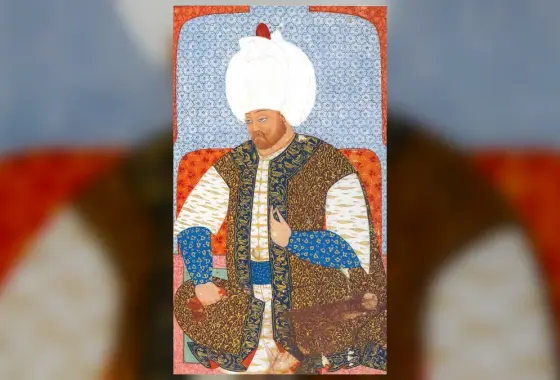
Selim was the son of Suleiman the Magnificent and Hürrem Sultan. After the deaths of his brothers Mustafa and Bayezid he was left as sole heir, and he came to the throne when his father died on the Szigetvár campaign in 1566.
Sokollu Mehmed Pasha
The most influential figure in government under Selim II was Suleiman’s last grand vizier, Sokollu Mehmed Pasha. On his initiative a project to link the Don and Volga by canal was attempted in 1569, but the expedition failed. The idea of a Suez canal was also raised in this period.
Cyprus and Lepanto
In 1570 a campaign was launched against Venetian-held Cyprus; Nicosia fell in 1570 and Famagusta in 1571, and the island became Ottoman. In response, the fleet of the Holy League of Venice, Spain and the Papacy defeated the Ottoman fleet at Lepanto on 7 October 1571. The Ottomans built a new fleet in a single winter and in 1574 took Tunis from the Spanish.
The Selimiye and his death
The Selimiye Mosque, which Mimar Sinan called his “masterpiece”, was built in Edirne on Selim II’s orders (1569–1575) and is now on the UNESCO World Heritage List. Selim II died in Istanbul in December 1574 and was buried in his tomb in the grounds of Hagia Sophia. He was succeeded by his son Murad III.
The years as prince and the road to the throne
As a prince, Selim served as governor in provinces such as Konya, Manisa and Kütahya. The rivalry for the throne between him and his brother Bayezid turned into open conflict in 1559 with a battle near Konya. The defeated Bayezid took refuge with his sons in Safavid Iran; after a long diplomatic process he was put to death there in 1561.
When Suleiman the Magnificent died during the siege of Szigetvár in 1566, Grand Vizier Sokollu Mehmed Pasha kept the news secret for a time. The aim was to prevent the army from breaking up before the fortress fell and to allow Selim, who was in Kütahya, to ascend the throne safely. Selim joined the army at Belgrade.
Peace treaties and distant seas
- Treaty of Edirne (1568): The treaty signed with the Habsburgs recognised the borders in Hungary as they stood and maintained Austria's annual payment.
- Yemen (1568–1571): A major revolt in Yemen was suppressed by forces under the command of Koca Sinan Pasha.
- The Aceh Sultanate: In response to a request for help against the Portuguese from the Aceh Sultanate in Sumatra, gunners and craftsmen were sent.
- Peace with Venice (1573): Venice accepted that Cyprus was Ottoman territory and undertook to pay a war indemnity.
The fleet rebuilt under Kılıç Ali Pasha after the defeat at Lepanto showed that Ottoman naval power had recovered quickly.
The architecture of the Selimiye
The dome of the Selimiye Mosque is about 31 metres in diameter and rises on eight great piers. Four slender minarets more than 70 metres high stand at the corners of the mosque. Mimar Sinan completed this work when he was around eighty; the Tezkiretü'l-Bünyan, which tells of his life, names the Selimiye as his most mature work. The mosque and its complex were added to the UNESCO World Heritage List in 2011.
The tomb at Hagia Sophia and the final years
In the last years of his reign, Selim II commissioned Mimar Sinan to repair and strengthen Hagia Sophia. Sinan added supporting buttresses to the walls of the building and cleared its surroundings, placing the structure under protection. This work is considered an important step in the survival of the Byzantine-era building into later centuries.
After the sultan's death, his tomb, also designed by Sinan, was built in the garden of Hagia Sophia. The interior walls of the tomb are covered with İznik tiles. The princes who lost their lives when his son Murad III ascended the throne were also buried in this tomb. Today the tomb is among the sultans' tombs around Hagia Sophia that can be visited.
Sources and further reading
- Türkiye Diyanet Vakfı İslâm Ansiklopedisi, “Selim II”.
- UNESCO World Heritage, “Selimiye Mosque and its Social Complex”.
- Encyclopaedia Britannica, “Selim II”.
- Gülru Necipoğlu – The Age of Sinan: Architectural Culture in the Ottoman Empire (Reaktion Books, 2005)
- Giancarlo Casale – The Ottoman Age of Exploration (Oxford University Press, 2010)
- Türkiye Diyanet Vakfı İslâm Ansiklopedisi – "Ayasofya Camii" (Turkish)
People also ask
Who was Selim II? Selim II, son of Suleiman the Magnificent, reigned from 1566 to 1574.
When and where was Selim II born? Born: 1524, Istanbul.
When did Selim II reign? Reign: 1566 – 1574.
Who was Selim II’s father? Father: Suleiman the Magnificent.






Leave a comment
Your email address will not be published. Required fields are marked *