



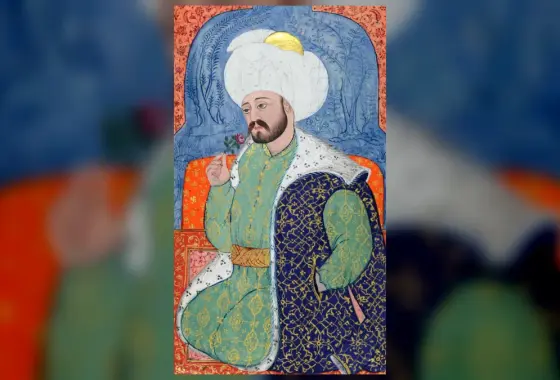
Mehmed was one of the sons of Bayezid I. When his father was captured by Timur at the Battle of Ankara in 1402, he withdrew to Amasya. The Ottoman lands were then divided among rival princes, a period known as the Ottoman Interregnum.
Struggle with his brothers
Mehmed first defeated his brother İsa Çelebi, who had seized Bursa. Against Süleyman Çelebi, who held Rumelia, he backed his brother Musa Çelebi; after defeating Süleyman, Musa in turn faced Mehmed. In 1413 at the Battle of Çamurlu near Sofia, Musa was defeated and killed, and Mehmed became sole ruler.
Restoring the state
Mehmed brought some of the Anatolian principalities that had regained independence back under control and fought the Karamanids. In 1416 he suppressed the widespread revolt led by Sheikh Bedreddin and his followers, and defeated the attempt of Mustafa Çelebi, who claimed to be his brother. He kept peaceful relations with Byzantium.
Death
Mehmed I died in Edirne in 1421. He was buried in the Green Tomb opposite the Green Mosque he built in Bursa, famous for its tile decoration. He was succeeded by his son Murad II.
A short picture of the Interregnum
After the defeat at Ankara in 1402, Timur returned the lands of the beyliks taken by the Ottomans, such as Aydın, Saruhan, Germiyan, Menteşe and Karaman, to their former rulers. Bayezid I died in captivity in 1403, and the Ottoman lands were divided among the princes.
- Süleyman Çelebi: He controlled the Rumelian lands centred on Edirne and made a treaty with Byzantium.
- İsa Çelebi: He held Bursa and its surroundings; he disappeared from the scene after his defeat by Mehmed.
- Musa Çelebi: He crossed into Rumelia, defeated Süleyman and ruled briefly in Edirne.
- Mehmed Çelebi: Starting from the area around Amasya and Tokat, he eliminated his brothers one by one.
The revolt of Sheikh Bedreddin
Sheikh Bedreddin, son of the judge of Simavna, was a scholar who had served as chief military judge under Musa Çelebi and had written works on Islamic law and Sufism. His followers launched large-scale uprisings: Börklüce Mustafa on the Karaburun peninsula and Torlak Kemal around Manisa. These movements were suppressed in bloody clashes; Bedreddin himself was captured and executed at Serres. Bedreddin's ideas and the nature of the uprising are still debated among historians today.
Gallipoli and the Green Complex
During the reign of Mehmed I the Ottoman fleet was defeated by the Venetian fleet off Gallipoli in 1416. This defeat showed that the Ottomans were not yet strong enough at sea to match Venice.
The most lasting work of the years of peace is the Green Complex in Bursa. The architecture of the mosque is attributed to Hacı İvaz Pasha, and its tiles are the work of craftsmen named in its inscription as "masters of Tabriz". The Green Mosque and the Green Tomb are part of the site "Bursa and Cumalıkızık: the Birth of the Ottoman Empire", added to the UNESCO World Heritage List in 2014.
His nickname, the sürre tradition and his legacy
In Ottoman sources Mehmed I is also known by the nickname "Kirişçi" because of his strength and skill in archery. The title "Çelebi", for its part, was an epithet used for princes at the time, expressing refinement and distinction.
The Sürre-i Hümayun, the tradition of sending gifts and money every year to the people of Mecca and Medina, is generally held to have begun among the Ottomans in his reign. This tradition was continued with great ceremonies for centuries.
Mehmed I's greatest achievement, however, is that he brought a fragmented state back under a single rule after more than ten years of civil war. Historians emphasise that his reign laid the groundwork for the growth under his son Murad II and his grandson Mehmed the Conqueror.
Sources and further reading
- Türkiye Diyanet Vakfı İslâm Ansiklopedisi, “Mehmed I”.
- Halil İnalcık, The Ottoman Empire: The Classical Age 1300–1600.
- Encyclopaedia Britannica, “Mehmed I”.
- Dimitris J. Kastritsis – The Sons of Bayezid: Empire Building and Representation in the Ottoman Civil War of 1402–1413 (Brill, 2007)
- UNESCO World Heritage – "Bursa and Cumalıkızık: the Birth of the Ottoman Empire" (2014)
- Türkiye Diyanet Vakfı İslâm Ansiklopedisi – "Sürre" (Turkish)
People also ask
Who was Mehmed I (Çelebi)? Mehmed I, known as Çelebi Mehmed, was a son of Bayezid I.
When and where was Mehmed I (Çelebi) born? Born: c. 1389.
When did Mehmed I (Çelebi) reign? Reign: 1413 – 1421 (as sole ruler).
When did Mehmed I (Çelebi) die? Died: May 1421, Edirne.
Leave a comment
Your email address will not be published. Required fields are marked *