



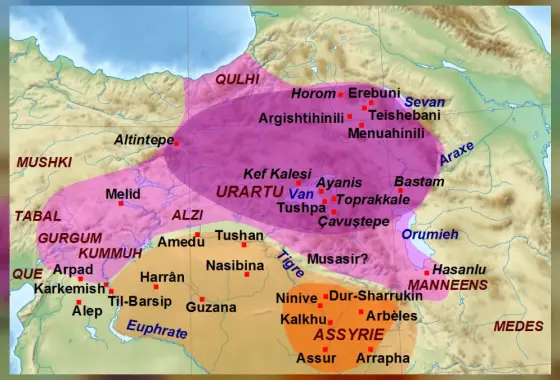
The name Urartu comes from Assyrian sources; the Urartians called their country “Biainili”. In the mid-9th century BC King Sarduri I founded Tushpa on the rock on the eastern shore of Lake Van and made it his capital.
Expansion
Under King Menua and his son Argishti I, Urartu expanded from the Caucasus to northern Syria. In 782 BC Argishti founded the fortress of Erebuni on the site of today’s Yerevan. In this period Urartu fought Assyria for control of eastern Anatolia and northern Syria.
Fortresses, canals and metalwork
The Urartians built strong fortresses, palaces and temples on steep mountain slopes. The roughly 50-kilometre Menua Canal (Şamram Canal), built under Menua to carry water to Van, is still partly in use. The Urartians were also famous for their bronze work, horse harness, shields and cauldrons. They adapted cuneiform to their own language and left many inscriptions.
End
The campaign of the Assyrian king Sargon II in 714 BC dealt Urartu a heavy blow, and Cimmerian and Scythian raids also weakened the kingdom. Although it recovered for a time in the 7th century BC, Urartu collapsed in the early 6th century BC, probably as a result of attacks by the Medes and Scythians. Urartian remains such as Van Fortress and Çavuştepe are important archaeological sites today.
Sources and further reading
- Encyclopaedia Britannica, “Urartu”.
- Oktay Belli, publications on Urartian excavations and research.
- Turkish Ministry of Culture and Tourism, records on the Van Fortress Mound and Tushpa.
People also ask
What was the Kingdom of Urartu? The Kingdom of Urartu ruled eastern Anatolia around Lake Van from the mid-9th century to the early 6th century BC.
What was the Kingdom of Urartu’s capital? Capital: Tushpa (Van Fortress).
When did the Kingdom of Urartu end? End: Early 6th century BC.

Leave a comment
Your email address will not be published. Required fields are marked *