



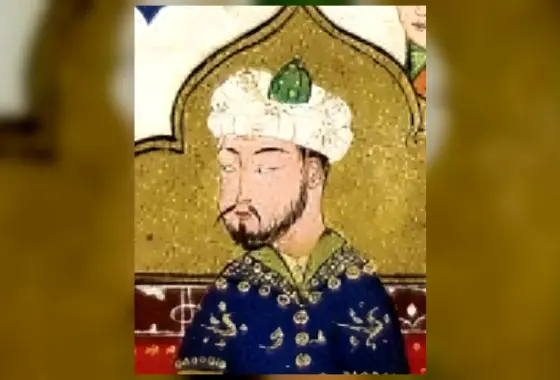
Bayezid was the son of Murad I. When his father was killed at the Battle of Kosovo in 1389, he was proclaimed ruler on the battlefield.
Anatolia and the Balkans
Bayezid quickly brought Anatolian principalities such as Saruhan, Aydın, Menteşe, Germiyan and Hamid under Ottoman rule and defeated the Karamanids. In the Balkans most of Bulgaria came under Ottoman control. His rapid movements earned him the nickname “Yıldırım”.
The siege of Constantinople and Nicopolis
In the 1390s he blockaded Constantinople and built the fortress of Anadoluhisarı on the Asian shore of the Bosphorus. On 25 September 1396 at Nicopolis he crushed the crusader army gathered under King Sigismund of Hungary to relieve the city. After this victory the Grand Mosque of Bursa was built.
The Battle of Ankara
Correspondence with Timur, who had sheltered some Anatolian beys, turned into open hostility. In the battle on the Çubuk plain near Ankara on 28 July 1402, helped by the defection of troops from the Anatolian principalities, the Ottoman army was defeated and Bayezid was captured.
Death and the Interregnum
Bayezid died in captivity at Akşehir in March 1403, and his body was brought to his tomb in Bursa. A succession struggle among his sons followed. This Ottoman Interregnum ended in 1413 when Mehmed I became sole ruler.
His accession and Yakub Celebi
When Murad I died at the Battle of Kosovo, Bayezid was proclaimed ruler on the battlefield. His brother Yakub Celebi, who had fought successfully in the same battle, was killed shortly afterwards. The sources explain this event as a way to prevent a succession struggle from dividing the state. Many historians see it as one of the first known instances of fratricide in the Ottoman dynasty; the practice would later be set out as an explicit rule in Mehmed the Conqueror's law code.
Kadi Burhan al-Din and the eastern frontier
Bayezid's strongest rival in the east was Kadi Burhan al-Din, ruler of the state centred on Sivas and also a poet. After Kadi Burhan al-Din died in 1398 in a clash with the Aq Qoyunlu chief Kara Yuluk Osman, Bayezid added Sivas and its surroundings to Ottoman territory. The Ottoman frontier thus reached Timur's sphere of influence. In 1400 Timur took Sivas and harshly punished those who had defended the city; Bayezid's son Ertugrul also died during these events.
Captivity and Timur's Anatolian campaign
After the Battle of Ankara, Bayezid's son Musa Celebi was also taken prisoner along with him. During the months he remained in Anatolia, Timur had Bursa plundered and took the fortress of Smyrna from the Knights of Rhodes. He returned the Anatolian principalities that had been annexed by the Ottomans to their former rulers. This decision led to the sudden collapse of the centralised structure Bayezid had built and prepared the ground for the succession struggle among his sons.
His buildings in Bursa and his family
Bayezid commissioned the Yildirim Complex in Bursa, which bears his name; it includes a mosque, a madrasa, a hospital and a tomb. The Grand Mosque of Bursa, whose construction began after the victory at Nicopolis, is one of the largest works of early Ottoman architecture with its twenty domes and was completed around 1400. Bayezid married Olivera (Despina Hatun), daughter of the Serbian ruler Lazar, who had died at Kosovo. This marriage strengthened Serbia's position as a principality bound to the Ottomans.
Bayezid in European literature
Bayezid's capture by Timur became a story told in Europe for a long time. In the English playwright Christopher Marlowe's play Tamburlaine, staged in the late 1580s, "Bajazeth" is shown as a prisoner locked in a cage. This scene helped spread the cage story in Europe. Historians, however, note that contemporary sources contradict one another on this point and that the detail of the cage is largely a literary exaggeration.
Frequently asked questions
Was Bayezid really carried in a cage? The story appears in some sources, but most historians consider it a later exaggeration.
Sources and further reading
- Türkiye Diyanet Vakfı İslâm Ansiklopedisi, “Bayezid I”.
- Halil İnalcık, The Ottoman Empire: The Classical Age 1300–1600.
- Encyclopaedia Britannica, “Bayezid I”.
- Colin Imber – The Ottoman Empire, 1300–1650: The Structure of Power (Palgrave Macmillan, 2002)
- Türkiye Diyanet Vakfı İslâm Ansiklopedisi – entry “Kadı Burhâneddin” (in Turkish)
- Christopher Marlowe – Tamburlaine the Great (1587–1588)
People also ask
Who was Bayezid I (Yıldırım)? Bayezid I, the fourth Ottoman ruler, reigned from 1389 to 1402.
When and where was Bayezid I (Yıldırım) born? Born: c. 1360.
When did Bayezid I (Yıldırım) reign? Reign: 1389 – 1402.
Who was Bayezid I (Yıldırım)’s father? Father: Murad I.
Leave a comment
Your email address will not be published. Required fields are marked *