



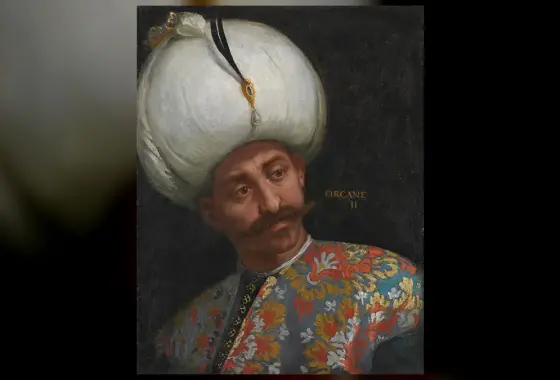
Orhan was the son of Osman Gazi, founder of the Ottoman principality. He led campaigns in his father’s last years and took over the principality on Osman’s death.
Bursa and the Byzantine cities
Bursa, long under blockade, surrendered in 1326 and became the Ottoman capital. In 1329 at Pelekanon near Maltepe he defeated the army of the Byzantine emperor Andronikos III. Nicaea (1331) and Nicomedia (1337) followed. By annexing the lands of the Karesi principality he reached the shores of the Dardanelles.
Building the state
Under Orhan the first Ottoman silver coin, the akçe, was struck, and in 1331 the first Ottoman madrasa opened in İznik. As a first step towards a standing army, yaya (infantry) and müsellem (cavalry) units were created. Bursa was developed with mosques, soup kitchens and inns.
Crossing into Europe
In the Byzantine civil war he backed John Kantakouzenos and married his daughter Theodora. During this alliance Ottoman troops crossed into Thrace. His son Süleyman Pasha took the fortress of Tzympe in 1352–1353 and in 1354 Gallipoli, whose walls had been brought down by an earthquake, giving the Ottomans their first permanent territory in Europe.
Death
Orhan Gazi died in Bursa in 1362 and was buried in his tomb at Tophane. As the heir Süleyman Pasha had died earlier, he was succeeded by his other son, Murad I.
Orhan Bey through Ibn Battuta's eyes
The famous Moroccan traveller Ibn Battuta also stopped in Bursa while touring Anatolia in the early 1330s. In his travel account he describes Orhan Bey as the greatest of the Turkmen rulers, the richest and the one with the most land and soldiers; he writes that Orhan owned nearly a hundred fortresses and constantly travelled among them. He also relates that he met Orhan's wife, Nilufer Hatun, in Iznik. This account is valuable as a contemporary outside witness to the strength of the principality in those years.
The building of Bursa and world heritage
After conquering Bursa, Orhan Gazi laid the core of what is today the city's historic centre. The complex bearing his name included a mosque, a soup kitchen, a bath and an inn; the Orhan Bey Han, also known as the Emir Han, is one of the first commercial buildings of the Bursa bazaar. These buildings are part of the site added to the UNESCO World Heritage List in 2014 as "Bursa and Cumalikizik: the Birth of the Ottoman Empire". The complex layout became a model for the growth of later Ottoman cities.
His family and princes
Orhan's best-known wife is Nilufer Hatun; Murad I and Suleyman Pasha were her sons. From his marriage to the Byzantine princess Theodora he had a son named Halil. The heir, Suleyman Pasha, died around 1357 after falling from his horse during a hunt. In the same period the young Prince Halil was kidnapped by pirates off Phocaea and was freed through Byzantine mediation after a ransom was paid. These events left the question of succession to Murad I in Orhan's final years.
The alliance with the Genoese
Orhan Gazi also made use of the rivalry among the naval powers of the Mediterranean. In 1352 he came to terms with the Genoese, who were fighting Venice and Byzantium; this cooperation helped Ottoman forces move freely in the region of the Straits. The Genoese controlled Black Sea trade through their colony at Galata. This relationship is an early example of the policy, which the Ottomans would use again later, of balancing European powers against one another.
The Mekece endowment deed: one of the first documents
The Mekece endowment deed, drawn up in Orhan Bey's name and dated 1324, is regarded as one of the oldest Ottoman documents to have survived. Through this document, land was endowed to cover the expenses of a dervish lodge at Mekece. The name of Orhan's father, Osman, also appears in the deed. The document is important because it shows how, from its very first years, the principality supported dervishes and their lodges to secure settlement and road safety in newly conquered areas.
Sources and further reading
- Türkiye Diyanet Vakfı İslâm Ansiklopedisi, “Orhan Gazi”.
- Halil İnalcık, The Ottoman Empire: The Classical Age 1300–1600.
- Encyclopaedia Britannica, “Orhan”.
- Ibn Battuta – The Travels (Tuhfat al-Nuzzar), Anatolia section
- UNESCO World Heritage Centre – Bursa and Cumalikizik: the Birth of the Ottoman Empire, inscribed 2014
People also ask
Who was Orhan Gazi? Orhan Gazi, son of Osman Gazi, was the second Ottoman ruler.
When and where was Orhan Gazi born? Born: c. 1281.
When did Orhan Gazi reign? Reign: 1324 – 1362 (traditional dates).
Who was Orhan Gazi’s father? Father: Osman Gazi.



Leave a comment
Your email address will not be published. Required fields are marked *