



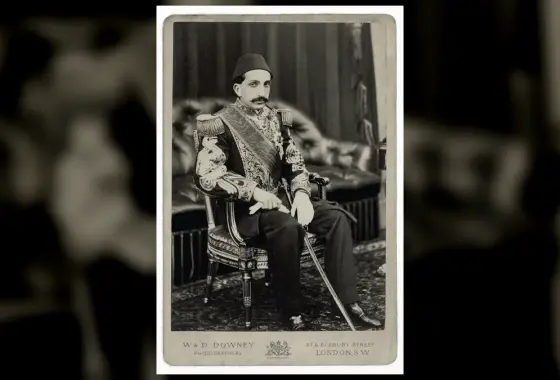
Abdul Hamid was the son of Sultan Abdülmecid. In 1876, after his uncle Abdülaziz and his brother Murad V were deposed, he became sultan on a promise to proclaim a constitution.
The First Constitutional Era
On 23 December 1876 the first Ottoman constitution, the Kanun-i Esasi, was proclaimed, and the parliament met in 1877. But the Russo-Turkish War of 1877–1878 ended in heavy losses, and the Treaty of Berlin took away large territories in the Balkans. In February 1878 Abdul Hamid suspended parliament indefinitely.
His government
For thirty years Abdul Hamid concentrated government at Yıldız Palace. Many primary and secondary schools and higher schools such as the Mülkiye and the Darülfünun were opened, and the telegraph and railway networks expanded. The Hejaz Railway, linking Damascus to Medina, was built largely with donations from Muslims. The Ottoman Public Debt Administration was set up in 1881 to manage foreign debt. Press censorship and a widespread system of informers drew criticism.
Foreign policy
He tried to balance the great powers against one another and emphasised the office of caliph in the Islamic world. Tunisia (1881) and Egypt (1882) were effectively lost. The Greco-Turkish War of 1897 ended in Ottoman victory.
The end of his reign
In July 1908 a movement led by the Committee of Union and Progress restored the constitution (the Second Constitutional Era). After the 31 March Incident of 1909 he was deposed and sent to Thessalonica. He was brought back to Istanbul in 1912 and died at Beylerbeyi Palace in 1918.
Modernisation in education, communication and transport
The reign of Abdulhamid II was one of the most intensive periods of state-led modernisation in the Ottoman Empire. Middle-level schools known as rüşdiye and idadi spread to provincial towns, and in 1900 a university called Darülfünun-ı Şahane opened in Istanbul. Higher schools of law, medicine, civil administration, military training and engineering continued to train officials and officers for the state.
Telegraph lines reached the far corners of the empire and speeded up communication between the centre and the provinces. In railways, the Anatolian and Baghdad lines were built with substantial German capital, and they held an important place in the diplomacy of the period for both economic and political reasons. Taken together with the strict control exercised in the same years, all this shows that modernisation was pursued within a centralised and tightly supervised style of government.
The financial crisis and the Ottoman Public Debt Administration
In 1875 the Ottoman state announced that it could not pay its foreign debts. The crisis was still under way in 1876, when Abdulhamid took the throne, and the cost of the 1877–1878 war made matters worse. After long bargaining with the creditor states, the Decree of Muharrem was issued in December 1881, and with it the Ottoman Public Debt Administration was founded.
This body began to collect certain revenue items directly for the benefit of the creditors, such as salt, tobacco, stamp duty, silk and the fisheries. As a result, an important part of state revenue came under foreign supervision. At the same time, historians stress that the administration built a regular system of collection and made it easier for the Ottoman state to borrow again. For that reason the Public Debt Administration is seen both as a symbol of the debates over sovereignty and as an effort at financial stability.
The Hamidiye regiments and the events of 1894–1896
One of the most disputed subjects of Abdulhamid’s reign concerns the events in eastern Anatolia. In 1891 the Hamidiye Light Cavalry Regiments were founded from tribal members, with the aims of guarding the frontier and tying the tribes of the region to the state. In practice, however, they were criticised for upsetting local balances and for increasing violence in some districts.
In 1894–1896 severe violence against Armenians took place in eastern Anatolia and in Istanbul; the seizure of the Ottoman Bank by armed Armenian militants in 1896 also belongs to this period. Estimates of the death toll vary, depending on the source, from tens of thousands to more than one hundred thousand. Historians interpret responsibility and scope differently; to understand this subject soundly, Ottoman archives and the reports of foreign consulates of the time need to be read together.
Deposition and afterwards
After the proclamation of the Second Constitutional Era in July 1908, Abdulhamid was forced to restore the constitution. Following the 31 March Incident in Istanbul on 13 April 1909, the Action Army arriving from Salonica brought the capital under control. On 27 April 1909 Abdulhamid was deposed by a decision of the parliament and a fatwa of the Sheikh al-Islam; his brother Mehmed V Reşad took his place.
Abdulhamid was first held at the Villa Alatini in Salonica. In 1912, when the danger arose that Salonica would fall to the Greek army during the Balkan War, he was brought to Istanbul and placed in Beylerbeyi Palace, where he died on 10 February 1918. In historical writing some see him as a repressive ruler and others as a modernising ruler who tried to keep the state standing in hard conditions; most recent studies suggest weighing both sides together.
The Hejaz Railway and relations with the Islamic world
The Hejaz Railway, a line running from Damascus to Medina, was begun in 1900 and reached Medina in 1908. Its purpose was to shorten the pilgrims’ journey and to strengthen Ottoman control over the Hejaz. Donations from Muslims and specially issued stamps were also used in financing it, and German and Ottoman experts worked together on its engineering.
Abdulhamid also emphasised the religious and political weight of the caliphate towards Muslim communities outside the empire. Envoys and clergy were sent to India, Central Asia and South-East Asia. This policy aimed on the one hand to create a counterweight against the colonial powers of Europe and on the other to raise the loyalty of the Muslim population inside the empire.
Censorship, intelligence and how Yıldız Palace worked
Abdulhamid’s administration exercised tight control over the press. Newspapers and books were examined before publication, and certain words and subjects were banned. Correspondence, telegrams and reports (jurnals) collected at Yıldız Palace reached the sultan directly, and a network of secret police and informers damaged social trust.
The opponents of this period, especially the Young Turks, carried on publishing in cities such as Paris and Geneva. The palace took measures against opponents abroad through embassies and agents. Historians note that censorship put lasting pressure on communication and public debate, but also that the number of newspapers and readers continued to grow in the same years.
Sources and further reading
- Türkiye Diyanet Vakfı İslâm Ansiklopedisi, “Abdülhamid II”.
- François Georgeon, Abdulhamid II: Le sultan calife.
- Encyclopaedia Britannica, “Abdülhamid II”.
- Erik J. Zürcher – Turkey: A Modern History
- Encyclopaedia Britannica – Abdülhamid II
- Türkiye Diyanet Foundation Encyclopaedia of Islam – “Abdülhamid II” entry
- Erik J. Zürcher – Turkey: A Modern History
- Encyclopaedia Britannica – Hejaz Railway
- Türkiye Diyanet Foundation Encyclopaedia of Islam – “Hicaz Demiryolu” entry
People also ask
Who was Abdul Hamid II? Abdul Hamid II reigned over the Ottoman Empire from 1876 to 1909.
When and where was Abdul Hamid II born? Born: 21 September 1842, Istanbul.
When did Abdul Hamid II reign? Reign: 1876 – 1909.
When did Abdul Hamid II die? Died: 10 February 1918, Istanbul.





Leave a comment
Your email address will not be published. Required fields are marked *