



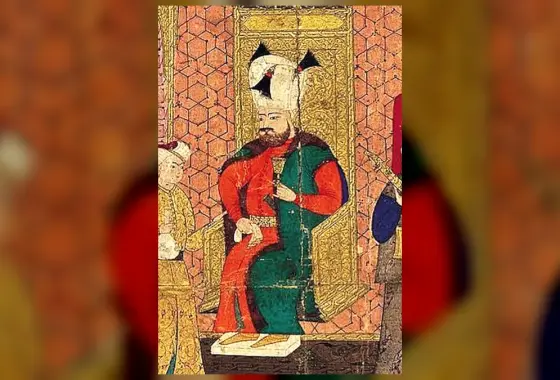
Murad was the son of Ahmed I and Kösem Sultan. He became sultan at eleven in 1623 when his uncle Mustafa I was deposed. The state was then in a difficult position because of Janissary and sipahi revolts, the Celali rebellions in Anatolia and war with Iran; Baghdad had also fallen to the Safavids.
Restoring authority
In 1632 leading statesmen were killed in a revolt in Istanbul. Murad IV then took personal control of government and dealt harshly with the rebels. To restore order he banned tobacco and alcohol and closed coffeehouses. The famous Treatise of Koçi Bey, describing the state’s problems, was presented to him.
Yerevan and Baghdad
In 1635 he campaigned against the Safavids and took Yerevan, which was soon lost again. In 1638, on a campaign he led in person, Baghdad was recaptured. The Yerevan and Baghdad Kiosks at Topkapı Palace were built to commemorate these victories.
Qasr-e Shirin and his death
Under the Treaty of Qasr-e Shirin (Zuhab) signed with Iran in 1639, Baghdad remained Ottoman and Yerevan was left to Iran. The border it drew largely set the outlines of today’s Turkey–Iran and Iraq–Iran borders. Murad IV died in Istanbul in February 1640, aged only 27, and was succeeded by his brother Ibrahim.
The first years of the reign: Kösem Sultan's regency
When Murad IV came to the throne at the age of eleven, state affairs were in practice run by his mother Kösem Sultan and the viziers. These years were among the periods in which the authority of the centre was at its weakest. Abaza Mehmed Pasha, governor-general of Erzurum, rebelled in 1623 and surrendered only in 1628.
In the east the situation was even more serious. The Safavid Shah Abbas I captured Baghdad in 1624. Neither Hafız Ahmed Pasha's siege of 1625–1626 nor Hüsrev Pasha's campaign of 1630 was enough to recover the city. These failures clearly showed the difficulties facing the army and the treasury.
Bans, fire and controversy
In 1633 a great fire in Istanbul burned a large part of the city. Coffeehouses were closed in this period, and the ban on tobacco was enforced with severe penalties. Sources relate that the sultan walked the city in disguise to check that the ban was being observed.
In the same years the Kadızadeli movement, led by the preacher Kadızade Mehmed Efendi, launched fierce debates about religious practices and innovations. In the middle of the century Katib Çelebi, in his work Mizan al-Haqq, assessed these debates on subjects such as tobacco and coffee in a measured tone.
The Baghdad campaign step by step
- Departure: In the spring of 1638 the sultan set out from Istanbul at the head of the army and marched to Baghdad through Anatolia.
- The siege: The siege, which began in November 1638, lasted about forty days; Grand Vizier Tayyar Mehmed Pasha lost his life during the final assaults.
- Surrender: The city surrendered in December 1638. The new grand vizier, Kemankeş Kara Mustafa Pasha, negotiated the peace of Qasr-e Shirin with Iran the following year.
Historians regard the reign of Murad IV as a period in which central authority was re-established by harsh methods. In the sources of his time this severity is described both as a force that restored order and as a source of fear.
Witnesses of his time: Koçi Bey and Evliya Çelebi
Two witnesses are especially important for understanding the reign of Murad IV. Koçi Bey, who was trained in palace service, attributed the decline of the state in the treatise he presented to the sultan to the breakdown of the timar system, bribery and appointments without merit; as a remedy he proposed a return to the old order. In later centuries this text also became one of the reference works in debates about "reform".
The young Evliya Çelebi, for his part, caught the sultan's attention in 1636 with his recitation of the Qur'an in Hagia Sophia and spent some time in palace circles. The Book of Travels contains many anecdotes about Murad IV's strength, severity and conversations. Historians find these accounts valuable but at times exaggerated, so it is recommended to read them alongside other sources.
Sources and further reading
- Türkiye Diyanet Vakfı İslâm Ansiklopedisi, “Murad IV”.
- Koçi Bey, Risale.
- Encyclopaedia Britannica, “Murad IV”.
- Katib Çelebi – The Balance of Truth (trans. G. L. Lewis, Allen & Unwin, 1957)
- Gabriel Piterberg – An Ottoman Tragedy: History and Historiography at Play (University of California Press, 2003)
- Robert Dankoff – An Ottoman Mentality: The World of Evliya Çelebi (Brill, 2004)
People also ask
Who was Murad IV? Murad IV came to the throne at eleven and reigned over the Ottoman Empire from 1623 to 1640.
When and where was Murad IV born? Born: 1612, Istanbul.
When did Murad IV reign? Reign: 1623 – 1640.
Who was Murad IV’s father? Father: Ahmed I.




Leave a comment
Your email address will not be published. Required fields are marked *