



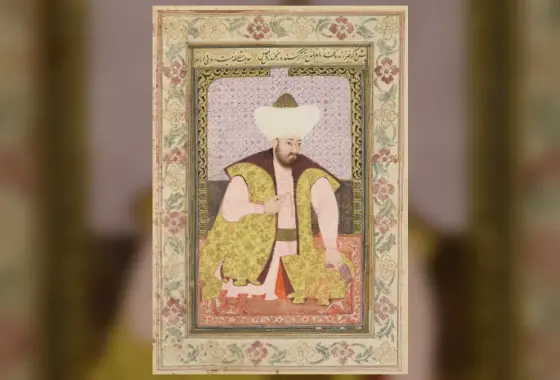
Murad was the son of Mehmed I and came to the throne on his father’s death in 1421. Early in his reign he crushed the revolts of Mustafa Çelebi, who claimed to be his uncle (“the False Mustafa”), and of his brother Küçük Mustafa, and in 1422 besieged Constantinople.
The Balkans and Anatolia
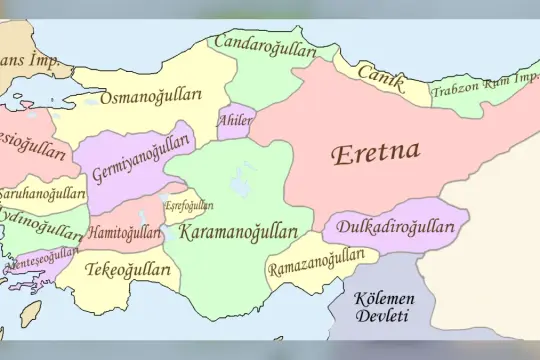
He took Thessalonica from the Venetians in 1430 and brought back under control the Anatolian principalities that had regained independence during the Interregnum. He fought long wars with Hungary and Serbia; the Hungarian commander John Hunyadi was his greatest rival.
Abdication and Varna
In 1444, after the Peace of Edirne-Szeged, he abdicated in favour of his twelve-year-old son Mehmed II and retired to Manisa. When a crusader army broke the peace and advanced, he took command again and defeated the crusaders at Varna on 10 November 1444; King Władysław of Hungary and Poland was killed in the battle. He returned to the throne in 1446.
Second Kosovo and death
In October 1448 he defeated Hunyadi’s army at the Second Battle of Kosovo. Murad II died in Edirne in 1451 and was buried in the Muradiye complex in Bursa. The Üç Şerefeli Mosque he built in Edirne marks an important stage in the development of Ottoman architecture.
1443–1444: the Long Campaign and the peace of Edirne-Szeged
In 1443 a Hungarian-Polish army led by John Hunyadi advanced deep into the Balkans; this expedition is known as the "Long Campaign". The army withdrew in the face of winter conditions and Ottoman resistance, but it still persuaded the Ottomans to make peace. The peace of Edirne-Szeged, signed in 1444, provided for a ten-year truce.
At the same time, Ibrahim Bey of Karaman was attacking Ottoman lands in Anatolia. To avoid fighting on two fronts at once, Murad II first came to terms with Karaman and then left the throne to his son and withdrew to Manisa.
The Morea, Albania and Skanderbeg
- The Hexamilion (1446): Murad II destroyed the Hexamilion wall that guarded the entrance to the Peloponnese and made the despots of the Morea pay tribute.
- Skanderbeg: Gjergj Kastrioti, an Albanian nobleman raised at the Ottoman court, left the Ottoman army in 1443 and began a resistance in Albania.
- Krujë (1450): Murad II besieged Krujë, Skanderbeg's stronghold, but withdrew without taking the fortress.
A poet and patron sultan
Murad II wrote poems under the pen name "Muradi" and supported poets and scholars at his court. In his time many works were translated from Arabic and Persian into Turkish, and Turkish began to find a larger place in court literature.
The Muradiye Complex he built in Bursa is today part of the UNESCO-listed site "the Birth of the Ottoman Empire". According to tradition, at his request the centre of the dome of his tomb was left open so that rain could fall on his grave. This simple tomb is often associated with the character of a ruler who at one point in his life gave up his throne of his own accord.
The return to the throne and the state he left to Mehmed
After the victory at Varna, Murad II withdrew to Manisa once again; however, the first reign of the young Mehmed II did not last long. The Janissary revolt that broke out in Edirne in 1446, known as Buçuktepe, showed that the government was in difficulty. Partly through the influence of Grand Vizier Çandarlı Halil Pasha, Murad II was called back to the throne and ruled until his death.
When Murad II died in 1451, he left his son a state whose borders in Anatolia and the Balkans were secure, whose army was experienced and whose treasury was in good order. This legacy became one of the important foundations of the conquest of Istanbul two years later.
Why is the Üç Şerefeli Mosque important?
Completed in 1447, the Üç Şerefeli Mosque in Edirne is among the first Ottoman mosques to bring together a broad central dome, an arcaded courtyard and four minarets. It takes its name from its minaret with three balconies (şerefe). Architectural historians see the building as an important stage on the road to the great domed mosques of Mimar Sinan a century later.
Sources and further reading
- Türkiye Diyanet Vakfı İslâm Ansiklopedisi, “Murad II”.
- Halil İnalcık, The Ottoman Empire: The Classical Age 1300–1600.
- Encyclopaedia Britannica, “Murad II”.
- Colin Imber – The Crusade of Varna, 1443–45 (Ashgate, 2006)
- UNESCO World Heritage – "Bursa and Cumalıkızık: the Birth of the Ottoman Empire" (2014)
- Halil İnalcık – Fatih Devri Üzerinde Tetkikler ve Vesikalar (Turkish Historical Society, 1954)
- Godfrey Goodwin – A History of Ottoman Architecture (Thames & Hudson, 1971)
People also ask
Who was Murad II? Murad II reigned over the Ottoman Empire from 1421 to 1451, with a short break.
When and where was Murad II born? Born: 1404, Amasya.
When did Murad II reign? Reign: 1421 – 1444, 1446 – 1451.
When did Murad II die? Died: February 1451, Edirne.



Leave a comment
Your email address will not be published. Required fields are marked *