



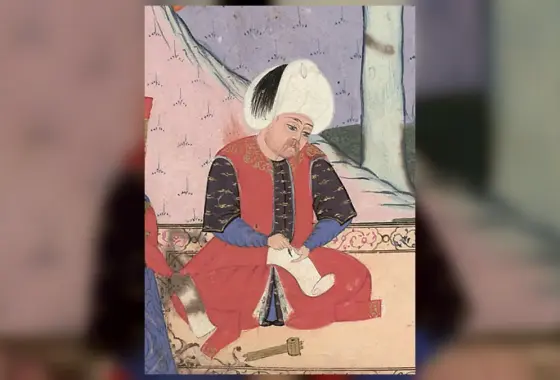
Selim was the son of Sultan Bayezid II and served for many years as governor of Trabzon. In the last years of his father’s reign he fought his brothers with the backing of the Janissaries and took the throne in 1512.
The Battle of Chaldiran
Concerned at the growing influence of the Safavid shah Ismail in Anatolia, he marched east. On 23 August 1514 he defeated the Safavid army at Chaldiran and briefly entered Tabriz. He then brought the Dulkadir principality and most of eastern Anatolia under Ottoman rule.
The Mamluk campaign
On 24 August 1516 at Marj Dabiq near Aleppo he defeated the Mamluk sultan Qansuh al-Ghawri, and Syria and Palestine passed to the Ottomans. After the Battle of Ridaniya on 22 January 1517 Cairo was taken and Egypt conquered. When the Sharif of Mecca declared allegiance, the Hejaz also came under Ottoman protection, and Selim used the title “Servant of the Two Holy Sanctuaries”.
Death
While preparing a new campaign, he died near Çorlu in September 1520 of a severe skin infection that sources call “şirpençe”. He was buried in his tomb beside the Yavuz Selim Mosque in Istanbul and was succeeded by his son Suleiman.
The Trabzon years
Selim spent a long part of his time as a prince as governor of the province of Trabzon. This post brought him face to face with the Georgian principalities and the Safavid frontier and allowed him to follow developments in the east closely. His son Suleyman, the future Suleyman the Magnificent, was born in Trabzon in 1494. The sources record that in these years Selim raided Georgia without his father's permission and adopted a hard line towards the Safavids.
How did the struggle for the throne end?
In the last years of Bayezid II, a struggle for the throne began among the princes Ahmed, Korkud and Selim. The Shahkulu revolt that broke out in Anatolia in 1511 strengthened the impression that the state had weakened. That same year Selim met his father's army near Corlu and was defeated; however, with the support of the Janissaries he came to Istanbul in 1512 and his father handed the throne to him. After Selim took the throne, his brothers Ahmed and Korkud were killed in 1513.
The sacred relics and Topkapi
According to tradition, after the Egyptian campaign a mantle, a banner and other sacred relics believed to have belonged to the Prophet Muhammad were brought to Istanbul. These relics are displayed today in the Privy Chamber of Topkapi Palace, in the Chamber of the Sacred Relics. Part of the collection was added in later centuries. Protection of Mecca and Medina gave the Ottoman sultans a new responsibility and prestige in the Islamic world; every year a procession carrying gifts was sent to the holy cities.
The poet sultan: Selimi
Although Selim was known as a harsh warrior, he was also a ruler with an interest in poetry. Most of the poems he wrote under the pen name "Selimi" are in Persian, and they were collected in a divan. A copy of the divan was presented to the German Emperor Wilhelm II and was printed in Berlin in 1904. Alongside themes of war and kingship, his poems also show mystical, Sufi feelings.
Piri Reis's world map
The Ottoman seaman Piri Reis presented the world map he had drawn in 1513 to Selim during the Egyptian campaign in 1517. The surviving fragment of the map shows the coasts of the Americas and the Atlantic Ocean, and it is thought to draw on a lost map by Columbus. The fragment was found in Topkapi Palace in 1929 and is preserved today in the palace library. This episode shows that maritime knowledge, too, reached the court in Selim's reign.
Frequently asked questions
When did the caliphate pass to the Ottomans? Traditionally with the conquest of Egypt in 1517, though historians debate whether there was any formal transfer.
Sources and further reading
- Türkiye Diyanet Vakfı İslâm Ansiklopedisi, “Selim I”.
- Feridun M. Emecen, Yavuz Sultan Selim.
- Encyclopaedia Britannica, “Selim I”.
- H. Erdem Çıpa – The Making of Selim: Succession, Legitimacy, and Memory in the Early Modern Ottoman World (Indiana University Press, 2017)
- Topkapi Palace Museum – Chamber of the Sacred Relics
- Topkapi Palace Museum Library – The Piri Reis Map (1513)
People also ask
Who was Selim I (Yavuz)? Selim I, known in Turkish as Yavuz (“the Stern”), was the ninth Ottoman sultan, reigning from 1512 to 1520.
When and where was Selim I (Yavuz) born? Born: 1470, Amasya.
When did Selim I (Yavuz) reign? Reign: 1512 – 1520.
When did Selim I (Yavuz) die? Died: September 1520, near Çorlu.

Leave a comment
Your email address will not be published. Required fields are marked *