



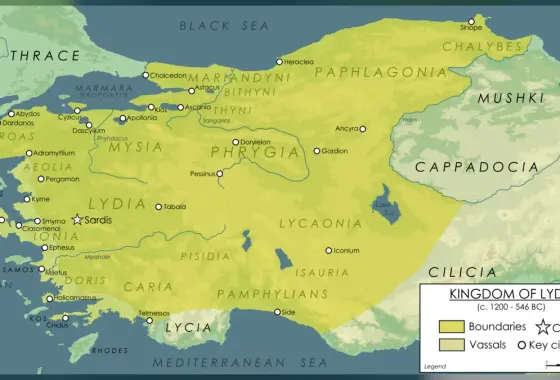
The Lydians were a people of western Anatolia from the late 2nd millennium BC, speaking a language of the Anatolian branch of the Indo-European family. In the 7th century BC, under the Mermnad dynasty founded by Gyges, Lydia became a powerful kingdom and brought the Ionian cities of the Aegean coast under its control.
The first coins
From electrum, a natural mix of gold and silver carried by the Pactolus (today’s Sart Çayı) flowing past Sardis, the first stamped coins were struck in the late 7th century BC. The innovation was an important step in transforming trade worldwide. Under Croesus, coins of pure gold and pure silver also began to be struck.
Croesus
Lydia’s last king, Croesus, became legendary in the Greek world for his wealth; the English phrase “rich as Croesus” and the Turkish “Karun kadar zengin” both come from his name. He made generous offerings to the temple at Delphi and contributed to building the Temple of Artemis at Ephesus. A war between Lydia and the Medes ended in 585 BC after a solar eclipse, with the Halys (Kızılırmak) accepted as the border between them.
End
Croesus went to war against the Persian king Cyrus the Great, who had grown powerful by defeating the Medes. In 547/546 BC the Persian army took Sardis, and Lydia became a satrapy of the Persian Empire. Sardis later remained important as the starting point of the Royal Road. The great tumuli at Bin Tepe near Salihli are the tombs of the Lydian kings.
Sources and further reading
- Herodotus, Histories, book I.
- Ekrem Akurgal, Ancient Civilizations and Ruins of Turkey.
- Encyclopaedia Britannica, “Lydia”.
People also ask
What was the Kingdom of Lydia? The Kingdom of Lydia was founded in the Gediz and Küçük Menderes basins of western Anatolia, with its capital at Sardis.
What was the Kingdom of Lydia’s capital? Capital: Sardis (Salihli, Manisa).
When did the Kingdom of Lydia end? End: 547/546 BC, conquest by Cyrus the Great.



Leave a comment
Your email address will not be published. Required fields are marked *