



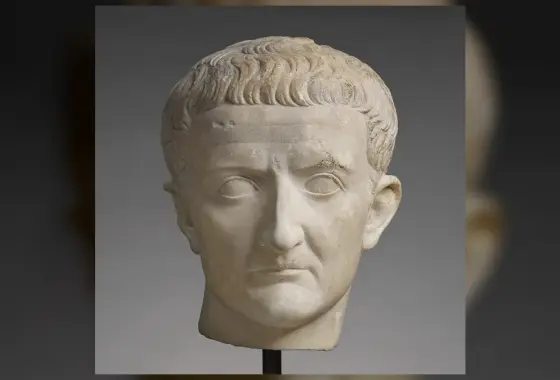
Tiberius was Livia’s son by her first marriage. When his mother married the emperor Augustus, he grew up at court. He won important victories in Germania and Pannonia. After Augustus’s chosen heirs died one by one, Tiberius was adopted in AD 4 and became emperor on Augustus’s death in 14.
His government
Tiberius tried to preserve the order Augustus had created, preferring to consolidate the frontiers rather than launch new conquests. By cutting spending he strengthened the treasury. But his relations with the Senate were strained, and treason (maiestas) trials gradually created a climate of fear.
Sejanus and Capri
In 26 he left Rome and settled on the island of Capri, leaving government largely to the praetorian prefect Sejanus. When it emerged that Sejanus was trying to seize power, he was executed in 31, followed by further trials and executions.
Judaea
Under Tiberius, Judaea was governed by Pontius Pilate. The New Testament and the Roman historian Tacitus both place the crucifixion of Jesus in this period.
Death
Tiberius died in 37 at Misenum on the Bay of Naples and was succeeded by his great-nephew Caligula. Ancient historians portray him as harsh and suspicious, while some modern historians judge his administrative skill more favourably.
His first missions as a young commander
Tiberius took on important missions before he had even reached his mid-twenties. In 20 BC he was sent to the East; he played a role in placing a pro-Roman king on the Armenian throne, and in the same year he was part of the delegation that received from the Parthians the legionary standards they had earlier captured from Roman armies. In 15 BC he campaigned with his brother Drusus against the peoples of the Alpine region and brought Raetia and its surroundings under Roman rule.
Marriage and his withdrawal to Rhodes
At Augustus's wish, Tiberius was forced to divorce his much-loved wife Vipsania and marry the emperor's daughter Julia. This marriage was unhappy. In 6 BC, at the height of his career, Tiberius unexpectedly withdrew from public office and settled on the island of Rhodes. The reasons for this retreat, which lasted about eight years, are explained in different ways in the ancient sources. After the deaths of Augustus's grandsons he was recalled to Rome.
The Pannonian revolt and the Rhine frontier
In AD 6 a great revolt broke out in Pannonia and Illyricum. Tiberius suppressed this revolt after three years of hard fighting. Immediately afterwards, in AD 9, he was sent to the Rhine frontier after three legions under Varus were destroyed in the Teutoburg Forest in Germania. There he concentrated on strengthening the frontier and restoring order rather than on large new conquests. This experience also influenced his pursuit of a defensive foreign policy during his reign as emperor.
Germanicus and the Piso trial
Tiberius's adopted nephew Germanicus campaigned in Germania in AD 14–16 and won great popularity among the people. Tiberius assigned him to the East; Germanicus fell ill and died at Antioch in AD 19. Rumours spread that Piso, the governor of Syria, had poisoned him, and Piso was tried before the senate. Piso died before the trial was concluded. The affair contributed to Tiberius falling out of favour because of suspicions within the court.
The credit crisis of AD 33 and the palace on Capri
According to Tacitus, a sudden shortage of money and credit hit Rome in AD 33; as creditors tried to call in debts, land prices fell. Tiberius transferred a fund of 100 million sesterces from the state treasury to the banks so that interest-free loans could be granted for three years, and the crisis subsided. The remains of the Villa Jovis that he had built on the island of Capri, where he spent his last years, can still be visited today and are among the island's most visited sights.
Sources and further reading
- Tacitus, Annals, books I–VI.
- Suetonius, Lives of the Twelve Caesars: Tiberius.
- Encyclopaedia Britannica, “Tiberius”.
- Tacitus, Annals, Book VI (chapter 17: the credit crisis of AD 33)
- Barbara Levick, Tiberius the Politician, 2nd edition, Routledge, 1999
People also ask
Who was Tiberius? Tiberius was the second Roman emperor, reigning from 14 to 37.
When and where was Tiberius born? Born: 16 November 42 BC, Rome.
When did Tiberius reign? Reign: 14 – 37.
When did Tiberius die? Died: 16 March 37, Misenum.




Leave a comment
Your email address will not be published. Required fields are marked *