



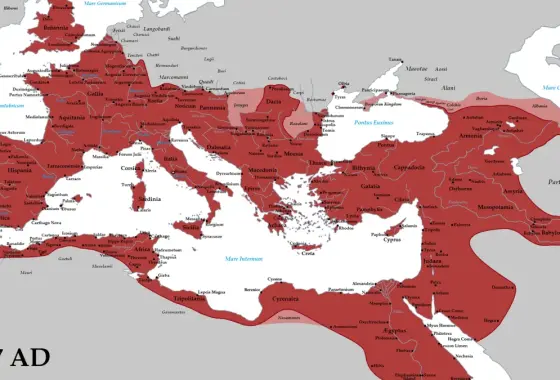
Rome was founded as a small city in Italy in the 8th century BC, ruled first by kings and, after 509 BC, as a republic. After long civil wars, Octavian received the title “Augustus” from the Senate in 27 BC and became, in effect, the first emperor. This date is taken as the start of the Roman Empire.
Pax Romana and expansion
The two centuries after Augustus are known as the “Pax Romana” for their relative peace and prosperity. The empire reached its greatest extent under Trajan in 117: the whole Mediterranean world, from Britain to Egypt and from Spain to Mesopotamia, was under one government, including most of Anatolia.
Crisis and reorganisation
In the 3rd century, short reigns, civil wars, epidemics and frontier invasions shook the state. Diocletian (284–305) reorganised the government, and Constantine I (306–337) granted freedom to Christianity and founded Constantinople (today’s Istanbul) as a new capital in 330.
Division and the fall of the West
When Theodosius I died in 395, the empire was divided between his two sons into east and west. The Western Empire weakened under pressure from Germanic peoples and the Huns; in 476 the last Western emperor, Romulus Augustulus, was deposed. The Eastern Roman Empire, known today as Byzantium, survived until 1453.
Legacy
- Law: Roman law underlies the legal systems of many countries, including much of Europe and Türkiye.
- Language: Latin is the ancestor of French, Spanish, Italian and other languages, and the Latin alphabet is the world’s most widely used script.
- Architecture and roads: arches, domes and concrete; thousands of kilometres of roads and aqueducts.
Daily life in the cities: Pompeii and the Colosseum
No place shows the lives of ordinary Romans better than Pompeii. The city was buried under ash and pumice by the eruption of Mount Vesuvius in 79 AD, which preserved its houses, bakeries, taverns, wall inscriptions and paving stones. Excavations began in the 18th century and still continue; Pompeii, Herculaneum and Torre Annunziata were inscribed together on the UNESCO World Heritage List in 1997. In Rome, the Flavian Amphitheatre, better known as the Colosseum, was opened in 80 AD under Emperor Titus and became the stage for spectacles watched by tens of thousands of people.
Expanding citizenship: the decision of 212
Roman citizenship began as a privileged status; citizens enjoyed the protection of Roman law and particular rights in taxation and the courts. Over the centuries this right was extended step by step. In 212 AD, a decree issued by Emperor Caracalla and known as the Constitutio Antoniniana made almost all free inhabitants of the empire citizens. The ancient writer Cassius Dio claims the measure was meant to raise tax revenue; historians also stress that it spread a shared Roman identity across the provinces.
Roman traces in Anatolia
Anatolia was among the wealthiest regions of the Roman world, and the remains of this period are now some of the most visited archaeological sites in Türkiye. The Library of Celsus at Ephesus was built in the early 2nd century in memory of a provincial governor; Ephesus joined the UNESCO list in 2015. Aphrodisias, famous for its marble quarries and sculpture workshops, was inscribed in 2017, and Hierapolis-Pamukkale, known for its thermal springs, in 1988. The theatres, baths and colonnaded streets of these cities show how Roman urban life took shape in Anatolia.
The army and the frontiers: the limes
The empire's borders were guarded by a chain of forts, watchtowers and walls manned by legions and auxiliary units; this system is called the limes. Its best-known example is Hadrian's Wall in Britain, begun in 122 AD and running for about 117 kilometres. Under the name “Frontiers of the Roman Empire”, UNESCO inscribed Hadrian's Wall in 1987, the Upper German-Raetian Limes in 2005 and the Antonine Wall in Scotland in 2008; the Danube and Lower German sections were added in 2021.
Frequently asked questions
When did the Roman Empire fall? The Western Empire ended in 476; the Eastern (Byzantine) Empire lasted until 1453.
Why the separate name “Byzantine”? Historians coined it later; the empire’s own people always called themselves Romans.
Sources and further reading
- Mary Beard, SPQR: A History of Ancient Rome.
- Encyclopaedia Britannica, “Roman Empire” and “ancient Rome”.
- World History Encyclopedia, “Roman Empire”.
- Suetonius, The Lives of the Twelve Caesars.
- UNESCO World Heritage Centre – "Archaeological Areas of Pompei, Herculaneum and Torre Annunziata", "Ephesus", "Aphrodisias" and "Frontiers of the Roman Empire"
- Encyclopaedia Britannica – "Constitutio Antoniniana" and "Colosseum"
People also ask
What was the Roman Empire? The Roman Empire began in 27 BC when Augustus became the first emperor and, at its height, stretched from Britain to Mesopotamia.
What was the Roman Empire’s capital? Capital: Rome; after 330, Constantinople in the east.
When did the Roman Empire reach its greatest extent? Greatest extent: 117, under Trajan.





Leave a comment
Your email address will not be published. Required fields are marked *