



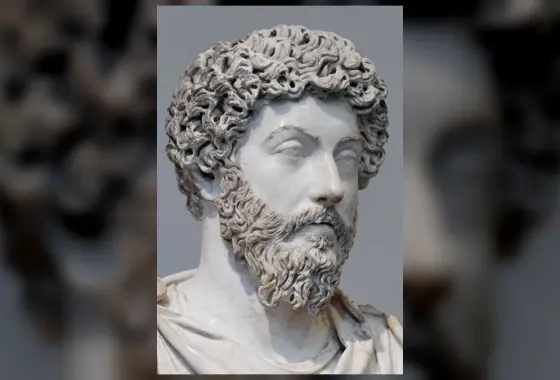
At Emperor Hadrian’s wish, Marcus Aurelius was adopted by Antoninus Pius and raised from youth in Stoic philosophy. When he became emperor in 161 he shared power for a time with his adoptive brother Lucius Verus, the first time Rome had two emperors ruling together.
Hard years
His reign began with war against the Parthians in the east. The Antonine Plague, thought to have spread with soldiers returning from that campaign, struck the empire’s population hard. Long wars then followed on the Danube frontier against the Marcomanni and other Germanic peoples, and Marcus spent most of his last years on that front.
The Meditations
The notes he wrote to himself in Greek during his campaigns were later published as the Meditations. In plain language they set out Stoic ideas such as duty, patience, the naturalness of death and focusing on what lies within one’s control, and they still have a wide readership today.
Death and aftermath
Marcus Aurelius died on the Danube front in 180 and was succeeded by his son Commodus. Historians usually see his death as the end of the era of the “Five Good Emperors” and of the Pax Romana.
His teachers: Fronto and Rusticus
The two teachers who influenced Marcus Aurelius most in his youth represented different worlds. His correspondence with Marcus Cornelius Fronto, a master of Latin rhetoric, was found in 1815 by the Italian scholar Angelo Mai beneath the later writing of an old manuscript (a palimpsest); these letters open a rare window on the young emperor's daily life. The Stoic philosopher Quintus Junius Rusticus, on the other hand, introduced him to the lectures of Epictetus. In the first book of the Meditations, Marcus lists one by one what he learned from each teacher, writing that Rusticus taught him to stay away from showy speech.
The revolt of Avidius Cassius and the eastern tour
In 175 a false report spread that the emperor had died. Avidius Cassius, the powerful commander of the eastern provinces, proclaimed himself emperor on hearing it, and Egypt and most of Syria recognised him. Once it became clear that Marcus was alive, support faded, and Cassius was killed by his own officers about three months later. Marcus generally treated the rebels with moderation. He then toured the eastern provinces; during this journey his wife Faustina died at Halala in Cappadocia, and the village was refounded in her name as Faustinopolis.
The column and the equestrian statue in Rome
The column depicting Marcus Aurelius' Marcomannic wars was erected in Rome after his death and stands today in Piazza Colonna. The most famous scene in its spiral reliefs is the "rain miracle", said to have saved Roman soldiers from thirst. The emperor's bronze equestrian statue is the only bronze equestrian statue of a Roman emperor to have survived to our day; it is thought to have escaped being melted down in the Middle Ages because it was mistaken for the Christian emperor Constantine. Michelangelo placed the statue on the Capitoline square in 1538. The original is now kept in the Capitoline Museums, and a copy stands in the square.
His physician Galen and the epidemic
The physician Galen of Pergamon was among Marcus Aurelius' court doctors and also looked after the health of the emperor's son Commodus. Having witnessed the epidemic known as the Antonine Plague, Galen recorded symptoms such as fever, diarrhoea and skin eruptions. On the basis of these records most researchers think the epidemic may have been smallpox, although a definite diagnosis is not possible. Estimates of its death toll also vary widely. Galen's writings remained among the basic sources of medical education in both the Islamic world and Europe for well over a thousand years.
Frequently asked questions
In what language was the Meditations written? In Greek, the cultural language of the age.
Sources and further reading
- Marcus Aurelius, Meditations.
- Cassius Dio, Roman History, Books LXXI–LXXII.
- Encyclopaedia Britannica, “Marcus Aurelius”.
- Anthony R. Birley – Marcus Aurelius: A Biography (Routledge, 1987)
- Cassius Dio, Roman History, Book LXXII (Avidius Cassius)
- Musei Capitolini – Equestrian statue of Marcus Aurelius
People also ask
Who was Marcus Aurelius? Marcus Aurelius was Roman emperor from 161 to 180.
When and where was Marcus Aurelius born? Born: 26 April 121, Rome.
When did Marcus Aurelius reign? Reign: 161 – 180.
When did Marcus Aurelius die? Died: 17 March 180, Vindobona (Vienna) or Sirmium.


Leave a comment
Your email address will not be published. Required fields are marked *