



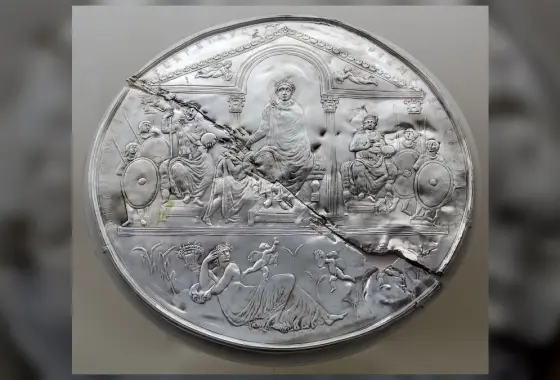
Theodosius was the son of a general from Spain. When the eastern emperor Valens was defeated and killed by the Goths at the Battle of Adrianople (Edirne) in 378, the western emperor Gratian made Theodosius emperor of the east in 379.
Settlement with the Goths
After several years of war, in 382 Theodosius settled the Goths in the Balkans as allies (foederati), serving in the Roman army under their own commanders. The solution brought peace in the short term but created new problems later.
Religious policy
With the Edict of Thessalonica in 380, the faith adopted at the Council of Nicaea (İznik) in 325 became the empire’s official religion. The Second Ecumenical Council met in Constantinople in 381. Laws of 391–392 banned pagan sacrifices and temple worship, and the ancient Olympic Games are traditionally held to have ended around this time, in about 393.
The Thessalonica incident
In 390, after a commander was killed in Thessalonica, thousands of people were massacred in the hippodrome on the emperor’s orders. Bishop Ambrose of Milan made Theodosius perform public penance, a notable episode in the history of church–state relations.
Death and the division of the empire
After defeating usurpers in the West, Theodosius briefly ruled the whole empire alone, and died in Milan in 395. The empire was divided between his sons Arcadius (East) and Honorius (West) and was never reunited. The Egyptian obelisk standing in Istanbul’s Sultanahmet Square (the Hippodrome) was erected on his orders in 390.
Civil wars: Magnus Maximus and the Battle of the Frigidus
Theodosius’s reign was not only about the Goths and the church; civil wars in the West also shaped the politics of the period. Magnus Maximus, proclaimed emperor in Britain in 383, overthrew the western emperor Gratian and established his rule in Gaul. Theodosius first tried to reach an understanding with him, but when Maximus attacked Italy he was defeated near Aquileia in 388 and executed.
Soon a new crisis arose in the West. After the death of the young emperor Valentinian II in 392, the commander Arbogast raised Eugenius to the throne. In 394 Theodosius defeated Eugenius and Arbogast at the Battle of the Frigidus (the Vipava valley in modern Slovenia). With this victory he became sole ruler of the whole empire, but the battle also cost the western army a considerable part of its strength and weakened the West’s defences.
Building in Constantinople and the Obelisk
Theodosius’s contributions to the capital Constantinople can still be seen on the skyline of Istanbul today. The first form of the Golden Gate at the western entrance of the city was built in this period as a triumphal arch. The Forum of Theodosius, a large square, is also counted among the important structures of the age; its column and statues became symbols of the city in the following centuries.
The Obelisk in Sultanahmet Square is the best-known work associated with Theodosius’s name. This granite monument, raised in ancient Egypt in the time of Thutmose III, was brought from Egypt around 390 and placed in the Hippodrome. The Latin and Greek inscriptions and reliefs on its marble base show how the monument was erected and the place of the imperial family in the hippodrome. The structure is a fine example of Rome’s habit of gathering the symbols of the old world in the new capital.
The Council of 381 and the drive for unity of belief
Theodosius saw religious unity as a priority for the stability of the state. The Second Ecumenical Council, which met in Constantinople in 381, reaffirmed the principles of faith adopted at Nicaea and, by widening the statements on the Holy Spirit, formed the basis of the text now known as the Nicene–Constantinopolitan Creed. The council also limited the influence of the teaching of Arius.
One of the canons of the council granted the bishop of Constantinople the rank “second in honour after Rome”. This decision was an important step showing that Istanbul would be the centre of the eastern church, and it is counted among the starting points of later disputes between Rome and the East. Theodosius’s religious policy is therefore defined not only by the ban on pagan worship but also by the effort to settle divisions within the church by means of the state.
His sons and the two halves of the empire
After Theodosius’s death his elder son Arcadius took the East and his younger son Honorius the West. Both were young, so real power remained in the hands of their commanders. In the West the commander Stilicho governed in Honorius’s name. After 395 Alaric rose to lead the Goths; Alaric had earlier served in Theodosius’s allied units. In 410 Alaric’s Goths sacked Rome for three days.
Emperors had divided the administration before, but after 395 the empire was never again permanently united under one ruler. The East continued to exist, governed from Constantinople, throughout the Middle Ages, while the West broke apart within about a century. For this reason Theodosius is remembered in history both as the last ruler to unite the empire and as the ruler who prepared the ground for its division.
The ban on pagan worship and the Altar of Victory dispute
The sharpest side of Theodosius’s religious policy is the ban on pagan sacrifices and temple worship through laws of 391–392. While a part of the Roman Senate asked for the old religious traditions to be protected, Ambrose, bishop of Milan, opposed these demands. The dispute over removing the Altar of Victory from the Senate house is remembered as one of the symbols of this tension.
Historians hold different views on how far the bans were enforced. According to some specialists, enforcement varied by region and the old worship quietly continued in many places. Even so, these measures are regarded as an important threshold that shaped the relation between state and church in later centuries.
The army, the Goths and the tax burden
Theodosius’s agreement with the Goths also changed the structure of the army. The Goths served as separate units under their own commanders. This increased the weight of commanders of barbarian origin in the army and created discontent in the Roman aristocracy.
Large armies and court expenses raised the tax burden. In 387 the people of Antioch, protesting against a tax increase, toppled the emperor’s statues; the city was punished after the incident and then pardoned. The episode is an example of why Theodosius is remembered both as a harsh ruler and, when needed, a forgiving one.
Sources and further reading
- Encyclopaedia Britannica, “Theodosius I”.
- Codex Theodosianus, book XVI.
- Ambrose, Letters (Thessalonica incident).
- Stephen Williams, Gerard Friell – Theodosius: The Empire at Bay
- Encyclopaedia Britannica – Theodosius I
- Istanbul Metropolitan Municipality Cultural Heritage – Obelisk of Theodosius
- Stephen Williams, Gerard Friell – Theodosius: The Empire at Bay
- Encyclopaedia Britannica – Theodosius I
- Ambrose – Letters
People also ask
Who was Theodosius I? Theodosius I was Roman emperor from 379 to 395.
When and where was Theodosius I born? Born: 347, Hispania (Spain).
When did Theodosius I reign? Reign: 379 – 395.
When did Theodosius I die? Died: 17 January 395, Milan.





Leave a comment
Your email address will not be published. Required fields are marked *