



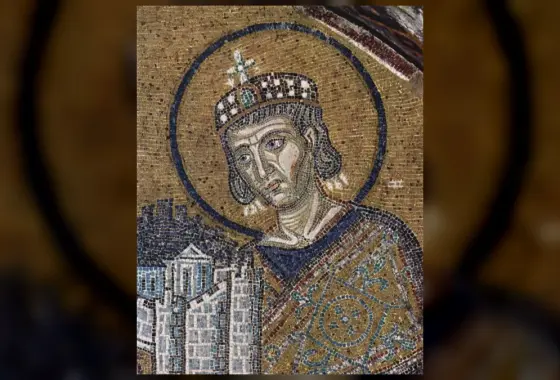
Constantine was born the son of Emperor Constantius I during the “tetrarchy”, when four emperors ruled Rome together. When his father died in Britain in 306, the troops proclaimed him emperor, and in the civil wars that followed he defeated his rivals one by one.
The Milvian Bridge and Christianity
In 312 he defeated his rival Maxentius at the Battle of the Milvian Bridge near Rome. Ancient sources say that after seeing a sign before the battle he had a Christian symbol painted on his soldiers’ shields. In 313, with the eastern emperor Licinius, he made the arrangement known as the Edict of Milan, granting freedom to Christianity and other religions. In 325 he convened the first ecumenical council at Nicaea (İznik).
Constantinople
In 324 he also defeated Licinius and became sole emperor. He enlarged and rebuilt the old city of Byzantion and on 11 May 330 proclaimed it the empire’s new capital as Constantinople. For the next thousand years it was the capital of the Eastern Roman (Byzantine) Empire, and after 1453 of the Ottoman Empire.
Death
Constantine died in 337 near Nicomedia (İzmit), reportedly baptised shortly before his death. The empire was divided among his sons.
The solidus: a gold coin that lasted seven centuries
One of Constantine's most lasting reforms concerned money. The gold solidus, which he began minting in the early 4th century, was set at 72 coins to the Roman pound, about 4.5 grams each. Unlike the coins that had lost value in previous decades, the solidus kept its weight and fineness for a very long time. In the Eastern Roman (Byzantine) Empire it remained a reliable measure of international trade for about seven centuries and was used across a wide area from the Mediterranean to India. The words for "soldier" in several languages also go back to the name of this coin, with which soldiers were paid.
Changes in the army and the state
After defeating Maxentius in 312, Constantine disbanded the Praetorian Guard in Rome. The army was divided more clearly into frontier troops (limitanei) and a mobile field army (comitatenses) that moved with the emperor. Civil administration and military command were separated: the praetorian prefects lost their military powers and became civil governors of large regions, while commanders with the title "magister militum" took charge of the army. These measures continued reforms begun under Diocletian and formed the basis of the late Roman state.
The family tragedy of 326
The darkest event of Constantine's reign took place in 326. Crispus, his eldest son from his first marriage and a commander regarded as successful, was put to death on the emperor's orders at Pola (today's Pula in Croatia). Shortly afterwards the empress Fausta also died; ancient sources say she was killed in an overheated bath. The real reason for these events is unknown, and later writers passed on various rumours of intrigue. Even Eusebius, who wrote in praise of Constantine, remains silent on the subject. The affair also shaped how the throne was divided among his sons after the emperor's death.
His buildings, from Rome to Istanbul
The Arch of Constantine in Rome was erected by the Senate in 315 to commemorate the victory at the Milvian Bridge; some of its reliefs were taken from older monuments. In Rome, Constantine had a great basilica built over the spot believed to be the tomb of Saint Peter, and construction of the Church of the Holy Sepulchre in Jerusalem also began in his time. One of the monuments he raised in Constantinople still stands today: the column erected in 330, now known as Çemberlitaş. Because it was damaged by fires and earthquakes over the centuries, the column has been reinforced with iron hoops.
Frequently asked questions
Did Constantine make Christianity the state religion? No. He granted it freedom and supported it; it became the official religion under Theodosius I in 380.
Sources and further reading
- Eusebius, Life of Constantine.
- Encyclopaedia Britannica, “Constantine I”.
- World History Encyclopedia, “Constantine I”.
- Eusebius – Life of Constantine (Vita Constantini)
- David Potter – Constantine the Emperor (Oxford University Press, 2013)
- Encyclopaedia Britannica – “solidus” and “Arch of Constantine” entries
People also ask
Who was Constantine the Great? Constantine I was Roman emperor from 306 to 337.
When and where was Constantine the Great born? Born: c. 272, Naissus (today’s Niš, Serbia).
When did Constantine the Great reign? Reign: 306 – 337 (sole emperor after 324).
When did Constantine the Great die? Died: 22 May 337, near Nicomedia (İzmit).





Leave a comment
Your email address will not be published. Required fields are marked *