



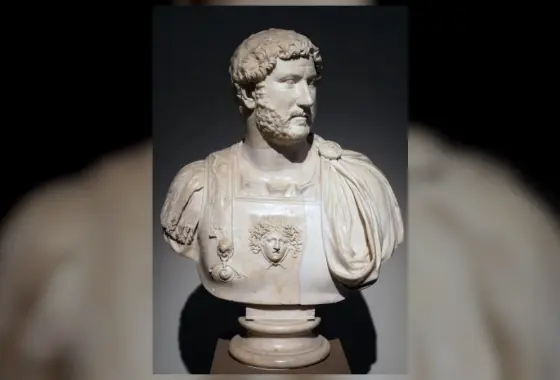
Hadrian was a relative of the emperor Trajan and grew up under his guardianship. After Trajan died in Cilicia in 117, it was announced that he had adopted Hadrian, who was proclaimed emperor; the genuineness of the adoption was questioned in ancient sources.
Consolidating the frontiers
Hadrian withdrew from the Mesopotamian lands Trajan had conquered in the east and fixed the empire’s frontiers on defensible lines. In northern Britain, the roughly 118-kilometre Hadrian’s Wall, begun around 122, symbolises this policy and is now on the UNESCO World Heritage List.
The travelling emperor
For much of his reign Hadrian toured Gaul, Britain, Spain, Africa, Greece, Anatolia and Egypt. He visited many cities in Anatolia; Hadrian’s Gate in Antalya, built in 130, commemorates his visit. He greatly admired Greek culture and commissioned many buildings in Athens.
Buildings and revolts
The Pantheon in Rome was rebuilt in its present form under him, and his great villa at Tivoli is also on the UNESCO list. In 132–135 the Bar Kokhba revolt in Judaea was suppressed with heavy losses.
Death
Hadrian died in 138 at Baiae on the Bay of Naples. The mausoleum he built in Rome is today’s Castel Sant’Angelo. He was succeeded by his adopted son Antoninus Pius.
The emperor who toured the provinces
What most clearly sets Hadrian apart from his predecessors is that he spent much of his reign away from Rome, travelling through the provinces. From 121 onward he visited a vast area that included Gaul, Germania, Britannia, Hispania, Anatolia, Syria, Egypt and Greece. On these journeys he did not merely hold ceremonies; he inspected the army, examined forts and frontier lines, and supported building projects such as aqueducts, harbours and temples in the cities. Ancient sources say that the emperor ate the same food as the soldiers, walked bareheaded on marches and personally checked the discipline of the units. This attitude is interpreted as a style of rule meant to strengthen the bond between the army and the emperor.
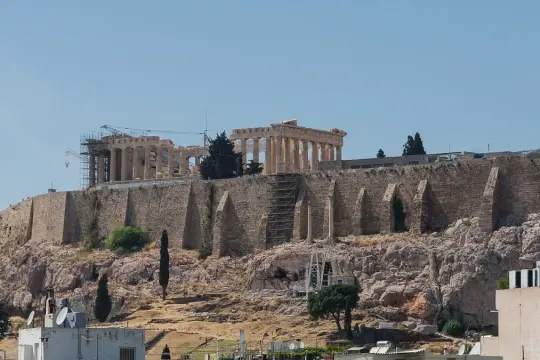
Hadrian had a deep admiration for Greek culture and showed particular favour to Athens. The completion of the Olympieion (the Temple of Zeus), which had long stood unfinished, took place in his time; the city also gained new districts and a library. In Anatolia, cities such as Ephesus, Smyrna and Cyzicus received the emperor’s attention, and the Hadrian’s Gate in Antalya is regarded as having been built to commemorate his visit around 130. Provincial communities therefore remembered the emperor not as a distant ruler but as a patron who came to their cities and took an interest in them.
Work in law, administration and architecture
Hadrian’s approach to government was not limited to frontier policy. To organise administration he increased the role of members of the equestrian class in the imperial bureaucracy and gave court services a more orderly structure. In law, he is said to have assigned the jurist Salvius Julianus the task of compiling and arranging the annual edicts of the praetors. This work is considered to have helped Roman law gain a more stable text. Regulations limiting certain arbitrary practices toward slaves and women are also attributed to his time, though the scope of these measures is debated in the sources.
Architecture is among the emperor’s most lasting legacies. The Pantheon in Rome, as seen today, is regarded as having been completed largely in his time, in the 120s; the inscription on the building, however, commemorates Agrippa, who had built an earlier structure. The large villa at Tivoli, with gardens and halls inspired by buildings he saw in various provinces, is a palace complex and is listed as a UNESCO World Heritage Site. The tomb structure on the bank of the Tiber was later turned into the fortress known as Castel Sant’Angelo. These buildings show Hadrian’s technical as well as aesthetic pursuits.
The Judaean revolt and the end of the reign
The harshest conflict of Hadrian’s time was the Bar Kokhba revolt that broke out in Judaea between 132 and 135. Ancient sources explain its causes differently: some accounts link it to the plan to refound Jerusalem as a Roman colony called Aelia Capitolina, others to a ban on circumcision. Historians still debate the order of these events. The revolt began under Simon bar Kokhba and occupied the Romans for a long time; Rome had to move many units into the region. After the revolt was suppressed, Jews were forbidden from entering Jerusalem and the province came to be called Syria Palaestina. The casualty figures given by Cassius Dio are considered exaggerated and should be read with care.
Hadrian’s last years were marked by illness. The death of his beloved Antinous by drowning in the Nile in 130 had shaken him deeply; the emperor founded a city in his name and created a divine cult after his death. The succession problem was also on the agenda in his final years; his chosen heir Aelius Caesar died early, and the emperor made Antoninus Pius his successor by adoption. Hadrian died at Baiae on 10 July 138. The Senate at first resisted deifying him, but this approval was granted at the insistence of Antoninus Pius.
Military life on Hadrian’s Wall
Hadrian’s Wall, begun around 122 in the north of Britannia, is a frontier line about 118 kilometres long, and it was not merely a barrier but a system of observation and control. Along the wall, small fortified gates (milecastles) stood at regular intervals with watchtowers between them, while large unit forts lay behind and on the line. The wall made it possible to control the passage of small groups from the north, to regulate taxes and trade and to observe the local population. For this reason historians interpret it not simply as a defensive wall but as a tool of frontier management.
Wooden writing tablets found at forts such as Vindolanda provide unique information on the daily life of soldiers on the wall. These tablets contain supply orders, unit lists and personal letters; in one letter an invitation to the birthday of an officer’s wife is mentioned. Hadrian’s Wall is today part of UNESCO’s “Frontiers of the Roman Empire” listing. Another line was later built just to the north under Antoninus Pius, but it could not be held for long.
Sources and further reading
- Historia Augusta, “Hadrian”.
- UNESCO World Heritage, “Frontiers of the Roman Empire” and “Villa Adriana (Tivoli)”.
- Encyclopaedia Britannica, “Hadrian”.
- Cassius Dio – Roman History
- Historia Augusta – “Life of Hadrian”
- Encyclopaedia Britannica – Hadrian
- Vindolanda Tablets Online
- UNESCO – Frontiers of the Roman Empire
- Cassius Dio – Roman History
People also ask
Who was Hadrian? Hadrian ruled the Roman Empire from 117 to 138.
When and where was Hadrian born? Born: 24 January 76, probably Italica (Spain).
When did Hadrian reign? Reign: 117 – 138.
When did Hadrian die? Died: 10 July 138, Baiae.



Leave a comment
Your email address will not be published. Required fields are marked *