



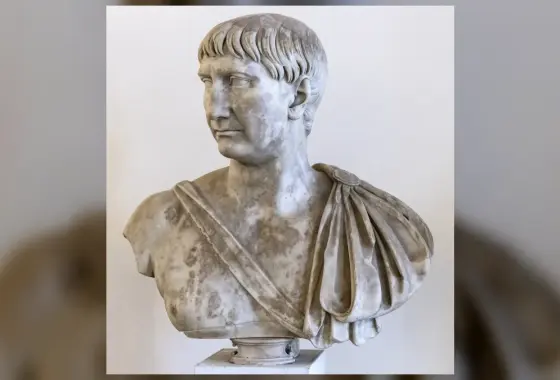
Trajan was born in Italica, a Roman colony in Spain, and was the first emperor born outside Italy. A successful general, he was adopted by Emperor Nerva as his heir and came to the throne in 98.
Dacia and the eastern campaigns
Trajan fought two wars against the kingdom of Dacia north of the Danube and made it a Roman province in 106, a victory depicted on the reliefs of Trajan’s Column. From 114 he campaigned against the Parthian Empire, taking Armenia and Mesopotamia and reaching the Persian Gulf. Around 117 Rome reached the greatest extent in its history.
Government
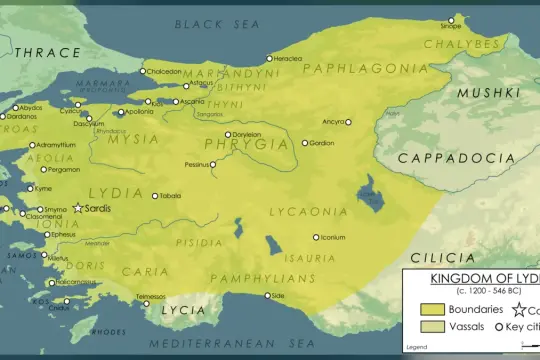
Trajan kept good relations with the Senate, expanded the “alimenta” programme for poor children and built roads, harbours and bridges. His forum and markets in Rome were among the largest public buildings of the age. His letters with Pliny the Younger, governor of Bithynia, are an important source on provincial government.
Death
Trajan died in 117 at Selinus in Cilicia (today’s Gazipaşa in Antalya, Türkiye) while returning from the east. His adopted son Hadrian succeeded him and withdrew from the new lands in Mesopotamia, judging them too hard to defend.
The Danube bridge and the Tabula Traiana
While preparing for the second Dacian war, Trajan had the architect Apollodorus of Damascus build a bridge over the Danube. The bridge near Drobeta (today's Drobeta-Turnu Severin in Romania) was completed around 105; at more than a kilometre long, it remained the longest arch bridge in the world for about a thousand years. The remains of its piers can still be seen on both banks of the river. In the Iron Gates gorge there is also a rock inscription describing Trajan's road building, the Tabula Traiana. The inscription was moved higher up so that it would not be submerged by the lake of the Iron Gates dam built in 1964–1972.
"Optimus Princeps": the title of best emperor
The Senate gave Trajan the title "Optimus" (the best), which appeared among his official titles from 114 onward. Earlier, Pliny the Younger had delivered a long speech of praise (the Panegyricus) to the emperor in the Senate in the year 100. Trajan's memory remained so strong that, according to the 4th-century historian Eutropius, the Senate greeted later emperors with the wish "be luckier than Augustus and better than Trajan". In Dante's Divine Comedy, Trajan appears as an example of a ruler remembered for his justice.
His reply to Pliny: the question of the Christians
In the 110s Pliny the Younger, governor of Bithynia, wrote to the emperor asking how he should treat Christians who had been denounced to him. Trajan's reply is among the earliest official documents describing Rome's attitude towards Christians. According to this reply, Christians were not to be sought out, but if they were accused and convicted and refused to show respect to the Roman gods, they were to be punished. The emperor also clearly ordered that anonymous accusations should be ignored, writing that they were "not in keeping with the spirit of our age". This exchange forms letters 96 and 97 of Book X of the Letters.
His traces in Anatolia
Trajan's name lives on in many ancient cities in present-day Türkiye. The Trajaneum on the acropolis of Pergamon is a temple begun in his name for the imperial cult and completed under his successor Hadrian; some of its marble columns have been re-erected. In Ephesus, the Fountain of Trajan on Curetes Street is an ornate monumental fountain built in the emperor's name in the early 2nd century. Selinus (Gazipaşa), the town where the emperor died, was also known for a time as Traianopolis in his memory.
Frequently asked questions
Where is Trajan’s Column? In Trajan’s Forum in Rome; it was completed in 113.
Sources and further reading
- Encyclopaedia Britannica, “Trajan”.
- Cassius Dio, Roman History, Book LXVIII.
- Pliny the Younger, Letters, Book X.
- World History Encyclopedia, “Trajan”.
- Pliny the Younger, Letters, Book X (96–97) and Panegyricus
- Julian Bennett – Trajan: Optimus Princeps (Routledge, 1997)
- Eutropius, Breviarium, Book VIII
People also ask
Who was Trajan? Trajan was Roman emperor from 98 to 117. He conquered Dacia (today’s Romania), pushed into Mesopotamia in his Parthian campaigns and brought the empire to its greatest territorial extent.
When and where was Trajan born? Born: 53, Italica (Hispania, today’s Spain).
When did Trajan reign? Reign: 98 – 117.
When did Trajan die? Died: 117, Selinus (Cilicia, today’s Gazipaşa, Türkiye).

Leave a comment
Your email address will not be published. Required fields are marked *