



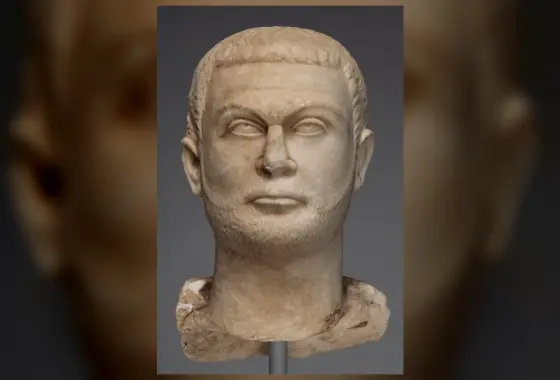
Diocletian was born into a humble family on the coast of today’s Croatia and rose through the army. In 284, after the death of the emperor Numerian, he was proclaimed emperor by the troops. This date is taken as the end of the crisis of the third century, in which emperors were killed one after another.
The Tetrarchy
Seeing how hard it was to rule the vast empire alone, Diocletian first made Maximian co-emperor (Augustus) in the west. In 293 each Augustus was given a deputy and successor (Caesar), creating the Tetrarchy. Diocletian ruled the east, with Nicomedia (İzmit) as his centre.
Reforms
He made the provinces smaller and more numerous, separated civil and military administration, enlarged the army and created a new tax system. In 301, to fight inflation, he issued the Edict on Maximum Prices, fixing ceiling prices for hundreds of goods and services, but it failed.
Persecution of Christians
In 303 edicts ordering the destruction of churches and the burning of scriptures began the “Great Persecution”. It lasted several years, especially in the eastern provinces, and ended in 311–313.
Abdication
In 305 Diocletian, together with Maximian, became the first Roman emperor to abdicate voluntarily. He spent his last years in his great palace at today’s Split, now on the UNESCO World Heritage List. Before his death the Tetrarchy had already collapsed in civil war.
Economy and the tax system
The crisis of the 3rd century had badly disrupted the Roman economy. Because the currency kept losing value, inflation had risen and state payments had become difficult. Diocletian approached this problem from several directions. To renew the monetary system he introduced a new coinage arrangement around 294, but this was not enough to stop inflation completely. He then issued the “Edict on Maximum Prices” (Edictum de pretiis) in 301, which set price ceilings for hundreds of goods and services. The edict lost its effect quickly because of the difficulty of enforcing it and the black market. Even so, the inscription fragments we have today provide valuable information about the prices and occupations of the period.
A deep reorganisation was also made in the tax system. A system of tax units calculated on the basis of land and population was set up, which made it easier for the state to plan its revenue and the army’s needs in advance. While this new order aimed to cover the empire’s administrative costs, it placed a heavy burden on peasants and strengthened practices that encouraged people to stay tied to the land. Historians argue that Diocletian rescued the state but made the lower parts of society pay the price.
Reorganising the army and the provinces
At the centre of Diocletian’s administrative reforms was the separation of the empire’s civil and military administration. The provinces were divided into smaller units, which were grouped into larger regions called “dioceses”. In this way each official’s area of responsibility narrowed while the state’s control increased. The number of bureaucrats grew, which both made it easier for government to reach the ground and raised costs. The army was also reorganised: frontier units and mobile units were separated more clearly, and the total number of soldiers was increased.
In foreign policy Diocletian’s time is considered successful. In the war of 297–298 the Caesar Galerius, despite an initial defeat, won a great victory against the Sasanian king Narseh, and by the treaty of 299 Rome gained some lands beyond the Tigris. This treaty secured the eastern frontier for many years. In the north, campaigns were launched against Germanic and Sarmatian peoples, and the Danube and Rhine frontier lines were strengthened again. These successes are often cited as examples showing that the Tetrarchy worked in practice.
The Great Persecution, abdication and the palace at Split
The darkest aspect of Diocletian’s reign was the anti-Christian measures that began in 303 and are known as the “Great Persecution”. The first edicts ordered the destruction of churches, the burning of scriptures and the arrest of clergy; later edicts widened the pressure to a general obligation to offer sacrifice. The sources note that the Caesar Galerius had great influence on this decision. The severity of the persecution varied from region to region; in the west, under Constantius Chlorus, it was applied more lightly. The policy did not succeed in destroying the Christian community and effectively ended with the edict of toleration proclaimed by Galerius in 311.
On 1 May 305 Diocletian abdicated voluntarily, a rare decision in Roman history, and led Maximian to take the same step. He settled in the large palace he had built near Split on the Adriatic coast; this structure is now a UNESCO World Heritage Site and forms the core of Split’s old town. According to ancient accounts, he answered calls to return to politics by speaking of the vegetables he grew in his garden; the details of this anecdote vary from source to source. After his withdrawal the Tetrarchy dissolved quickly, and after civil wars Constantine became sole ruler.
The Jovian–Herculian ideology and court ceremony
Diocletian’s rule was not made up of administrative reforms alone; he also placed the empire’s authority on a religious and ceremonial foundation. He took the title “Jovius” (descended from Jupiter), while his colleague Maximian took “Herculius” (descended from Hercules). This system declared that the authority of the two emperors rested on a divine source and aimed to weaken the tendency to seize power by military coup. The Caesars were also presented as members of the divine family within this framework.
Court ceremony changed too. People knelt when approaching the ruler and kissed the hem of his robe, and the emperor wore ornate and heavy garments. Historians regard this practice as a sign of the move toward the “dominate” (lordship) period, though how new it was is debated. The role of the capital also changed: emperors stayed not in Rome but in cities near the frontier such as Nicomedia, Antioch, Milan and Trier. The Roman Senate kept its prestige but moved away from being the actual political centre.
Sources and further reading
- Lactantius, On the Deaths of the Persecutors.
- UNESCO World Heritage, “Historical Complex of Split with the Palace of Diocletian”.
- Encyclopaedia Britannica, “Diocletian”.
- Lactantius – On the Deaths of the Persecutors
- Eutropius – Breviarium
- Encyclopaedia Britannica – Diocletian
- Aurelius Victor – On the Caesars
- Lactantius – On the Deaths of the Persecutors
- Encyclopaedia Britannica – Diocletian
People also ask
Who was Diocletian? Diocletian ruled the Roman Empire from 284 to 305.
When and where was Diocletian born? Born: c. 244, Dalmatia.
When did Diocletian reign? Reign: 284 – 305.
When did Diocletian die? Died: c. 311, Split (Croatia).





Leave a comment
Your email address will not be published. Required fields are marked *