



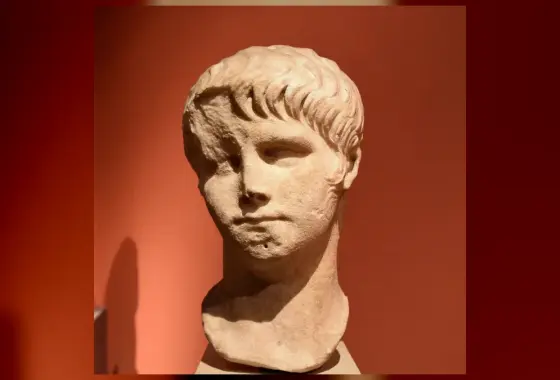
Nero was the son of Agrippina, a descendant of Augustus. By marrying the emperor Claudius, his mother secured her son’s position as heir. When Claudius died in 54, Nero became emperor at sixteen.
The early years
In the early years of his reign government ran smoothly under the influence of the philosopher Seneca and the praetorian prefect Burrus. But Nero came to resent his mother’s influence and had Agrippina killed in 59.
The fire of Rome
The Great Fire of Rome, which broke out in July 64, destroyed much of the city. Tacitus writes that Nero was not in Rome when it started and directed the relief effort, but that rumours spread that he had started it. Nero blamed the Christians and had them severely punished; according to tradition the apostles Peter and Paul were killed in Rome in this period. After the fire he built his vast palace, the Domus Aurea.
Passion for the arts and the end
Nero loved singing, poetry and chariot racing, and competed in person in contests in Greece. The Pisonian conspiracy against him in 65 was harshly crushed, and Seneca was forced to commit suicide. In 68, after governors in Gaul and Spain revolted and the Senate declared him a public enemy, he took his own life outside Rome. His death was followed by the civil war known as the “Year of the Four Emperors”.
The golden years and early government
The first years of Nero’s reign are remembered as a balanced period of government when compared with what followed. In the Roman tradition this phase is also known by a name meaning “Nero’s five years”. On behalf of the young emperor, government was largely run by Seneca and the praetorian prefect Burrus. Relations with the Senate went well; the emperor won sympathy in the public eye through steps such as easing punishments and regulating certain tax practices. Tacitus describes the administration in this period as relatively moderate, with the real conflict taking place inside the palace, especially between the emperor’s mother Agrippina and his advisers.
In foreign policy the most important matter was the Armenian question between Rome and the Parthian Empire. After the campaigns led by the commander Corbulo, a settlement was reached at Rhandeia in 63: the Parthian prince Tiridates would sit on the Armenian throne but would receive his crown from the Roman emperor. In Britannia a great revolt broke out in 60–61 under Queen Boudica; Roman towns were destroyed, but the revolt was eventually suppressed. These events show that Nero’s era was not made up only of palace intrigue, and that serious tests were faced on the empire’s frontiers.
The turning point: developments after 62
The year 62 is regarded as a breaking point in Nero’s reign. The death of the praetorian prefect Burrus and Seneca’s gradual withdrawal from politics left the emperor without experienced advisers. In the same year the emperor’s first wife Octavia was exiled and soon killed; Nero married Poppaea Sabina. After this, treason (maiestas) trials increased and pressure on senators hardened. Tacitus depicts this period as an atmosphere of fear and display; however, because most ancient sources were written in Senate circles hostile to Nero, they may offer a one-sided portrait.
In 65 a major assassination plot against the emperor, known by the name of Piso, was uncovered. Most of the conspirators were executed or forced to commit suicide, and Seneca was among them. Nero’s desire to appear on stage as an artist became more visible in these years. In 66–67 he made a long trip to Greece, took part in contests at Olympia and other games, and proclaimed freedom for the Greek cities. These actions were found humiliating by the Roman aristocracy, though they were welcomed with joy by part of the people in Greece.
The Golden House, revolts and the end of the reign
The rebuilding of Rome after the great fire became one of Nero’s most debated undertakings. In the new plan streets were widened, the height of buildings was limited and the use of stone in construction was encouraged, making it harder for later fires to spread. In the same period the emperor had a large palace and park complex built in the centre of the city, known as the Domus Aurea (Golden House). Much of the public criticised this as setting aside public land after the fire for the emperor’s private residence. The Flavian dynasty later built the Colosseum on this site and returned the land to the people.
In 68 Vindex, the governor in Gaul, rebelled; soon afterward Galba, the governor in Hispania, also turned against the emperor. Although Vindex was defeated, Galba’s movement gained strength. Having lost the support of the praetorian units as well, Nero was declared a “public enemy” by the Senate. The emperor fled Rome and ended his life on 9 June 68 with the help of his attendants. The Julio-Claudian dynasty ended with him, and the empire was dragged into the civil war of 69, known as the “Year of the Four Emperors”. For a while rumours circulated among the people that Nero would return; this belief is known as the “Nero legend”.
Nero’s image: how reliable are the sources?
Most of what we know about Nero rests on Tacitus, Suetonius and Cassius Dio; all three wrote after Nero, in settings close to Senate circles. The emperor’s negative portrait therefore partly reflects the viewpoint of the dynasty that followed him and of senators. For example, the claim that he “played the lyre while Rome burned” conflicts with Tacitus, who notes that he was at Antium during the fire; moreover, the violin-like instrument was not yet known at that time. Modern researchers try to separate such accounts with care.
On the other hand, Nero’s cultural activities are also noteworthy. In 60 he launched the Neronia games, which included Greek-style music and athletic contests, and he busied himself with poetry and music. The Roman aristocracy considered this unbecoming of an emperor, but sympathy for Nero lasted a long time in the eastern provinces. The scale of the persecution of Christians is also debated: Tacitus links it to the fire of 64, while some modern historians think its size has been exaggerated. A reader assessing Nero should therefore also take into account the political position of the sources.
Sources and further reading
- Tacitus, Annals, books XIII–XVI.
- Suetonius, Lives of the Twelve Caesars: Nero.
- Encyclopaedia Britannica, “Nero”.
- Tacitus – Annals
- Suetonius – The Twelve Caesars
- Cassius Dio – Roman History
- Tacitus – Annals
- Suetonius – The Twelve Caesars
- Encyclopaedia Britannica – Nero
People also ask
Who was Nero? Nero, the last emperor of the Julio-Claudian dynasty, ruled the Roman Empire from 54 to 68.
When and where was Nero born? Born: 15 December 37, Antium.
When did Nero reign? Reign: 54 – 68.
When did Nero die? Died: 9 June 68, near Rome.
Leave a comment
Your email address will not be published. Required fields are marked *