



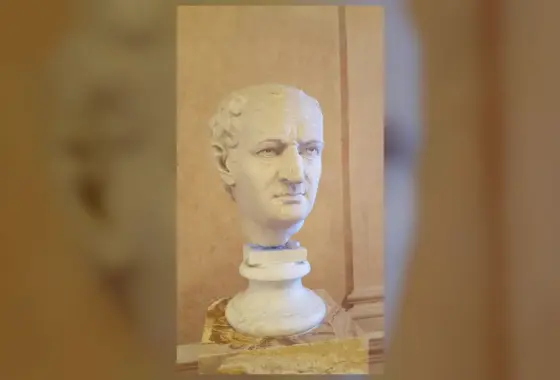
Vespasian came from a non-aristocratic family of the equestrian class in Italy. He distinguished himself as a legionary commander in the conquest of Britain, and in 66 the emperor Nero gave him the task of crushing the great revolt in Judaea.
The Year of the Four Emperors
After Nero’s death in 68, Galba, Otho and Vitellius became emperor in quick succession. In July 69 the eastern legions proclaimed Vespasian emperor; his supporters defeated Vitellius and by December 69 Vespasian was sole master of Rome. His son Titus, continuing the war in Judaea, took Jerusalem in 70 and the Temple was destroyed.
His government
Vespasian refilled a treasury emptied by civil war and Nero’s spending with new taxes and strict financial policy. According to ancient sources, when his son criticised a tax on public urinals, he replied that money does not smell (pecunia non olet). He also reorganised the army and provincial administration.
The Colosseum
On the site of the artificial lake in the grounds of Nero’s Domus Aurea, he began building a great amphitheatre for the people. The Flavian Amphitheatre, known today as the Colosseum, was opened in 80 under his son Titus.
Death
Vespasian died in 79. According to Suetonius, he joked on his deathbed, “Alas, I think I am becoming a god.” He was succeeded by his sons Titus and then Domitian.
The Lex de imperio Vespasiani
Part of the law listing Vespasian's powers has survived on a bronze tablet. This text, known as the "Lex de imperio Vespasiani", grants the emperor powers such as making treaties, convening the senate and doing whatever he deemed to be in the public interest. The tablet resurfaced in Rome in the Middle Ages; in the fourteenth century the popular leader Cola di Rienzo displayed it as proof of the sovereignty of the people. Today it is kept in the Capitoline Museums in Rome.
The triumph of 71 and the Temple of Peace
After the end of the war in Judaea, Vespasian and his son Titus held a joint triumph in Rome in 71. The spoils brought from the Temple of Jerusalem were displayed in this procession. Vespasian showed part of these spoils to the public in a new public space opened in 75, known as the "Temple of Peace" (Templum Pacis). The reliefs of the Arch of Titus, built after Titus's death, also depict this triumph.
The censorship and the renewal of the senate
In 73–74 Vespasian held the office of censor together with his son Titus. During this term he revised the rolls of the senatorial and equestrian orders, which had shrunk during the civil war, and allowed new families from Italy and the provinces to enter the senate. In the same period Latin rights were granted to many communities in Hispania. These steps helped to open Rome's ruling class further to families from outside Italy.
Arrangements in Anatolia and the East
Vespasian also made important arrangements in Anatolia to strengthen the empire's eastern frontier. In 72 he annexed the Kingdom of Commagene and brought it under provincial administration. Legions were stationed in Cappadocia, and the region was combined with Galatia into a large province. Lycia and Pamphylia were also joined into a single province. These arrangements aimed to create a stronger line of defence against the Parthians along the Euphrates frontier.
The Flavian dynasty
The Flavian dynasty founded by Vespasian ruled Rome for about a quarter of a century, from 69 to 96. His elder son Titus dealt during his short reign with disasters such as the eruption of Vesuvius in 79 and the great fire in Rome. His younger son Domitian maintained a long and harsh rule; when he was assassinated in 96, the dynasty came to an end. The dynasty's name lives on in the Flavian Amphitheatre, today the symbol of Rome.
Sources and further reading
- Suetonius, Lives of the Twelve Caesars: Vespasian.
- Tacitus, Histories.
- Encyclopaedia Britannica, “Vespasian”.
- Barbara Levick, Vespasian, 2nd edition, Routledge, 2017
- Musei Capitolini, "Lex de imperio Vespasiani" collection page
People also ask
Who was Vespasian? Vespasian ruled the Roman Empire from 69 to 79 and founded the Flavian dynasty.
When and where was Vespasian born? Born: 17 November 9, Falacrina (Italy).
When did Vespasian reign? Reign: 69 – 79.
When did Vespasian die? Died: 23 June 79.
Leave a comment
Your email address will not be published. Required fields are marked *