



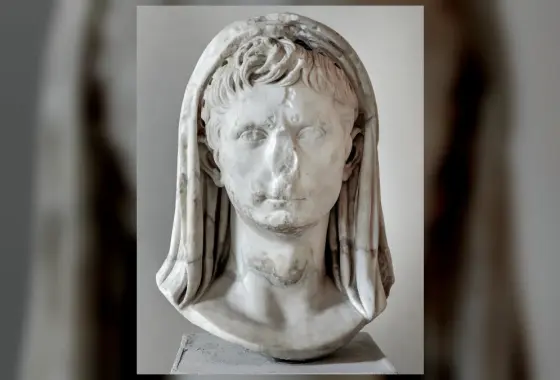
Augustus was born in Rome in 63 BC. His great-uncle Julius Caesar adopted him and named him heir in his will. When Caesar was assassinated in 44 BC, Octavian was only 18, yet he quickly moved to the centre of Roman politics.
From civil war to empire
Octavian first formed the “Second Triumvirate” with Mark Antony and Lepidus and fought Caesar’s assassins. He later fell out with Antony and, at the naval Battle of Actium in 31 BC, defeated Antony and the Egyptian queen Cleopatra; Egypt was annexed the following year.
In 27 BC the Senate granted him the title “Augustus” (venerable). He kept the institutions of the republic in appearance and called himself “princeps”, the first citizen, but real power over the army and the state was his. This arrangement is taken as the beginning of the Roman Empire.
His rule
- Peace and order: he ended the civil wars and created a regular, salaried army.
- Provinces: he reorganised taxation and administration and pushed the frontiers to the Danube and the Rhine.
- The city of Rome: he built temples, forums and public works; he is credited with saying he found Rome a city of brick and left it a city of marble.
- Calendar: the month of August is named after him.
Death and legacy
Augustus died in AD 14 and was succeeded by his adopted son Tiberius. The best-preserved copy of the Res Gestae Divi Augusti, his own account of his life and achievements, is inscribed on the walls of the Temple of Augustus in Ankara, Türkiye.
The Res Gestae and the Temple of Augustus in Ankara
Before his death, Augustus prepared a text called "Res Gestae Divi Augusti" (The Deeds of the Divine Augustus), describing his achievements in his own words. The text was inscribed on bronze tablets in front of his mausoleum in Rome, but these tablets have not survived. Today the most complete copy of the text is on the walls of the Temple of Augustus and Rome in Ankara, in both Latin and Greek. For this reason the inscription is known among scholars as the "Monumentum Ancyranum" (the Monument of Ancyra).
His family and the search for an heir
Augustus's only biological child was his daughter Julia. Over his long reign he chose several possible heirs, but they died one after another: his nephew Marcellus in 23 BC, his closest friend and son-in-law Agrippa in 12 BC, and Agrippa and Julia's sons Lucius in AD 2 and Gaius in AD 4. In the end Augustus adopted Tiberius, his wife Livia's son from her earlier marriage, in AD 4; Tiberius became emperor after his death.
The defeat in the Teutoburg Forest
The greatest military disaster of the last years of Augustus's reign came in AD 9 in Germania. Germanic tribes led by Arminius ambushed and destroyed three legions (XVII, XVIII and XIX) under the governor Varus in the Teutoburg Forest. According to Suetonius, on hearing the news Augustus cried out: "Quinctilius Varus, give me back my legions!" The battlefield is associated with the Kalkriese area in Germany, excavated since 1987.
The Ara Pacis and the Mausoleum of Augustus
Two of Augustus's buildings in Rome still tell the story of his era today. The Ara Pacis Augustae, meaning Altar of Peace, was built by decree of the Senate and dedicated in 9 BC; its reliefs show a ceremonial procession of Augustus's family and priests. The mausoleum that Augustus began building around 28 BC was used for different purposes over the centuries; after a long restoration it reopened to visitors in 2021.
Frequently asked questions
Are Augustus and Octavian the same person? Yes. Born Gaius Octavius, he is called Octavian after his adoption by Caesar and Augustus after 27 BC.
Why is the Ankara inscription important? It preserves the most complete Latin and Greek copy of the Res Gestae.
Sources and further reading
- Suetonius, The Lives of the Twelve Caesars, “Augustus”.
- Res Gestae Divi Augusti (Monumentum Ancyranum, Ankara).
- Encyclopaedia Britannica, “Augustus”.
- Mary Beard, SPQR.
- Augustus – Res Gestae Divi Augusti (Monumentum Ancyranum)
- Suetonius – Life of Augustus (De Vita Caesarum II)
- Varusschlacht im Osnabrücker Land – Museum and Park Kalkriese
People also ask
Who was Augustus? Augustus, born Gaius Octavius, was the adopted son of Julius Caesar and, after long civil wars, became Rome’s first emperor in 27 BC.
When and where was Augustus born? Born: 23 September 63 BC, Rome.
When did Augustus reign? Reign: 27 BC – AD 14.
When did Augustus die? Died: 19 August AD 14, Nola.

Leave a comment
Your email address will not be published. Required fields are marked *