



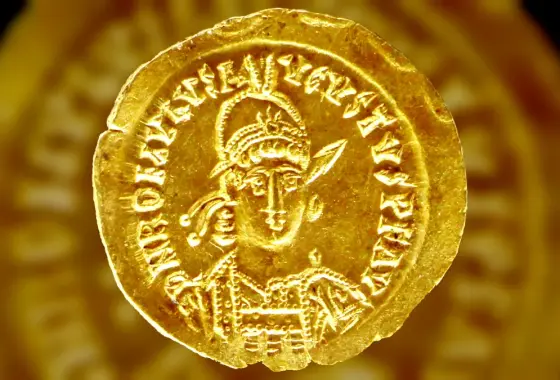
Romulus was the son of Orestes, a commander from Pannonia who in his youth had served as a secretary and envoy at the court of the Hunnic ruler Attila. In 475 Orestes rebelled against the Western emperor Julius Nepos and proclaimed his young son emperor instead of himself.
A brief reign
Real power during Romulus’s reign lay with his father. By then the Western Empire was largely limited to Italy; Gaul, Spain and Africa had passed to Germanic kingdoms, and the army consisted mainly of Germanic soldiers. Mocking his name and the title Augustus, people and sources called him “Augustulus” (little Augustus).
Odoacer and 476
When Orestes refused the land demands of the Germanic soldiers in Italy, they proclaimed their commander Odoacer king. Orestes was captured and killed, and on 4 September 476 Romulus was deposed. Odoacer did not declare himself emperor; he sent the imperial regalia to Constantinople, to the eastern emperor Zeno. Some historians believe Odoacer’s father was Edeko, Attila’s envoy.
Afterwards
Taking pity on his youth, Odoacer spared Romulus and sent him with an annual pension to Castellum Lucullanum near Naples; nothing certain is known of his later life. Because Julius Nepos was legally still the lawful emperor until his death in 480, the title “last emperor” is debated, but 476 is generally accepted as the date of the fall of the Western Roman Empire.
The events of 476: from Orestes to Odoacer
The deposition of Romulus Augustulus was in fact the result of a dispute over pay and land in the Western Roman army. Most of the army in Italy consisted of units of Germanic origin called “foederati”. These soldiers demanded that one third of the land of Italy be given to them. Orestes, who held the position of regent, refused. The soldiers then chose Odoacer, a commander from the Heruli, Sciri and other Germanic units, as their king. In the summer of 476 Odoacer defeated Orestes’ forces; Orestes was captured near Piacenza and executed on 28 August 476. His brother Paulus was also killed near Ravenna.
Odoacer then entered Ravenna and deposed Romulus on 4 September 476. The way ancient sources describe this event is striking: Romulus was not killed; he was spared because he was a child and, given his family’s background, posed no threat. Odoacer granted the young emperor a pension and sent him to a settlement called Lucullanum near Naples in Campania. In other words, Romulus’s end was not a dramatic one, as is often thought, but a quiet withdrawal from the stage after being made politically ineffective.
Aftermath: Zeno, Nepos and the Kingdom of Italy
After deposing Romulus, Odoacer did not appoint a new Western emperor. Instead, he had the imperial insignia sent to Constantinople, to the Eastern Roman emperor Zeno. Zeno at that time recognised Julius Nepos, who was in exile, as the legitimate emperor of the West, and asked Odoacer to support him. Odoacer, however, preferred to define his own position as a ruler subordinate to Zeno with the title “patricius”. Nepos kept his title until he was killed in Dalmatia in 480, and after his death imperial rule in the West effectively ended.
Odoacer’s government of Italy continued many institutions of Roman administration: the Senate met, legal rules continued and Roman officials stayed in their posts. This is one of the reasons historians interpret 476 as a transition rather than a sharp break. Odoacer’s kingdom ended in 493: Theodoric, king of the Ostrogoths, who had entered Italy with Eastern Roman support, killed Odoacer at Ravenna after a long war and set up his own kingdom in its place.
Why is 476 called an “end”?
The description of 476 as the “fall of Rome” comes largely from the interpretations of later centuries. Edward Gibbon’s work “The Decline and Fall of the Roman Empire”, written in the 18th century, popularised this date as a turning point marking the end of Antiquity. For contemporaries, however, the situation was not so clear. The empire went on living in the East, in Constantinople, and many Romans in the West thought their lives continued without interruption. Modern researchers, with the concept of “late antiquity”, treat this period as a transformation spread over centuries rather than a sudden collapse.
Romulus’s name also reflects this symbolism. It is often cited as an irony of history that a child bearing the names of Romulus, Rome’s legendary founder, and Augustus, the first emperor, became the last emperor of the West. The nickname “Augustulus” was given by contemporaries or later writers who looked down on him. Historians note that it is hard to find new information about him and that the sources are short and scattered. Even so, Romulus Augustulus continues to be remembered as a name that symbolises the closing of the Western Roman political stage.
Romulus’s age, family and later fate
Romulus’s year of birth is not known with certainty; the sources indicate that he was in his teens or even younger when he was proclaimed emperor in 475. His father Orestes is said to have been of Pannonian origin. The family’s connection with Attila’s court comes from Orestes’ past and shows how military families on the frontier could rise among the Roman elites of the period. These families were people who could dominate both the Roman army and Germanic units in the empire’s last years.
Very little is known about Romulus’s life after 476. Some sources report that he lived in a fortress or villa at Lucullanum near Naples, and that this place was later turned into a monastery. Some researchers link a person named “Romulus” mentioned in a text of the Ostrogothic king Theodoric from the early 500s to him, but this match is not accepted as certain. When and how Romulus died is therefore unknown. This uncertainty is an interesting detail when considered together with the symbolic weight of his place in history.
What do we learn from Romulus Augustulus?
The story of Romulus Augustulus shows that the collapse of great states often takes place not on a single day but over a long process of erosion. By 476 the tax revenues of the Western Roman state had shrunk, large regions in Gaul, Hispania and Africa had slipped out of control, and the army had come to rely largely on Germanic units paid for their service. The removal of the emperor was the last visible result of this structural weakness.
At the same time, this story is a reminder of how practical matters such as military pay and land distribution can determine political regimes. When the soldiers’ demand for land was not met, power changed hands; for most people, however, life did not change at once. Taxes, courts and city governments kept working in a similar way for several generations. It is therefore more accurate to read 476 not as the beginning of a different age but as a symbolic date in a long transformation.
Sources and further reading
- Jordanes, Getica and Romana.
- Anonymus Valesianus, part II.
- Encyclopaedia Britannica, “Romulus Augustulus”.
- Procopius – Wars
- Jordanes – Getica
- Encyclopaedia Britannica – Romulus Augustulus
- Anonymus Valesianus
- Marcellinus Comes – Chronicon
- Encyclopaedia Britannica – Romulus Augustulus
- Peter Heather – The Fall of the Roman Empire
- Encyclopaedia Britannica – Romulus Augustulus
People also ask
Who was Romulus Augustulus? Romulus Augustulus, who reigned briefly in 475–476, is usually regarded as the last Western Roman emperor.
When did Romulus Augustulus reign? Reign: October 475 – September 476.
Who was Romulus Augustulus’s father? Father: Orestes.



Leave a comment
Your email address will not be published. Required fields are marked *