



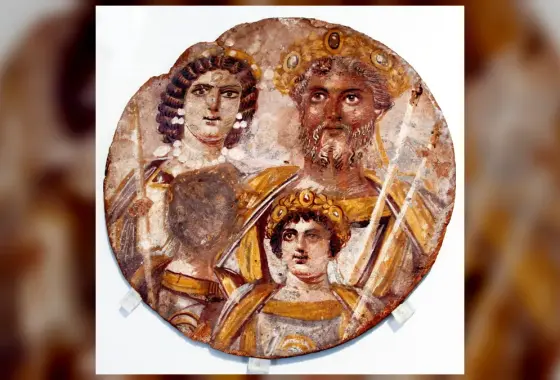
Severus was born into a local aristocratic family at Leptis Magna, a wealthy Roman city in North Africa. As a senator he served in various provinces, and in 193 he was governor of Upper Pannonia on the Danube.
The Year of the Five Emperors
After the murder of the emperor Commodus in 193, Pertinax and Didius Julianus rose and fell in quick succession. The Danube legions proclaimed Severus emperor, and he entered Rome. He then defeated his eastern rival Pescennius Niger at Issus (Hatay) in 194 and his western rival Clodius Albinus at Lugdunum (Lyon) in 197. Byzantium (Istanbul), which had backed Niger, was taken after a long siege and later rebuilt by Severus.
The Parthian campaign
In 197–198 he campaigned against the Parthians, sacked their capital Ctesiphon and created a new province in northern Mesopotamia. He adorned his birthplace, Leptis Magna, with grand buildings whose ruins are now on the UNESCO World Heritage List.
A government resting on the army
Severus raised soldiers’ pay, allowed them to marry and rebuilt the praetorian guard from his own legionaries. According to Cassius Dio, his last advice to his sons was: “Be harmonious, enrich the soldiers, and scorn all other men.”
Death
Severus went on campaign to Britain in 208 and died at today’s York (Eboracum) in 211. He was succeeded jointly by his sons Caracalla and Geta; Caracalla soon had his brother killed.
Julia Domna and the Severan dynasty
Around 187 Septimius Severus married Julia Domna, the daughter of a priestly family from the Syrian city of Emesa (modern Homs). The couple had two sons, Caracalla (Bassianus), born in 188, and Geta, born in 189. In ancient sources Julia Domna is remembered as an educated woman close to politics, and it is said that philosophers and writers gathered around her.
After becoming emperor, Severus placed this family at the centre of his public image in order to strengthen his dynasty. His wife and sons often appeared on coins and in statues, and Caracalla was raised to the rank of Augustus at a young age. That the dynasty came from North Africa and Syria is a striking sign that imperial government no longer belonged only to an Italy-centred aristocracy.
Monuments in Rome and the rebuilding of Leptis Magna
Severus’s reign also left its mark in architecture. In the Roman Forum the Arch of Septimius Severus was erected in 203 to commemorate the victories won against the Parthians; its faces carry reliefs showing scenes from the campaigns. In the same period a monumental fountain façade known as the Septizodium was built on the southern slope of the Palatine Hill.
Severus’s home town of Leptis Magna was equipped in this period like an imperial city. A broad colonnaded street, a new harbour, a forum and a large basilica were added, along with an arch with four faces. The ruins of Leptis Magna in today’s Libya are counted among the best-preserved examples of Roman architecture in North Africa. In the same period a marble plan of the city of Rome was also prepared; known as the Forma Urbis Romae, it was a detailed map of the city.
Army reform and the Parthica legions
Severus based his power on the army, and for that reason he made important changes in the military order as well. Before the campaign against the Parthians he raised three new legions: I, II and III Parthica. Of these, II Parthica was stationed at Albanum near Rome and formed a reserve that could move with the emperor. For the first time, a regular legion was therefore stationed close to the capital.
By discharging the former members of the Praetorian Guard and replacing them with soldiers chosen from the provincial legions, he ended the privilege of troops of Italian origin. The pay rises and permission to marry aimed to strengthen the soldiers’ loyalty to the emperor. Yet the financial burden of this policy was heavy and it led to a reduction in the proportion of silver in the coinage. Many historians regard this practice as a forerunner of the economic troubles of the following decades.
Caracalla, Geta and the end of the dynasty
When Severus died in 211 the empire passed jointly to his two sons, but the rivalry between the brothers soon turned into open conflict. Before the year was out Caracalla had Geta killed in the presence of their mother and became sole ruler. Caracalla’s best-known measure is the Constitutio Antoniniana, issued in 212, which granted Roman citizenship to almost all free inhabitants of the empire.
The dynasty was briefly interrupted after Caracalla was killed in 217, then continued with Elagabalus and Severus Alexander, grandsons of Julia Domna’s sister. Severus Alexander’s murder by his own soldiers in 235 ended the dynasty, and Rome entered the fifty years of turmoil known as the Crisis of the Third Century. Severus’s model of rule based on the army is debated as both one of the causes and one of the first signs of that crisis.
The British campaign and the last years at Eboracum
In 208 Severus, although old and ill, went to Britain with his sons Caracalla and Geta. The aim was to secure the frontier against the Caledonian tribes north of Hadrian’s Wall. During the campaign Eboracum (modern York) served as the effective centre of the empire.
Ancient writers report that Severus suffered badly from gout during the campaign and was often carried on a litter. He died at Eboracum in 211. The campaign did not end in a decisive conquest; Caracalla preferred afterwards to return to Rome and the operations in Caledonia were abandoned. Even so, the campaign left important archaeological traces in the renewal of fortifications and supply lines on the British frontier.
Law and the role of jurists such as Papinian
The Severan age was also a productive time for Roman legal science. Jurists such as Papinian, Ulpian and Paulus worked in these years and just after; their writings formed the basis of Justinian’s compilations in later centuries. Papinian is known to have served as praetorian prefect under Severus.
Severus also widened the legal rights of provincial people. He regulated the legal position of members of the army and, through provincial governors, gave more attention to the administration of justice. These practices show that he was not merely a soldier-emperor but also a ruler who cared about the legal functioning of the state.
Sources and further reading
- Cassius Dio, Roman History, books 74–77.
- UNESCO World Heritage, “Archaeological Site of Leptis Magna”.
- Encyclopaedia Britannica, “Septimius Severus”.
- Anthony R. Birley – Septimius Severus: The African Emperor
- Encyclopaedia Britannica – Septimius Severus
- UNESCO – Archaeological Site of Leptis Magna
- Anthony R. Birley – Septimius Severus: The African Emperor
- Encyclopaedia Britannica – Septimius Severus
- Cassius Dio – Roman History
People also ask
Who was Septimius Severus? Septimius Severus, born at Leptis Magna in today’s Libya, ruled Rome from 193 to 211.
When and where was Septimius Severus born? Born: 11 April 145, Leptis Magna (Libya).
When did Septimius Severus reign? Reign: 193 – 211.
When did Septimius Severus die? Died: 4 February 211, Eboracum (York).
Leave a comment
Your email address will not be published. Required fields are marked *