



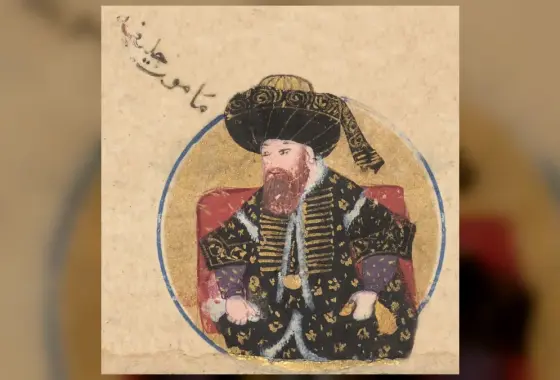
Al-Ma’mun was a son of Harun al-Rashid. After Harun’s death the caliphate passed to his brother al-Amin, while al-Ma’mun governed Khurasan. Civil war soon broke out between the brothers; al-Ma’mun’s general Tahir ibn al-Husayn took Baghdad in 813 and al-Amin was killed.
The House of Wisdom and science
Under al-Ma’mun, Baghdad’s House of Wisdom stood out as a centre for collecting books and making translations. Works by authors such as Aristotle, Galen and Euclid were rendered into Arabic. Observatories were built in Baghdad and Damascus, and work was done to measure the circumference of the Earth. Al-Khwarizmi, counted among the founders of algebra, dedicated his book to al-Ma’mun.
The Mihna
Al-Ma’mun adopted the Mu‘tazilite view that the Qur’an was created and in 833 began the Mihna, which pressed scholars to accept this view. Scholars such as Ahmad ibn Hanbal resisted. The policy continued under later caliphs and ended under al-Mutawakkil.
Death
Al-Ma’mun fell ill and died near Tarsus in 833 during a campaign against Byzantium and was buried in Tarsus. His brother al-Mu‘tasim succeeded him.
The Merv years and Ali al-Rida as heir
After the capture of Baghdad, al-Ma'mun stayed several more years in Merv in Khurasan. In 817 he named Ali al-Rida, whom the Shia regard as their eighth imam, as his heir and replaced the black colour of the Abbasids with green. This decision angered the Abbasid family in Baghdad; there his uncle Ibrahim ibn al-Mahdi was proclaimed caliph. Ali al-Rida died in Tus in 818. Al-Ma'mun returned to Baghdad in 819, the black colour was restored and the opposition melted away.
The rise of the Tahirid dynasty
Tahir ibn Husayn, the commander who had won the caliphate for al-Ma'mun, was appointed governor of Khurasan in 821. Tahir's descendants held this post from father to son, and the Tahirids became one of the first eastern dynasties that, while remaining loyal to the caliph, largely ran their own affairs. This is an early example of how governorships in Abbasid lands gradually turned into semi-independent states.
Observatories and measuring the earth
With al-Ma'mun's support, observations were carried out in Baghdad's Shammasiyya quarter and on Mount Qasiyun near Damascus. One product of this work is the set of astronomical tables called al-Zij al-Mumtahan, meaning "the verified tables", attributed to Yahya ibn Abi Mansur. According to the sources, the length of one degree of a meridian was measured on the plain of Sinjar in an attempt to calculate the circumference of the earth. These measurements show an effort not only to translate Greek knowledge but also to test it.
Byzantine campaigns and final years
In the last years of his life, from 830 onwards, al-Ma'mun campaigned against Byzantium every year and took several fortresses in south-eastern Anatolia. He is known to have corresponded with the Byzantine Emperor Theophilos during this period. According to a well-known story, he wished to invite the Byzantine scholar Leo the Mathematician to Baghdad, but the emperor did not allow it. After al-Ma'mun's death, his brother al-Mu'tasim began a new era by basing his army on Turkish soldiers.
The story of the dream of Aristotle
The tenth-century bookseller and bibliographer Ibn al-Nadim relates in his work al-Fihrist that al-Ma'mun saw Aristotle in a dream and asked him, "What is good?" According to this story, the dream led the caliph to have Greek works sought out and translated. Historians today regard the tale less as a real event than as a foundation legend of the translation movement told after the fact. Even so, it reflects well al-Ma'mun's interest in philosophy and rational debate.
Frequently asked questions
Did al-Ma’mun found the House of Wisdom? Its roots go back to Harun al-Rashid’s time, but it reached its peak under al-Ma’mun.
Sources and further reading
- Türkiye Diyanet Vakfı İslâm Ansiklopedisi, “Me’mûn” and “Beytülhikme”.
- Dimitri Gutas, Greek Thought, Arabic Culture.
- Encyclopaedia Britannica, “al-Ma’mun”.
- Hugh Kennedy – The Court of the Caliphs: The Rise and Fall of Islam's Greatest Dynasty (2004)
- Türkiye Diyanet Vakfı İslâm Ansiklopedisi – entries “Tâhirîler” and “Ali er-Rızâ” (in Turkish)
- Ibn al-Nadim – al-Fihrist (10th century)
People also ask
Who was Al-Ma’mun? Al-Ma’mun was Abbasid caliph from 813 to 833.
When did Al-Ma’mun reign? Reign: 813 – 833.
When did Al-Ma’mun die? Died: 833, near Tarsus.
Who was Al-Ma’mun’s father? Father: Harun al-Rashid.



Leave a comment
Your email address will not be published. Required fields are marked *