



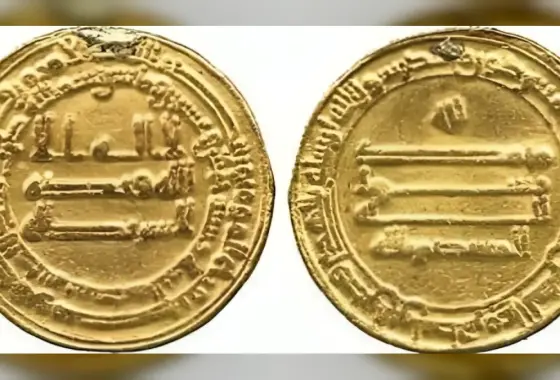
Al-Mu‘tasim was the son of Harun al-Rashid and brother of the caliph al-Ma’mun, under whom he governed Syria and Egypt. When his brother died near Tarsus during a Byzantine campaign in 833, he became caliph.
An army of Turkic soldiers
Even before becoming caliph, al-Mu‘tasim had formed a guard of Turkic soldiers (ghulams) bought or brought from Central Asia. As caliph he made this unit the core of the army, an important stage in the military and political rise of the Turks in the Islamic world.
Samarra
After clashes between the Turkic soldiers and the people of Baghdad, al-Mu‘tasim founded a new capital on the Tigris in 836: Samarra. The city was the Abbasid centre for about half a century. Its ruins and spiral minaret are now on the UNESCO World Heritage List.
Campaigns
Through his general Afshin he crushed the long-running revolt of Babak in Azerbaijan in 837. In response to the Byzantine emperor Theophilos’s raid on Zapetra (Sozopetra), he launched a great campaign into Anatolia in 838 and took Amorium, an important Byzantine city near today’s Emirdağ in Afyonkarahisar.
Death
Al-Mu‘tasim died in Samarra in 842 and was succeeded by his son al-Wathiq. The largely Turkic army he created later became a decisive force in the making and unmaking of caliphs.
Political context: the Abbasid caliphate and Turkish ghulams
Mu‘tasim’s caliphate coincided with a period in which the Abbasid state was undergoing a structural transformation. The Abbasid state was moving away from its first army structure based on Arab and Iranian soldiers in Khurasan and trying to redefine the relationship between caliph and army. The civil war between Harun al-Rashid’s sons al-Amin and al-Ma’mun had shaken army-based political balances and increased the need for loyal units the caliphs could trust. In this context, soldiers of Turkic origin brought from Central Asia were taken into army service within a system called ghulam or mamluk.
These soldiers were bound to the caliph by personal loyalty and had weak ties to the local aristocracy. They were therefore a reliable source of power for caliphs. Mu‘tasim had begun forming such a unit even in the time of his brother Ma’mun. After becoming caliph he expanded this practice systematically. However, this development was not a one-sided success story; the increase in the number of Turkish soldiers heightened tension between the people of Baghdad and the soldiers. City residents complained about the behaviour of soldiers of foreign origin. The sources describe these complaints turning at times into clashes.
The founding of Samarra and its architectural legacy
To reduce these tensions, Mu‘tasim decided in 836 to found a new capital on the banks of the Tigris. Samarra aimed to separate the army from Baghdad, where the population was dense, and create a safer living space for both soldiers and the caliph. The city was designed as a planned settlement with broad avenues, palaces and barracks. The caliph’s palace and the areas set aside for military units reflect the logic of the city’s founding. Craftsmen and architects from various regions worked on the construction.
Samarra remained the political centre of the Abbasid state for about fifty years; then the caliphs returned to Baghdad. The best-known surviving structure of the city is the Great Mosque with its spiral minaret, built in the time of al-Mutawakkil. The archaeological site of Samarra is on the UNESCO World Heritage List and provides important information about early Islamic palace architecture and urban planning. The stucco decoration style found in the city is considered an original style that also influenced later Islamic art. In this respect Mu‘tasim’s decision had lasting consequences not only politically but also for art history.
The Amorion campaign and historical assessment
Mu‘tasim’s best-known military success is the Amorion campaign of 838. After the Byzantine emperor Theophilos attacked Abbasid border regions and destroyed Zibatra, Mu‘tasim entered Anatolia with a large army. This campaign is regarded as a large-scale operation demonstrating the strength of Abbasid military organisation of the time. The armies advanced from different directions and Amorion, one of Byzantium’s important cities, was besieged. The city fell after a short siege. This event occupies a large place in both Abbasid and Byzantine sources and has become one of the symbols of the border struggle between the two states.
Mu‘tasim’s legacy is the subject of differing assessments among historians. On one hand, he increased the state’s military power by reorganising the army, ran a strong administration, and suppressed major internal problems such as the Babak revolt. On the other hand, dependence on Turkish soldiers led, in the period after him, to caliphs coming under the influence of these commanders. The Samarra period is also read as a process in which the caliphs’ political authority gradually eroded. Mu‘tasim must therefore be assessed both as a strong ruler and as a figure standing at the beginning of long-term problems. These judgments may change over time as the sources are reread.
Mu‘tasim’s character and approach to rule
The sources describe Mu‘tasim as a ruler with a strong physique, interested in military affairs and valuing practical skill more than education. In contrast to his brother Ma’mun’s identity as a patron of science and philosophy, the army and state security were in the foreground in Mu‘tasim’s court life. Even so, scholarly and literary activity continued in his time; scholars, poets and translators kept working in Baghdad and Samarra. The influence of the translation movement begun under Ma’mun was still felt in these years.
In his approach to rule, Mu‘tasim tried to strengthen central authority. He kept provincial governors under close supervision, sought to ensure order in tax collection and took a harsh stance against revolts. Although these policies seemed to stabilise the state in the short term, in the long term they increased the political weight of the army. Historians suggest considering Mu‘tasim’s personal abilities and the conditions of the period together when assessing him.
Mu‘tasim’s era and its place in Abbasid history
The era of Mu‘tasim is read as a transitional phase in Abbasid history. On one hand the state was militarily strong, as the Amorion campaign and the suppression of revolts show. On the other hand, the caliphs’ control over the army gradually declined because of the growing influence of Turkish commanders. The years in Samarra are regarded as the beginning of a process in which the caliphate’s political weight weakened while regional dynasties gained strength. Mu‘tasim is therefore, for those who want to understand Abbasid history, both a strong ruler and one of the defining figures of structural change.
Sources and further reading
- Al-Tabari, History of the Prophets and Kings.
- Türkiye Diyanet Vakfı İslâm Ansiklopedisi, “Mu‘tasım-Billâh”.
- UNESCO World Heritage, “Samarra Archaeological City”.
- al-Tabari – Tarikh al-rusul wa’l-muluk
- Türkiye Diyanet Foundation Encyclopaedia of Islam – “Mu‘tasım-Billâh” entry
- UNESCO World Heritage – “Samarra Archaeological City”
- al-Tabari – Tarikh al-rusul wa’l-muluk
- Türkiye Diyanet Foundation Encyclopaedia of Islam – “Mu‘tasım-Billâh” entry
People also ask
Who was Al-Mu‘tasim? Al-Mu‘tasim bi’llah, son of Harun al-Rashid, reigned as Abbasid caliph from 833 to 842.
When and where was Al-Mu‘tasim born? Born: c. 796, Baghdad.
Who was Al-Mu‘tasim’s father? Father: Harun al-Rashid.



Leave a comment
Your email address will not be published. Required fields are marked *