



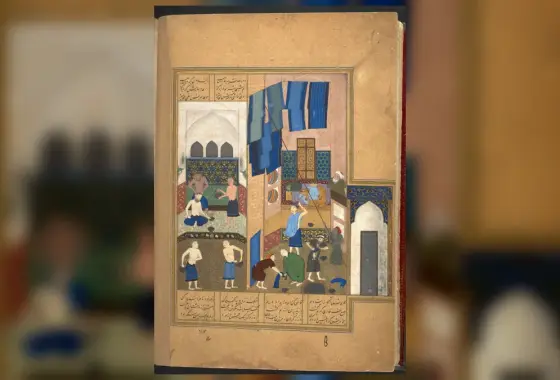
Harun al-Rashid was the son of the Abbasid caliph al-Mahdi and became caliph in 786 after the death of his brother al-Hadi. His reign of about 23 years is remembered as one of the brightest periods of the Abbasid state.
The Barmakids and government
In Harun’s early years the Persian Barmakid family held great power, especially Yahya ibn Khalid and his sons, who served as viziers and governors. In 803, for reasons that remain unclear, Harun suddenly removed the Barmakids from power, one of the most debated events of the period.
Relations with Byzantium
Harun had led campaigns against Byzantium even before becoming caliph. During his reign, campaigns into Anatolia forced Byzantium to agree to pay tribute to the Abbasids. Western sources also describe envoys and gifts exchanged between Harun and the Frankish king Charlemagne.
Science and culture
Baghdad became a meeting place for scholars, poets and merchants. The spread of paper-making strengthened book culture, and the foundations were laid for the translation and science movement that peaked under his son al-Ma’mun. In the One Thousand and One Nights, Harun became the legendary caliph who walks the streets of Baghdad in disguise; these stories are literary rather than historical.
Death and aftermath
Harun died in 809 at Tus while on a campaign to suppress a revolt in Khurasan. His plan to divide the caliphate between his sons al-Amin and al-Ma’mun soon led to civil war between the brothers.
Pilgrimages and Zubayda's water route
The sources report that Harun al-Rashid made the pilgrimage to Mecca many times during his reign, alternating a year of pilgrimage with a year of campaigning. His wife Zubayda had wells, cisterns and rest stations built along the pilgrim road from Iraq to Mecca; the route is known today as the "Darb Zubayda". The water channel that brought water to Mecca, remembered as "Ayn Zubayda", also bears her name. These works show the scale of the charitable foundations of the period.
The Raqqa years and the Byzantine frontier
Shortly after coming to the throne in 786, Harun reorganised the defensive zone on the Byzantine border and created a separate frontier province called the "Awasim". In the second half of his reign he moved his court largely to Raqqa on the Euphrates and lived there for long periods after 796. Compared with Baghdad, Raqqa was closer to the Byzantine frontier and to Syria; this choice was directly linked to Harun's policy of campaigns.
The Mecca documents of 802: the succession settlement
During his pilgrimage of 802, Harun had his sons al-Amin and al-Ma'mun swear solemn oaths in Mecca. Under this arrangement al-Amin would become caliph, while al-Ma'mun would govern Khorasan with wide powers and succeed his brother as caliph. The written texts of the agreement were hung in the Kaaba. Yet this careful settlement could not prevent the civil war that broke out between the brothers soon after Harun's death; the war ended in 813 with al-Amin's death.
Qadi Abu Yusuf and the Kitab al-Kharaj
One of the leading figures of Harun's reign was Qadi Abu Yusuf, a student of Abu Hanifa. According to the sources, he was the first person to be given the title "qadi al-qudat" (chief judge). At the caliph's request, Abu Yusuf wrote the Kitab al-Kharaj, which deals with taxation, land and public finance. The work contains advice on fair taxation and the duties of rulers, and is regarded as one of the oldest and most consulted texts in the history of Islamic public finance.
Frequently asked questions
What does “al-Rashid” mean? It is an epithet meaning “the rightly guided”.
Is the caliph of the Arabian Nights real? He is inspired by the real caliph, but the stories told about him are largely fictional.
Sources and further reading
- Türkiye Diyanet Vakfı İslâm Ansiklopedisi, “Hârûnürreşîd” and “Abbâsîler”.
- Hugh Kennedy, When Baghdad Ruled the Muslim World.
- Encyclopaedia Britannica, “Harun al-Rashid”.
- Hugh Kennedy – The Court of the Caliphs: The Rise and Fall of Islam's Greatest Dynasty (Weidenfeld & Nicolson, 2004)
- TDV Encyclopedia of Islam – "Hârûnürreşîd" and "Ebû Yûsuf" entries
- Abu Yusuf – Kitab al-Kharaj
People also ask
Who was Harun al-Rashid? Harun al-Rashid was the fifth Abbasid caliph, reigning from 786 to 809.
When and where was Harun al-Rashid born? Born: c. 763, Rayy.
When did Harun al-Rashid reign? Reign: 786 – 809.
When did Harun al-Rashid die? Died: 809, Tus (Khurasan).





Leave a comment
Your email address will not be published. Required fields are marked *