



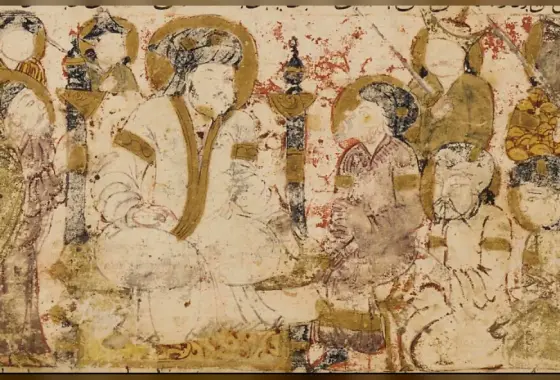
The Abbasids were a family tracing their descent to al-Abbas ibn Abd al-Muttalib, the Prophet’s uncle. For many years they ran a secret propaganda movement (da‘wa) against Umayyad rule. The revolt that began in Khurasan in 747 under Abu Muslim brought the Abbasids to power.
Proclamation of the caliphate
After Abbasid armies reached Iraq, Abu al-Abbas received the oath of allegiance as caliph in the mosque of Kufa in November 749. In January 750 the army of the last Umayyad caliph, Marwan II, was defeated on the Great Zab, a tributary of the Tigris. Marwan fled to Egypt, where he was killed.
The fate of the Umayyad family
In the first months of Abbasid rule many members of the Umayyad family were killed. One survivor, Abd al-Rahman ibn Mu‘awiya, escaped to al-Andalus, where in 756 he founded an independent Umayyad state. The meaning of the caliph’s epithet “al-Saffah” is debated; some scholars argue it means “the generous”, others “the shedder of blood”.
Death
In his short reign al-Saffah worked to establish the government and put down various revolts. He died of smallpox in 754 at al-Anbar on the Euphrates and was succeeded by his brother Abu Ja‘far al-Mansur, the founder of Baghdad.
The fate of Abu Salama al-Khallal
Abu Salama al-Khallal, the head of the Abbasid mission in Kufa, was known by the title "vizier of the family of Muhammad". However, after the Abbasid army entered Kufa he delayed the proclamation of Abu'l-Abbas as caliph for some time; according to the sources, he had considered giving the caliphate to a descendant of Ali. This suspicion brought about his end. In 750 he was killed by men sent by Abu Muslim. The episode shows that the new regime acted harshly against rivals within its own ranks from its very first months.
The uncles and the family's commanders
Al-Saffah governed the new state largely through members of his family. His uncle Abdallah ibn Ali commanded the Abbasid army at the Battle of the Great Zab and then took over the government of Syria. His other uncle Dawud ibn Ali was assigned to the Hijaz, and his brother Abu Ja'far to the regions of al-Jazira and Armenia. This arrangement soon caused problems as well: after al-Saffah's death Abdallah ibn Ali rebelled against al-Mansur as a claimant to the caliphate and in 754 was defeated near Nusaybin by the army under Abu Muslim's command.
The seat of government: al-Hashimiyya
Al-Saffah did not make Damascus, the Umayyad capital, his centre. He first established seats of government near Kufa and then at Anbar on the Euphrates, naming them "al-Hashimiyya" after Hashim, the ancestor of the family. This choice shows that the centre of gravity of the caliphate was shifting from Syria to Iraq and the east. The Khurasani soldiers who carried the Abbasid state and the rich farmland of Iraq were close to this new centre. The direction that al-Saffah began became permanent when his brother al-Mansur founded Baghdad in 762.
Talas on the eastern frontier
One of the most important foreign events that fell within al-Saffah's short reign was the Battle of Talas in Central Asia in the summer of 751. Abbasid forces under Ziyad ibn Salih, with the support of the Karluks, defeated the army of Gao Xianzhi, the commander of Tang China. The battle is associated with the halt of the Tang dynasty's advance in Central Asia. It is also regarded as an important turning point for the strengthening of Muslim influence in the region and for the Turkic tribes' encounter with Islam in the following centuries.
Khalid ibn Barmak and the new administrative cadre
The Abbasids largely preserved the diwan system inherited from the Umayyads, but added new figures of Khurasani and Iranian origin to the administration. The best known of them is Khalid ibn Barmak, a member of a family descended from the administrators of the Buddhist Nawbahar temple in Balkh. Under al-Saffah he served in the diwans responsible for financial affairs. His descendants, the Barmakids, became the most powerful vizier family of the state under later caliphs, especially in the time of Harun al-Rashid.
Sources and further reading
- Al-Tabari, History of the Prophets and Kings.
- Türkiye Diyanet Vakfı İslâm Ansiklopedisi, “Ebü’l-Abbas es-Seffâh” and “Abbâsîler”.
- Encyclopaedia Britannica, “al-Saffāḥ”.
- Hugh Kennedy, The Early Abbasid Caliphate: A Political History, 1981
- Turkish Religious Foundation Encyclopedia of Islam (TDV), "Ebû Seleme el-Hallâl" and "Talas Savaşı" entries
- Turkish Religious Foundation Encyclopedia of Islam (TDV), "Bermekîler" entry
People also ask
Who was Abu al-Abbas al-Saffah? Abu al-Abbas al-Saffah was the first Abbasid caliph, who overthrew the Umayyad Caliphate and founded the Abbasid Caliphate.
When did Abu al-Abbas al-Saffah die? Died: June 754, al-Anbar.
Which victory founded Abu al-Abbas al-Saffah’s rule? Founding victory: Battle of the Great Zab, January 750.


Leave a comment
Your email address will not be published. Required fields are marked *