



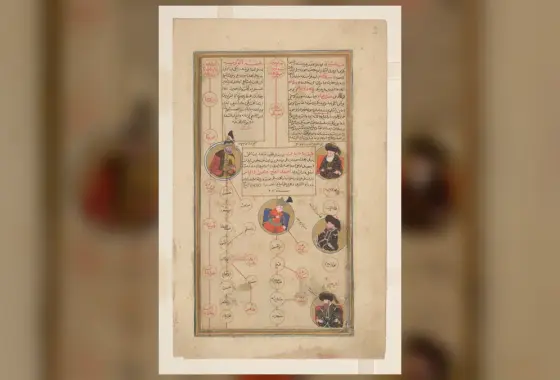
Abu Ja‘far Abdallah al-Mansur was the brother of the first Abbasid caliph, al-Saffah, and succeeded him in 754. Early in his reign he suppressed the revolt of his uncle Abdallah ibn Ali.
Concentrating power
Abu Muslim, leader of the Abbasid revolution, held great power in Khurasan. Al-Mansur saw him as a dangerous rival and had him killed in 755. He then crushed the 762 revolt of descendants of Ali, strengthening the authority of the caliphate.
The founding of Baghdad
For a new capital al-Mansur chose a site on the Tigris where trade routes met. Building began in 762 on a city named Madinat al-Salam (City of Peace), famous for its walled round plan with the palace and mosque at its centre. Baghdad soon became one of the largest cities in the world.
Government and death
Known for his frugality, al-Mansur strengthened the treasury and developed the vizierate, the postal service (barid) and the state offices. He died in 775 near Mecca on his way to the pilgrimage and was succeeded by his son al-Mahdi.
The plan of the Round City
According to the sources, al-Mansur had the astrologers of the day choose an auspicious date for laying the foundations of Baghdad; construction began in the summer of 762. The city's double ring of walls had four gates: the Kufa, Basra, Khurasan and Syria gates. Each gate marked the start of the road to the region it was named after. At the centre stood the caliph's palace with the Friday mosque beside it; the green dome (al-Qubba al-Khadra) above the palace was a landmark visible from afar. As the city grew rapidly, the markets moved outside the walls to the district of Karkh.
His relations with scholars
Al-Mansur's reign was a time when the relationship between religious scholars and the government took shape. According to a widely reported tradition, Abu Hanifa, founder of the Hanafi school, refused the post of judge offered by the caliph and died in prison in Baghdad in 767. Similarly, it is related that Imam Malik declined a proposal to make his work "al-Muwatta" the single source of law throughout the realm. These traditions show the importance early scholars placed on preserving their independence from political authority.
The first steps of the translation movement and al-Andalus
The first steps of the translation movement, which would later peak in Baghdad with the House of Wisdom, were taken under al-Mansur. At his court, the Indian astronomical work known as the "Sindhind" was rendered into Arabic and became one of the foundations of astronomical calculation in the Islamic world. Meanwhile Abd al-Rahman, a survivor of the Umayyad family, founded an independent emirate at Córdoba in 756, and al-Andalus remained outside Abbasid rule. According to tradition, al-Mansur nonetheless spoke of his rival Abd al-Rahman with praise as "the falcon of Quraysh".
The question of succession and new cities
Before he died, al-Saffah had named his nephew Isa ibn Musa as heir after his brother al-Mansur. Al-Mansur, however, wanted to leave power to his own son, and around 764 he persuaded Isa to accept coming after his son Muhammad al-Mahdi. This decision strengthened the pattern of the caliphate passing from father to son. Al-Mansur also had other cities built besides Baghdad: in 772 construction began on the city of al-Rafiqa on the Euphrates near Raqqa; part of its walls still stands today. For his son al-Mahdi the district of Rusafa was founded on the eastern bank of the Tigris, and Baghdad became a city spread across both banks.
His thrift and the treasury he left
The sources describe al-Mansur as an extremely careful ruler with money; for this reason, it is related, he was given the nickname "Abu'l-Dawaniq" (father of small coins). He is said to have left a full treasury at his death, which made possible the generous reign of his son al-Mahdi.
Frequently asked questions
Does the round city of Baghdad still exist? No; no remains of it survive, and our knowledge comes from written sources.
Sources and further reading
- Türkiye Diyanet Vakfı İslâm Ansiklopedisi, “Mansûr” and “Bağdat”.
- Hugh Kennedy, When Baghdad Ruled the Muslim World.
- Encyclopaedia Britannica, “al-Mansur”.
- Jacob Lassner – The Topography of Baghdad in the Early Middle Ages (Wayne State University Press, 1970)
- Dimitri Gutas – Greek Thought, Arabic Culture (Routledge, 1998)
People also ask
Who was Al-Mansur? Al-Mansur was the second Abbasid caliph, reigning from 754 to 775.
When did Al-Mansur reign? Reign: 754 – 775.
When did Al-Mansur die? Died: 775, near Mecca on pilgrimage.




Leave a comment
Your email address will not be published. Required fields are marked *