



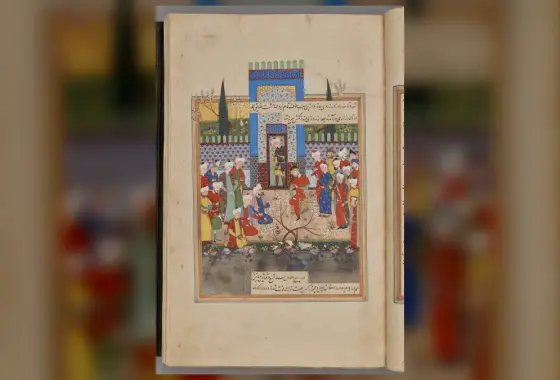
Al-Mutawakkil was the son of the caliph al-Mu‘tasim. After the death of his brother al-Wathiq in 847, he was chosen caliph with the backing of Turkic commanders and officials at court.
The end of the Mihna
The Mihna, begun under the caliph al-Ma’mun, sought to force officials and scholars to accept the Mu‘tazili doctrine that the Qur’an was created; scholars such as Ahmad ibn Hanbal were persecuted for refusing. Al-Mutawakkil ended the policy and supported the traditionalist scholars of hadith. Restrictive measures against non-Muslims were also introduced in this period.
Buildings at Samarra
Between 848 and 852 al-Mutawakkil built the Great Mosque of Samarra. Its spiral Malwiya minaret is one of the best-known structures of Islamic architecture and is part of a UNESCO World Heritage site. He also founded a new city north of Samarra named after him, al-Ja‘fariyya (al-Mutawakkiliyya).
Death
Al-Mutawakkil tried to curb the power of the Turkic commanders. In December 861 he was killed in his palace by Turkic guard commanders acting with his son al-Muntasir. In the following decade or so several caliphs were raised and deposed in quick succession, a period known as the “Anarchy at Samarra”.
The succession arrangement and the root of the conflict
In 849–850 al-Mutawakkil made an arrangement that placed the succession among three of his sons in order: first al-Muntasir, then al-Mu'tazz, then al-Mu'ayyad would take the throne. The provinces of the state were also divided among these sons. Over time, however, the caliph began to favour al-Mu'tazz and openly belittled his eldest son al-Muntasir. Historians think that this tension, combined with the power struggle between the Turkish commanders and the caliph, laid the ground for the assassination of 861.
Ja'fariyya and the Mosque of Abu Dulaf
Al-Mutawakkil also had a large mosque built in Ja'fariyya, the city he founded north of Samarra. This building, known today as the Mosque of Abu Dulaf, was built in 859–861 and, like the Great Mosque, has a spiral minaret; its dimensions, however, are smaller. The caliph tried to supply Ja'fariyya with water through a canal from the Tigris, but the canal never worked properly. After his death the city was soon abandoned and the administration moved back to the old centre of Samarra.
The Nilometer on Roda Island in Cairo
Another surviving structure from al-Mutawakkil's reign is the Nilometer on Roda Island in Cairo. Renewed by his order in 861, this measuring well was used to measure the annual flood level of the Nile. Because the height of the flood determined the harvest and therefore the tax to be collected, the Nilometer was of great importance for the administration of Egypt. Some sources attribute the design of the structure to the astronomer Ahmad ibn Muhammad al-Farghani. The well with its stone stairs and the measuring column in its centre can still be visited today.
Relations with Byzantium
Border wars with Byzantium continued during al-Mutawakkil's reign. In 853 a Byzantine fleet plundered Damietta on the Egyptian coast in a sudden raid; after this event the caliph ordered the city's walls to be strengthened. Alongside the wars there were also peaceful contacts: in 856 and 860 prisoner exchanges took place between the two sides on the banks of the Lamos (today's Limonlu) River in Cilicia. These exchanges show that war and diplomacy went hand in hand on the Abbasid–Byzantine frontier.
Cultural life at court
Despite political turmoil, al-Mutawakkil's court was the scene of a lively cultural life. Al-Buhturi and Ali ibn al-Jahm, among the leading Arab poets of the age, wrote poems in praise of the caliph; al-Buhturi's poems describing the palaces of Samarra still provide important information about these buildings today. The renowned translator and physician Hunayn ibn Ishaq, who rendered Greek works of medicine and philosophy into Arabic, also served as a court physician in this period. This translation activity shows that the accumulated learning that began under al-Ma'mun was continuing.
Sources and further reading
- Al-Tabari, History of the Prophets and Kings.
- Türkiye Diyanet Vakfı İslâm Ansiklopedisi, “Mütevekkil-Alallah” and “Mihne”.
- UNESCO World Heritage, “Samarra Archaeological City”.
- Hugh Kennedy, The Prophet and the Age of the Caliphates, 3rd edition, 2016
- Turkish Religious Foundation Encyclopedia of Islam (TDV), "Mikyas" entry
- Turkish Religious Foundation Encyclopedia of Islam (TDV), "Buhtürî" and "Huneyn b. İshak" entries
People also ask
Who was Al-Mutawakkil? Al-Mutawakkil ala Allah was Abbasid caliph from 847 to 861.
When and where was Al-Mutawakkil born? Born: 822, Baghdad.
When did Al-Mutawakkil die? Died: December 861, Samarra.
Who was Al-Mutawakkil’s father? Father: al-Mu‘tasim.



Leave a comment
Your email address will not be published. Required fields are marked *