



This article is part 4 of the series “How Did the Turks Shape World History?”.
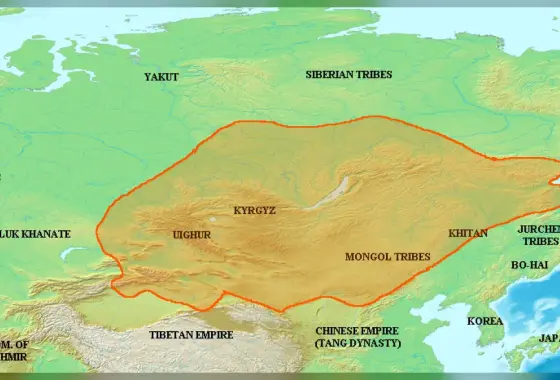
The Uyghurs ruled the Mongolian steppe after the Göktürks and offer the brightest example in Turkic history of the transition from nomadic life to settled urban culture. They shaped China’s destiny with their military power, but their most lasting mark was left in writing, books and art. The traditional Mongolian script still used in Mongolia today descends from the Uyghur alphabet.
The Uyghur Khaganate (744–840)
Between 742 and 744 the Uyghurs, together with the Basmyl and Karluk tribes, brought down the Second Göktürk Khaganate. Qutlugh Bilge Kül Khagan proclaimed his khaganate in 744. In the Orkhon valley the Uyghurs built a great walled capital, Ordu-Baliq (Karabalgasun), with palaces and markets. The Arab traveller Tamim ibn Bahr visited the city in the early 9th century and described its crowded bazaars. Possessing such a large urban centre set the Uyghurs apart from earlier steppe empires.
The ally who saved Tang China
When the An Lushan rebellion broke out against the Tang dynasty in 755, China’s two great capitals, Chang’an and Luoyang, fell to the rebels. The Tang court asked the Uyghurs for help, and in 757 Uyghur cavalry played a decisive role in recapturing both capitals. In return the Tang sent the Uyghurs great quantities of silk every year and granted them privileges in the horse-for-silk trade. Historians stress the part Uyghur help played in keeping the Tang dynasty alive for another century and a half.
Manichaeism: choosing a state religion
Travelling to China in 762–763, Bögü Khagan met Manichaean priests in Luoyang, embraced their faith and made it the official religion of the Uyghur Khaganate. Manichaeism, founded in 3rd-century Iran by Mani and centred on the struggle between light and darkness, had been harshly persecuted in Rome and Iran. The Uyghurs are the only major state in history to adopt Manichaeism as a state religion. The choice also reflected their close ties with Sogdian merchants and played an important role in the growth of book culture. The trilingual Karabalgasun inscription at Ordu-Baliq — in Old Turkic runes, Sogdian and Chinese — records the political and religious history of this period.
840: migration and a new life in Turfan
In 840 an attack by the Kyrgyz destroyed Ordu-Baliq and the khaganate collapsed. Some Uyghurs migrated southwest and founded a kingdom in the Turfan region centred on Qocho (Gaochang) and Beshbaliq; others settled in Gansu. The Turfan Uyghurs became a settled society living from oasis farming, irrigation and trade. In this kingdom Manichaeans, Buddhists and Nestorian Christians lived side by side, and monasteries, libraries and translation workshops flourished.
Turfan saw the golden age of Uyghur literature. Many works were translated into Uyghur from Sanskrit, Tocharian and Chinese; the Buddhist sutra Altun Yaruk (Golden Light) is the best known. The colourful frescoes of the Bezeklik caves show Uyghur princes and princesses in the dress of their time. In the early 20th century German, Russian, British and Japanese expeditions removed thousands of manuscripts and fragments of painting from the region; they are now kept in museums, above all in Berlin. Wooden movable type used for Uyghur script, found at Dunhuang, is among the remarkable finds in the history of printing.
An alphabet that spread across Asia
The Uyghurs used an alphabet developed from Sogdian script and written from top to bottom. Their greatest contribution to world history is the spread of this writing. When Genghis Khan defeated the Naimans in 1204, he took into his service Tatatunga, the Uyghur scribe who had kept the Naiman ruler’s seal, and Mongolian began to be written in this alphabet. In 1209 the Idiqut, ruler of the Turfan Uyghurs, voluntarily submitted to Genghis Khan; Uyghur scribes, financiers and teachers went on to hold important posts in the bureaucracy of the Mongol Empire.
In the 17th century the Uyghur-derived Mongolian script became the basis of the Manchus’ own alphabet. A script used on the steppes of Ötüken thus became one of the official scripts of the Qing, the last dynasty to rule China. Traditional Mongolian script is being revived in Mongolia today and is used in China’s Inner Mongolia region.
Conversion to Islam
The Turfan Uyghurs remained Buddhist for a long time; in the 14th and 15th centuries the region gradually became Muslim. The Kara-Khanids centred on Kashgar had converted earlier, and over time the Turkic peoples of the region merged into a shared identity known as “Uyghur”. Today Uyghurs live mainly in China’s Xinjiang (East Turkestan) region and in the countries of Central Asia.
Frequently asked questions
Were the Uyghurs the first settled Turks?
The Uyghurs were not the first Turkic people to build towns, but with their great capital, their transformation in Turfan into a fully settled farming and urban society and their rich written culture, they are regarded as the brightest early example of settled life in Turkic history.
Does today’s Mongolian script come from Uyghur?
Yes. The traditional (vertical) Mongolian script was adapted from the Uyghur alphabet at the beginning of the 13th century. Mongolia switched to the Cyrillic alphabet in the 20th century, but efforts to revive the traditional script continue.
Sources and further reading
- Türkiye Diyanet Vakfı İslâm Ansiklopedisi and Turkish historical literature, “Uygurlar”.
- Colin Mackerras, The Uighur Empire According to the T’ang Dynastic Histories (1972).
- Annemarie von Gabain, Das Leben im uigurischen Königreich von Qočo.
- Encyclopaedia Britannica, “Uyghur”, “Mongolian alphabet”.
People also ask
What was the Uyghur Khaganate? The Uyghur Khaganate was founded in 744 in the Ötüken region of Mongolia after the destruction of the Second Göktürk Khaganate.
When was the Uyghur Khaganate founded? Founded: 744, Qutlugh Bilge Kül Qaghan.
What was the Uyghur Khaganate’s capital? Capital: Ordu-Baliq (Karabalgasun, Orkhon Valley).
When did the Uyghur Khaganate end? End: 840, Kyrgyz attack.





Leave a comment
Your email address will not be published. Required fields are marked *