



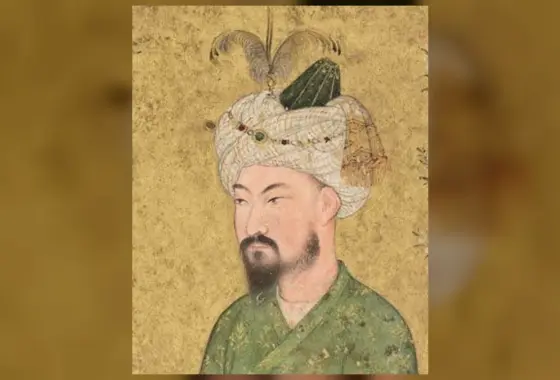
Babur was the son of Umar Shaikh Mirza, ruler of Fergana. When his father died in 1494 he came to the throne at eleven. In his youth he captured Samarkand several times but could not hold it against the Uzbek ruler Shaybani Khan.
Kabul
In 1504 he took Kabul and made it his new base, then began campaigning into India. During this period he added firearms and artillery to his army.
Panipat and India
On 21 April 1526 at Panipat, north of Delhi, he defeated the far larger army of the Delhi sultan Ibrahim Lodi. His battle formation of carts chained together, with cannon and musketeers behind them, is described in the sources as the “Rumi” (Ottoman) method. In 1527 he defeated the Rajput ruler Rana Sanga at Khanwa, securing his hold on northern India.
The Baburnama
Babur described his life, his campaigns and the plants and animals of the places he saw in the Baburnama, written in Chagatai Turkic. He also wrote poetry.
Death
Babur died in Agra on 26 December 1530. In accordance with his wishes he was later buried in his garden in Kabul (Bagh-e Babur). He was succeeded by his son Humayun; the empire lasted until 1857.
The journey of the Baburnama
Babur's memoir, written in Chagatai Turkish, was translated into Persian in 1589, in the reign of his grandson Akbar, by Abdul Rahim Khan-i Khanan. Illustrated copies of this translation were prepared in Akbar's workshop, and dispersed pages of these miniatures are found today in the great museums of the world. The work became known in Europe in the 19th century: the French translation by Pavet de Courteille was published in 1871 and the English translation by Annette Beveridge in 1922; Wheeler Thackston's 1996 translation is the most widely used English text today. The Baburnama is regarded as one of the most detailed and most candid memoirs written by a ruler's own hand in the Islamic world.
A passion for gardens
Babur is remembered as the ruler who brought the four-part Persian garden layout, the "charbagh", to India. In the Baburnama he complains about India's heat, dust and lack of running water; in Agra, on the banks of the Yamuna, he had gardens laid out with wells and water channels. His garden in Kabul is known today as "Bagh-e Babur", and Babur's grave is also there. The garden was restored and reopened to the public after an extensive project carried out by the Aga Khan Trust for Culture between 2002 and 2008.
The story of Humayun's illness
The best-known account of Babur's death appears in the Humayun-nama of his daughter Gulbadan Begum. According to the story, when his son Humayun fell gravely ill, Babur walked around his bed and prayed to God to transfer his son's illness to himself; Humayun recovered, while Babur fell ill and died a few months later. Historians regard this story less as an actual event than as a narrative of a father's love. Although Babur's reign in India lasted only four years, the dynasty he founded ruled in India for three centuries.
Cannon and muskets in his army
Learning from his defeats in Central Asia, Babur added firearms to his army. In the Baburnama he mentions his gunnery masters Ustad Ali Quli and Mustafa Rumi and describes the use of cannon at Panipat and Khanwa. Because firearms had not been widespread in warfare in India until then, they gave both a military and a psychological advantage. Opposing armies that used elephants lost their order as the animals panicked at the sound of the guns.
Frequently asked questions
Why “Mughal”? The word comes from the Persian and Indian form of “Mongol”; the dynasty itself identified as Timurid.
Sources and further reading
- Babur, Baburnama.
- Türkiye Diyanet Vakfı İslâm Ansiklopedisi, “Bâbür”.
- Encyclopaedia Britannica, “Babur”.
- The Baburnama: Memoirs of Babur, Prince and Emperor (trans. Wheeler M. Thackston, Oxford University Press, 1996)
- Stephen F. Dale – The Garden of the Eight Paradises: Bābur and the Culture of Empire in Central Asia, Afghanistan and India (Brill, 2004)
- Aga Khan Trust for Culture – "Bagh-e Babur" restoration project
People also ask
Who was Babur? Zahir al-Din Muhammad Babur descended from Timur on his father’s side and from Genghis Khan on his mother’s.
When and where was Babur born? Born: 14 February 1483, Andijan (Fergana).
Which victory founded Babur’s rule? Founding victory: First Battle of Panipat, 21 April 1526.
What is Babur’s famous work? Work: Baburnama (Chagatai Turkic).



Leave a comment
Your email address will not be published. Required fields are marked *