



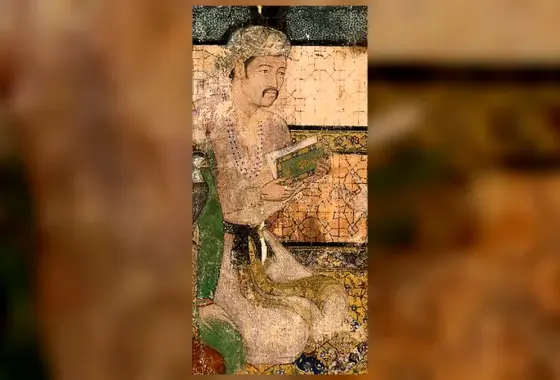
Akbar was the son of the Mughal ruler Humayun, born during his father’s years in exile. On Humayun’s sudden death in 1556 he came to the throne at thirteen. His guardian Bayram Khan defeated Hemu’s army at the Second Battle of Panipat that year, regaining Delhi for the Mughals.
Conquests
After taking power into his own hands, Akbar conquered Malwa, Rajputana, Gujarat, Bengal, Kashmir and the northern Deccan. Through marriages and alliances with Rajput rulers he made them a central part of the state.
Government
He created the mansabdari system ranking military and civil officials and reformed taxation. In 1564 he abolished the jizya tax on non-Muslims. Guided by sulh-i kul (“peace with all”), he invited scholars of different religions to debates at his court, and around 1582 introduced a teaching called “Din-i Ilahi”, which remained limited to his inner circle.
Culture and architecture
Near Agra he built a new capital, Fatehpur Sikri (now a UNESCO World Heritage site). Miniature painting flourished at his court, and the historian Abu’l-Fazl chronicled his reign in the Akbarnama.
Death
Akbar died in Agra in 1605 and was buried in his tomb at Sikandra. He was succeeded by his son Jahangir.
The House of Worship, translations and court culture
In 1575 Akbar had a debating hall called the "Ibadat Khana" (House of Worship) built at Fatehpur Sikri. Here first Muslim scholars, then Hindu, Jain and Zoroastrian scholars, and from 1580 Jesuit priests who came from Goa, debated religious and philosophical questions in the emperor's presence.
- The translation bureau: With Akbar's support, great Sanskrit works were translated into Persian. The Persian translation of the Mahabharata was given the name Razmnama ("Book of War") and illustrated with miniatures; the Ramayana was also translated.
- Reading and writing: According to the sources Akbar could not read or write; even so, he built up a large library and acquired a broad culture by having books read aloud to him.
- Masters of the court: The musician Tansen and the finance expert Todar Mal, together with the historian Abu'l-Fazl, are among the best-known figures of the court.
The tax system: Todar Mal's survey
One of the lasting innovations of Akbar's reign was the land-tax system set up under the leadership of his finance minister Todar Mal. Farmland was measured with standard units, the average yield and prices over ten years were calculated for each crop, and the tax was fixed in cash according to this average. This system, extended in 1580, aimed to make the relationship between peasant and state more predictable.
Together with the mansabdari system, this tax system formed the basis of the Mughal state's power in the following century. Historians regard Akbar's approach to government as a turning point in Mughal history because of both his military conquests and these institutional arrangements.
Ain-i Akbari: the inventory of an empire
We owe our detailed knowledge of Akbar's reign largely to his minister and historian Abu'l-Fazl. The Ain-i Akbari, the final volume of Abu'l-Fazl's Akbarnama, was completed in the late 1590s and is less a history book than a comprehensive survey of the state.
The work lists the provinces (subas) one by one, recording each region's revenues, crops, units of measure and weight, and the court's workshops, stables and expenses. It also contains long sections on Hindu philosophy, sciences and customs; in this respect it is seen as a reflection of Akbar's wish to understand different faiths.
A book lover who could not read
The sources report that Akbar never learned to read and write, yet had books read aloud to him every day. At his court Sanskrit works were translated into Persian; the Persian translation of the Mahabharata was prepared with miniatures under the title "Razmnama". Abu'l-Fazl, for his part, was ambushed and killed in 1602 at the instigation of Prince Salim (the later Jahangir), an event that deeply shook Akbar.
Sources and further reading
- Abu’l-Fazl, Akbarnama.
- Türkiye Diyanet Vakfı İslâm Ansiklopedisi, “Ekber Şah”.
- Encyclopaedia Britannica, “Akbar”.
- Abu'l-Fazl – Ain-i Akbari
- John F. Richards – The Mughal Empire (Cambridge University Press, 1993)
- Irfan Habib – The Agrarian System of Mughal India (1963)
- Abu'l-Fazl – Ain-i Akbari (trans. H. Blochmann and H. S. Jarrett, Asiatic Society of Bengal, 1873–1894)
- John F. Richards – The Mughal Empire (Cambridge University Press, 1993)
People also ask
Who was Akbar the Great? Jalal al-Din Muhammad Akbar ruled the Mughal Empire from 1556 to 1605.
When and where was Akbar the Great born? Born: 15 October 1542, Umerkot.
When did Akbar the Great reign? Reign: 1556 – 1605.
When did Akbar the Great die? Died: 27 October 1605, Agra.



Leave a comment
Your email address will not be published. Required fields are marked *