



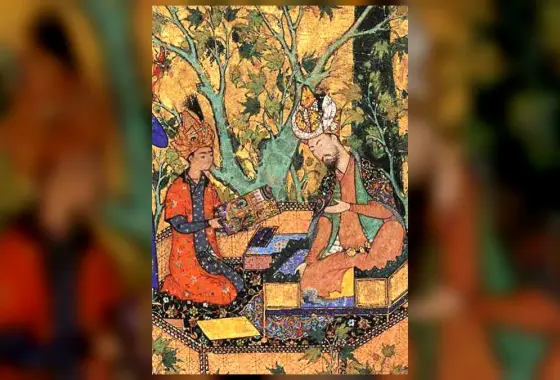
Humayun was the eldest son of Babur, founder of the Mughal Empire, and came to the throne on his father’s death in 1530. His early years were difficult because of his brothers’ claims to the throne and resistance from the Gujarat Sultanate and Afghan chiefs.
Sher Shah and exile
The Afghan ruler Sher Shah Suri, who had grown strong in Bihar and Bengal, defeated Humayun at Chausa in 1539 and at Kannauj in 1540. Having lost India, Humayun took refuge, after hard years in which his son Akbar was born in 1542, at the court of the Safavid shah Tahmasp in Iran.
Return
With Safavid support he took Kandahar and Kabul. When the Suri dynasty weakened after Sher Shah’s death, he entered India in 1555 and recaptured Lahore and Delhi. His years in Iran increased the influence of Persian art and miniature painting at the Mughal court.
Death and tomb
Humayun died in Delhi in January 1556 after falling down the stairs of his library, and was succeeded by his thirteen-year-old son Akbar. Humayun’s Tomb, built by his widow Bega Begum, is the first great example of the garden-tomb tradition that later inspired the Taj Mahal.
The brothers and the road to exile
After the death of Babur, the empire was not united in a single hand. Humayun's brothers Kamran, Askari and Hindal Mirza governed different regions and at times acted against him. Kamran Mirza in particular, who controlled Kabul and the Punjab, did not give his elder brother the support he needed against Sher Shah.
After the defeat of 1540, Humayun set out with a small retinue on a long and difficult journey across the deserts of Sindh. His son Akbar was born at Umarkot in 1542 during this journey. After Humayun recovered Kabul, the struggle between him and Kamran lasted for years; Kamran, finally captured, was blinded on Humayun's orders in 1553.
Artists from Iran
- The Safavid court: At the court of Shah Tahmasp, Humayun came to know the finest examples of Persian miniature painting.
- Painters: The Iranian painters Mir Sayyid Ali and Abd al-Samad entered his service and later came to India.
- The Mughal painting workshop: The artists trained by these masters carried out great illustrated book projects such as the Hamzanama under Akbar.
The return, the library and the tomb
In 1555 Humayun defeated the Suri ruler Sikandar Shah near Sirhind and opened the road to Delhi. Known for his love of astronomy and books, he died after falling down the stairs of the Sher Mandal, a building inside the Purana Qila in Delhi that he used as a library. His tomb was designed by the Persian architect Mirak Mirza Ghiyas and was added to the UNESCO World Heritage List in 1993.
The Gujarat campaign and the fortress of Champaner
In 1535 Humayun campaigned against Bahadur Shah, the sultan of Gujarat, and defeated him. The most famous episode of this campaign is the capture of the fortress of Champaner, on steep cliffs, by climbing its walls with iron spikes driven into the rock. This success did not last, however: while Humayun lingered in Gujarat, Sher Shah grew stronger in the east, and Gujarat too was soon lost.
Gulbadan Begum's Humayun-nama
One of the sources that describes Humayun's life most closely is the Humayun-nama, written by his sister Gulbadan Begum at Akbar's request. The work describes the years of exile, family relationships and daily life through the eyes of the women of the court. It is one of the rare memoirs written by a woman of the Mughal period; its only known manuscript is preserved today in the British Library.
What does the name "Humayun" mean?
The Persian word "humayun" means "blessed, fortunate, royal". The word also lived on in Ottoman Turkish in state terms such as "Hatt-ı Hümayun" and "Divan-ı Hümayun". Compared with the misfortunes of his life, the ruler's name is often mentioned by historians as an ironic detail.
Sources and further reading
- Gulbadan Begum, Humayun-nama.
- UNESCO World Heritage, “Humayun’s Tomb, Delhi”.
- Encyclopaedia Britannica, “Humāyūn”.
- UNESCO World Heritage – "Humayun's Tomb, Delhi" (1993)
- Annemarie Schimmel – The Empire of the Great Mughals: History, Art and Culture (Reaktion Books, 2004)
- British Library – Gulbadan Begum, Humāyūn-nāma (Or. 166)
People also ask
Who was Humayun? Humayun, son of Babur, was the second Mughal emperor.
When and where was Humayun born? Born: 6 March 1508, Kabul.
When did Humayun reign? Reign: 1530 – 1540, 1555 – 1556.
When did Humayun die? Died: January 1556, Delhi.



Leave a comment
Your email address will not be published. Required fields are marked *