



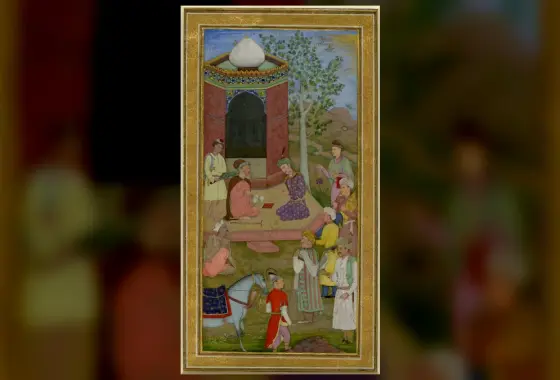
The Mughal Empire was a dynasty that ruled most of the Indian subcontinent from the 16th to the 19th century and became one of the richest and most populous states in the world. Its founder, Zahir al-Din Muhammad Babur, was a ruler of Turco-Mongol origin, descended from Timur on his father's side and from Genghis Khan on his mother's.
From Fergana to Panipat
Babur was born in 1483 in the Fergana Valley in today's Uzbekistan and came to the throne at just twelve. His youth was spent winning and losing Samarkand, in exile and in rebuilding his fortunes. After settling in Kabul he turned his eyes to India, and at the Battle of Panipat in 1526 he defeated a much larger army through skilful use of field artillery and mobile cavalry. In doing so he laid the foundations of an empire that would last more than three centuries.
The Baburnama: a ruler's candid memoir
Perhaps Babur's most lasting legacy is not his sword but his pen. The Baburnama, written in his native Chagatai Turkic, is considered one of the most candid autobiographies ever written by a ruler. Babur writes openly about his mistakes, longings and feelings as well as his victories. His description of India's plants, animals and climate with a naturalist's precision makes the work all the more valuable. Babur was also a poet and a passionate lover of gardens.
A golden age of art and tolerance
- Akbar: Babur's grandson Akbar is remembered as one of the empire's greatest rulers for his tolerance of different faiths, the debating assemblies he held with religious scholars and his strong system of government.
- Architecture: Humayun's Tomb in Delhi, the Agra Fort and Fatehpur Sikri are examples of a unique style blending Turkic, Persian and Indian traditions.
- The Taj Mahal: The white marble mausoleum built in Agra by Shah Jahan in memory of his wife Mumtaz Mahal was inscribed on the UNESCO World Heritage List in 1983 and chosen as one of the "New Seven Wonders of the World" in 2007.
- Miniatures and crafts: Miniature paintings, carpets and jewellery made in the imperial workshops are treasured by museums around the world.
The end of a long legacy
The empire weakened from the 18th century and came to an end in 1857, when the last Mughal emperor was deposed by the British. Yet the Mughal legacy lives on today in the architecture, cuisine, music and languages of India, Pakistan and Bangladesh.
Akbar's rule: the mansabdari system and Fatehpur Sikri
Babur's grandson Akbar (reigned 1556–1605) turned the empire into a lasting state with a strong central administration. Akbar developed the "mansab" system, which tied military and civil officials to numerical ranks: each official's rank determined the number of soldiers he had to maintain and his salary.
- Jizya: In 1564 Akbar abolished the jizya tax levied on the non-Muslim population; this step helped win the support of the large Hindu population.
- Fatehpur Sikri: This city, built as a new capital in the 1570s, was abandoned soon afterwards; today it is on the UNESCO World Heritage List.
- Debating assemblies: Akbar organised debates that brought together scholars of different religions.
How was the Taj Mahal built?
The Taj Mahal is the mausoleum that Shah Jahan had built on the banks of the Yamuna River in Agra for his wife Mumtaz Mahal, who died in 1631. According to UNESCO, construction lasted from about 1631 to 1648, and thousands of masters, workers and craftsmen were employed. White marble was used in the building, and its surfaces were decorated with inlay work made with precious stones.
The Taj Mahal is regarded as the most mature example of the blending of Indian, Persian and Central Asian architectural traditions, and it was added to the UNESCO World Heritage List in 1983. Today air pollution yellowing the white marble is a major conservation problem; this is why special measures to reduce pollution are applied around the building.
Frequently asked questions
Why is the dynasty called "Mughal"?
In Western languages the dynasty is known as "Mughal", a reference to Mongol ancestry. But its founder was a Timurid Turkic ruler, and Babur saw himself first and foremost as a descendant of Timur.
Where is Babur buried?
At his own request, Babur is buried in the "Gardens of Babur" in Kabul, the capital of Afghanistan.
Sources and further reading
- UNESCO – Taj Mahal
- UNESCO – Fatehpur Sikri
- Encyclopaedia Britannica – Akbar
People also ask
What was the Mughal Empire? The Mughal Empire was founded in India by Babur, a descendant of Timur, with his victory at Panipat in 1526.
When was the Mughal Empire founded? Founded: 1526, Babur (First Battle of Panipat).
What was the Mughal Empire’s capital? Capitals: Agra, Fatehpur Sikri, Lahore, Delhi.
When did the Mughal Empire reach its greatest extent? Greatest extent: Reign of Aurangzeb (1658 – 1707).






Leave a comment
Your email address will not be published. Required fields are marked *