



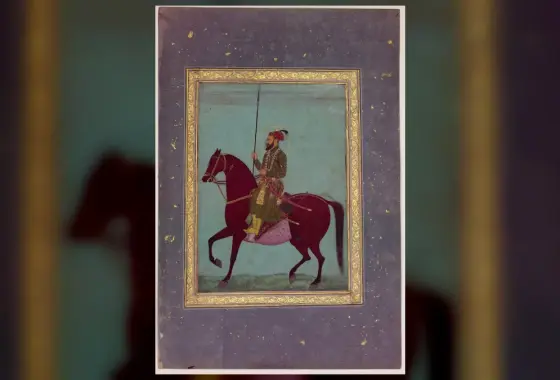
Aurangzeb was the son of Shah Jahan and Mumtaz Mahal and served as governor of the Deccan in his youth. When his father fell ill in 1657, a war of succession broke out among the brothers; Aurangzeb defeated his elder brother Dara Shikoh and in 1658 took the throne, confining his father in Agra Fort.
Religious and legal policies
The Fatawa-i Alamgiri, a great legal compilation according to Hanafi law, was written in his reign. In 1679 he reimposed the jizya tax that Akbar had abolished. Historians assess these policies in different ways.
Conquests in the Deccan
Aurangzeb spent the second half of his reign in the south, in the Deccan. He conquered the sultanates of Bijapur in 1686 and Golconda in 1687, and the empire spread over almost all of India. But years of war against the Marathas, who had grown strong under Shivaji, drained the treasury.
Death
Aurangzeb died at Ahmednagar in the Deccan in 1707 and, as he had wished, was buried in a simple grave at Khuldabad. After his death, succession struggles and the rise of regional powers led to the Mughal Empire’s rapid decline.
The Marathas, the Rajputs and the Sikhs
Aurangzeb's long reign is also remembered for conflicts with powerful communities inside the empire. These struggles laid the ground for the rapid weakening of Mughal authority after his death.
- The Marathas: The Maratha leader Shivaji escaped from house arrest in Agra in 1666 and in 1674 was crowned, proclaiming his own kingdom. His son Sambhaji was captured and executed in 1689, but Maratha resistance did not collapse; on the contrary, it spread across the Deccan.
- The Rajputs: In 1679, after the death of Jaswant Singh, ruler of Marwar, the seizure of his inheritance led part of the Rajput nobility to revolt.
- The Sikhs: In 1675 the ninth Sikh Guru, Tegh Bahadur, was executed in Delhi. His son Guru Gobind Singh founded the Khalsa in 1699, organising the Sikhs as an armed community.
His personality and the debates about him
Traditional accounts portray Aurangzeb as a ruler who lived simply, stayed away from wine and display, copied the Qur'an with his own hand and tried to earn his personal living by sewing prayer caps. His reign of nearly forty-nine years is one of the longest among the Mughal emperors.
Historians' assessments, however, differ sharply. At the beginning of the twentieth century, historians such as Jadunath Sarkar saw him as a ruler whose policies of religious pressure hastened the empire's decline. More recent studies, for example Audrey Truschke's 2017 book, suggest explaining his decisions within the political and fiscal conditions of the time. Today Aurangzeb remains one of the most heated subjects of historical debate in India, so it is important to read claims about him by comparing them with the sources of the period.
Aurangzeb's simple grave, built according to his will, is often compared with the magnificent Taj Mahal of his father Shah Jahan; this open-air grave is described as a symbol of his attitude to worldly wealth. After his death the war of succession among his sons was won by Bahadur Shah I, but the Mughal emperors never again gathered the power they had held under Aurangzeb.
The buildings of Aurangzeb's reign
Aurangzeb did not pursue a great building programme like his father Shah Jahan; his austere lifestyle and his devotion of the treasury to campaigns played a part in this. Still, a few works from his reign are counted among the last great examples of Mughal architecture.
- Badshahi Mosque (Lahore): Completed in 1673, the mosque, with its red sandstone and white marble decoration, was for a long time one of the largest mosques in the world.
- Bibi Ka Maqbara (Aurangabad): The mausoleum built by his son Azam Shah for Aurangzeb's wife Dilras Banu Begum is known as the "Taj of the Deccan" because it was modelled on the Taj Mahal.
- Moti Masjid (Delhi): A small marble mosque inside the Red Fort, built for the ruler's private worship.
Sources and further reading
- Türkiye Diyanet Vakfı İslâm Ansiklopedisi, “Evrengzîb”.
- Saqi Musta‘idd Khan, Ma’asir-i Alamgiri.
- Encyclopaedia Britannica, “Aurangzeb”.
- Jadunath Sarkar – History of Aurangzib (5 vols, 1912–1924)
- Audrey Truschke – Aurangzeb: The Man and the Myth (Penguin, 2017)
- John F. Richards – The Mughal Empire (Cambridge University Press, 1993)
- Catherine B. Asher – Architecture of Mughal India (The New Cambridge History of India, Cambridge University Press, 1992)
- Encyclopaedia Britannica – "Badshahi Mosque"
People also ask
Who was Aurangzeb (Alamgir)? Aurangzeb ruled the Mughal Empire from 1658 to 1707.
When and where was Aurangzeb (Alamgir) born? Born: 3 November 1618, Dahod.
When did Aurangzeb (Alamgir) reign? Reign: 1658 – 1707.
When did Aurangzeb (Alamgir) die? Died: 3 March 1707, Ahmednagar.


Leave a comment
Your email address will not be published. Required fields are marked *