



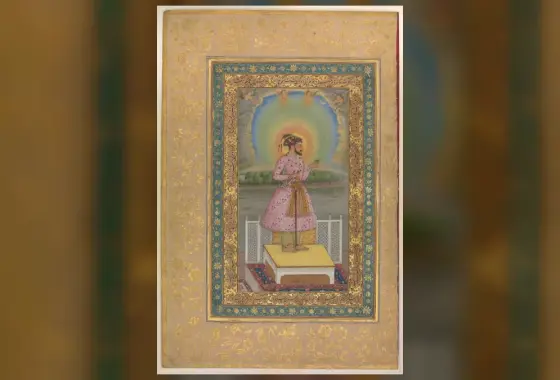
Shah Jahan was the son of the Mughal emperor Jahangir and grandson of Akbar. As a young man he won success on campaigns in the Deccan and Rajputana. After his father’s death in 1627 he won the succession struggle and became emperor in 1628.
The Taj Mahal
Shah Jahan’s beloved wife Mumtaz Mahal died in childbirth in 1631. In her memory he built a white marble mausoleum on the bank of the Yamuna at Agra. Completed over about twenty years, the Taj Mahal is now a UNESCO World Heritage site and the best-known work of Indo-Islamic architecture.
Other buildings
In Delhi he built the new city of Shahjahanabad, named after him, along with the Red Fort and the Jama Masjid. The famous jewelled Peacock Throne was also made in his reign.
The end of his reign
When Shah Jahan fell seriously ill in 1657, a war of succession broke out among his sons. The winner, his son Aurangzeb, deposed his father in 1658 and confined him in Agra Fort. Shah Jahan died there in 1666 and was buried beside his wife in the Taj Mahal.
Wars and borders during his reign
Although Shah Jahan's thirty-year reign is remembered as the empire's age of prosperity, it was spent in constant campaigns. Successes and disappointments went together:
- The Deccan: In 1636 the remaining lands of the Nizam Shahi sultanate of Ahmednagar were annexed to the empire; the sultanates of Bijapur and Golconda also accepted Mughal overlordship and paid tribute. His son Aurangzeb became governor of the Deccan in this period.
- Kandahar: The strategic city of Kandahar fell to the Safavids in 1649. Mughal armies besieged it three times, in 1649, 1652 and 1653, but could not retake it.
- Balkh and Badakhshan: A campaign in 1646–1647 to take the Central Asian lands of his ancestors ended in heavy losses and withdrawal.
How was the Taj Mahal built?
Construction of the Taj Mahal began in 1632. The main structure of the mausoleum was finished around 1643; the whole complex, with its garden, mosque, guest house and gateways, was completed in the early 1650s. Traditional accounts say that about twenty thousand workers and craftsmen worked on it. The white marble was brought from the Makrana quarries in present-day Rajasthan.
The floral motifs on the walls were made with the technique called "parchin kari", in which semi-precious stones are set one by one into recesses carved into the marble. The chief architect is usually named as Ustad Ahmad Lahauri. The Taj Mahal was inscribed on the UNESCO World Heritage List in 1983. Shah Jahan's famous Peacock Throne was carried off to Iran in 1739 when the Iranian ruler Nader Shah sacked Delhi, and was later broken up and lost.
In Shah Jahan's reign the imperial capital was moved in 1648 from Agra to the new city of Shahjahanabad in Delhi. Court historians described the ruler's government in detailed chronicles; the Padshahnama of Abd al-Hamid Lahori is the best known of them. A famous illustrated copy of this work is today held in the British Royal Collection.
The Padshahnama: official history and miniatures
Shah Jahan attached great importance to having an official history of his reign written. The court historian Abdul Hamid Lahori described the first twenty years of the reign in ten-year periods in the Persian Padshahnama; the work records campaigns, ceremonies, appointments and building activity day by day.
The most famous copy of the Padshahnama is a manuscript decorated with miniatures by the court's master painters. In the late 18th century this manuscript was presented by the Nawab of Awadh to King George III of England, and today it is kept in the Royal Collection at Windsor Castle. Its miniatures depict audiences, battle scenes and weddings with details that document the colourful world of the court.
Sources and further reading
- Türkiye Diyanet Vakfı İslâm Ansiklopedisi, “Şah Cihan”.
- UNESCO World Heritage, “Taj Mahal”.
- Encyclopaedia Britannica, “Shah Jahan”.
- Ebba Koch – The Complete Taj Mahal and the Riverfront Gardens of Agra (Thames & Hudson, 2006)
- John F. Richards – The Mughal Empire (Cambridge University Press, 1993)
- Milo Cleveland Beach, Ebba Koch – King of the World: The Padshahnama (Royal Collection / Thames & Hudson, 1997)
- Royal Collection Trust – "The Padshahnama" collection record
People also ask
Who was Shah Jahan? Shah Jahan ruled the Mughal Empire from 1628 to 1658.
When and where was Shah Jahan born? Born: 5 January 1592, Lahore.
When did Shah Jahan reign? Reign: 1628 – 1658.
When did Shah Jahan die? Died: January 1666, Agra Fort.



Leave a comment
Your email address will not be published. Required fields are marked *