



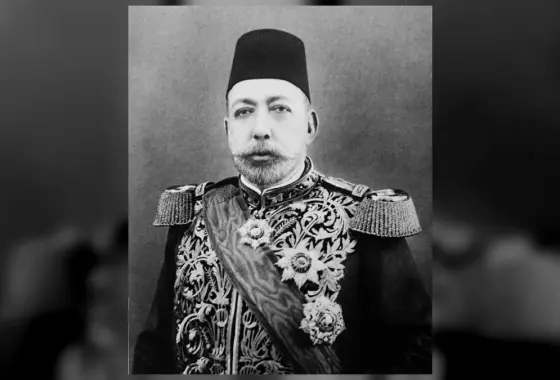
Mehmed V Reşad was a son of Sultan Abdulmejid I. After the 31 March Incident, his brother Abdulhamid II was deposed and Reşad became sultan on 27 April 1909, aged 64. He had spent many years in seclusion in the palace, with an interest in literature and Sufism.
The sultan’s powers in the constitutional era
Sultan Reşad was a constitutional monarch whose powers had been sharply curtailed by the constitutional amendments of 1909. Real power lay with the Committee of Union and Progress, which held the majority in parliament. On his tour of Rumelia in 1911 he visited Thessaloniki, Skopje and Kosovo.
A reign of wars
His reign saw the Italo-Turkish War that began with Italy’s attack in 1911 and the Balkan Wars of 1912 – 1913, in which the empire lost most of its lands in Rumelia. In November 1914 the empire entered the First World War on Germany’s side; the victory at Gallipoli in 1915 was its most important success of the war.
Death
Mehmed V Reşad died in Istanbul on 3 July 1918, as the war neared its end, and was buried in his tomb in Eyüp. He was the last Ottoman sultan to die on the throne; he was succeeded by his brother Mehmed VI Vahdeddin.
Political Background of the Throne Change
The beginning of Sultan Reşad's reign brought with it a highly complex political atmosphere in which both the internal and external dynamics of the Ottoman State were undergoing significant change, and traditional authority was facing a new constitutional order. This transition period represents a time when the management understanding of the state underwent a fundamental transformation, rather than just a change of ruler. The political conditions of the era led to a reconfiguration of the power balances within the administrative center of the empire.
With the transfer of the throne, new searches for the future of the state and political activity came to the fore. The changes experienced during this period are considered fundamental elements that directly influenced the administrative structure and political future of the empire. The uncertainties and winds of change brought by the new order triggered a process of transformation that was felt across all levels of the state.
Administration Under the Influence of the Committee
When examining the administrative structure, the decisive role of the İttihat ve Terakki Cemiyeti in the state mechanism is noteworthy. Within the framework of the new rules brought by the constitutional monarchy, the distribution of political authority and decision-making processes followed a different course from the traditional monarchical structure. The weight of the Committee in political processes was one of the most important elements shaping the management strategies and policies of the state.
The management approach during this period presents a structure where constitutional boundaries and parliament-oriented politics are prominent. The symbolic and limited powers of the Sultan prepared the ground for political power to concentrate more on the parliament and the Committee. This situation represents one of the most important structural changes seen in the management style of the Ottoman State.
Palace Life and Personal Interests
Sultan Reşad's personal world exhibits a calmer and more intellectual character shaped behind the closed doors of the palace. His long years within palace life allowed him to turn towards certain cultural and spiritual fields. His interest in profound areas such as literature and Sufism is seen as a reflection of his intellectual accumulation and his inner world.
These areas of interest gained a unique place within the palace culture of the period. His connection with literature and the spiritual depth brought by Sufism have been the fundamental elements nourishing his personal lifestyle and thought world. This can be evaluated as an area where the sovereign turned to his inner world amidst the intensity of political life and the hardships brought by wars.
Socio-Political Effects of the War Era
The wars experienced during his reign left deep marks on both the military and social structure of the state. Large-scale conflicts such as the Trablusgarp War, the Balkan Wars, and the First World War were processes that directly affected the borders and political power of the empire. These wars represent periods when the resources and administrative capacity of the state were tested to the highest level.
The territorial losses and military struggles brought by the wars created critical turning points that shaped the political future of the state. The difficulties experienced during this process created an impact that deeply shook all institutions and the social structure of the state. This complex environment created by the wars has been one of the fundamental determinants of the political and social transformations in the final period of the empire.
Key Characteristics of the Period
- The new management understanding brought by the constitutional order.
- The role of the İttihat ve Terakki Cemiyeti in political processes.
- Major changes experienced in the Rumeli territories.
- The effects of wars on the military and political structure of the state.
- The intellectual and traditional lifestyle of the palace.
Historical Legacy and the End of the Era
Sultan Reşad's reign holds a place in memory as one of the most critical and transformative periods in the historical process of the Ottoman State. This period, passed through with the great changes and wars experienced by the empire, symbolizes an era in which the structure and management understanding of the state changed fundamentally. This period is considered one of the last great tests of the empire in terms of both political and social aspects.
His status as the last Ottoman sultan to die on the throne makes his historical position even more distinct. With his era, the balance between the traditional structure of the empire and the efforts of modernization evolved into a new dimension in the course of history. This process serves as a summary of the transformation and the great changes experienced by the empire.
Cultural and Educational Transformation Processes
With the proclamation of the constitutional system, a profound cultural and intellectual transformation process was observed throughout the empire. The balance between preserving traditional values and modernization efforts constituted one of the most prominent social dynamics of the period. During this process, the changes in the structure and content of educational institutions influenced the worldview of different segments of society. While the long-standing madrasa tradition continued to exist, it was observed that new generations of educational models and scientific approaches were attempting to find their place between the state bureaucracy and civil society.
The vitality in the fields of literature and art emerged as a reflection of social changes. In addition to classical forms, the emergence of new intellectual movements and literary genres contributed to the diversification of intellectual accumulation. This cultural diversity provided a ground for various ideas from different geographies of the empire to come together and for a search for a new social identity. These changes, reflecting the spirit of the era, were felt not only within the palace circles but also in the heart of urban life.
This transformation in the field of education followed a path parallel to the aim of modernizing the administrative structure of the state. Newly established or reformed institutions aimed to train the new areas of expertise required by the empire. This situation created a complex and multilayered learning environment where traditional knowledge accumulation and modern technical knowledge attempted to coexist. This process became one of the most important building blocks of the social transformation in the empire's final period.
Press and Public Opinion Dynamics
The environment of freedom brought by the constitutional order also led to significant expansion in press and publishing activities. The increase in the number of newspapers and periodicals made political debates more visible to the public. Written media went beyond being a mere tool for conveying news and functioned as a platform where social views were shaped and political ideas clashed. This situation brought the interaction between state decisions and public expectations to a new dimension.
- The existence of various publications expressing political views.
- The role of the press in conveying information about wartime processes to the public.
- The intensification of political discussions and public opinion-forming efforts in urban centers.
- The impact of written texts on social memory and collective consciousness.
- The decisive nature of the speed and content of information dissemination on social reactions.
The weight of public opinion in political processes became an element that indirectly influenced the attitudes of governments and decision-makers. Especially during the periods of large-scale wars, the information provided by the press played a decisive role in the moral and motivational levels of society. The speed and content of information dissemination determined the speed and quality of social reactions to the empire's internal and external issues.
In conclusion, the relationship between the press and public opinion during this period became an inseparable part of the empire's modernization process. The democratization of information and the ability to discuss ideas freely made the transition process between traditional authority and the new constitutional order more dynamic and complex. These dynamics were among the fundamental determinants of the social and political atmosphere in the empire's final period.
Frequently asked questions
When did Sultan Reşad come to the throne? On 27 April 1909, after the deposition of Abdulhamid II.
Under which sultan did the Ottomans enter the First World War? The empire entered the war in November 1914, under Mehmed V Reşad.
Where is Sultan Reşad buried? In his own tomb in Eyüp, Istanbul.
Sources and further reading
- TDV Encyclopedia of Islam, “Mehmed V”.
- Encyclopaedia Britannica, “Mehmed V”.
- Feroz Ahmad, The Young Turks, Oxford University Press.
People also ask
Who was Who Was Sultan Reşad (Mehmed V)? Constitution and WWI? Mehmed V Reşad (1844 – 1918) became Ottoman sultan in 1909 after the deposition of Abdulhamid II.
When and where was Who Was Sultan Reşad (Mehmed V)? Constitution and WWI born? Born: 2 November 1844, Istanbul.
When did Who Was Sultan Reşad (Mehmed V)? Constitution and WWI die? Died: 3 July 1918, Istanbul.
Who was Who Was Sultan Reşad (Mehmed V)? Constitution and WWI’s father? Father: Abdulmejid I.






Leave a comment
Your email address will not be published. Required fields are marked *