



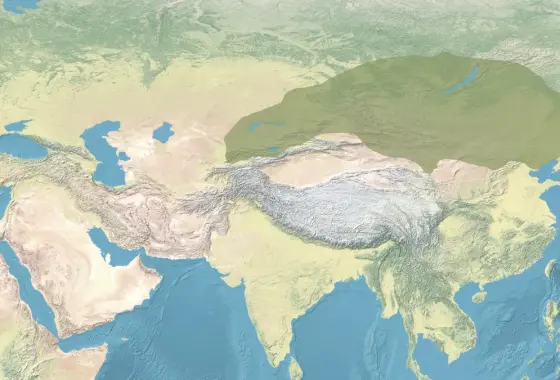
After the Eastern Turkic Khaganate fell to the Tang dynasty in 630, the Göktürks lived under Chinese rule for about half a century, and several bids for independence failed. In the early 680s a Göktürk noble named Kutluk withdrew to the mountains with a small group and began to reorganise.
Independence
The Orkhon Inscriptions say Kutluk set out with just 17 men, that the group soon grew to 70 and then to 700. With the support of the seasoned statesman Tonyukuk, successful campaigns were waged against China and neighbouring tribes. In 682 Kutluk took the title Ilterish Qaghan, “the one who gathers the realm”, and the Göktürk state was reborn.
Strengthening the state
Ilterish led many campaigns against the Toquz Oghuz, the Kyrgyz and China, and made the sacred Ötüken region the centre again. The inscriptions describe this period as a revival in which the Turkic people once more had an “el” (state) and a qaghan.
Death
Ilterish died around 692. Because his sons Bilge and Kül Tigin were young, his brother Qapaghan Qaghan succeeded him.
The founding in the Tonyukuk inscription
One of the most vivid sources on Ilterish Qaghan's rise is the Tonyukuk inscription, erected near today's Ulaanbaatar in the first quarter of the 8th century. In it the aged adviser tells, in his own voice, of the years spent under Chinese rule and of how the small group regrouped in the mountains. Tonyukuk stresses that it was he who urged the qaghan to act and guided him. Historians therefore treat the inscription as a valuable testimony while also taking into account that it is a narrative highlighting the adviser's own role.
Forty-seven campaigns, twenty battles
The Kül Tigin inscription sums up Ilterish Qaghan's reign as a period of struggle. According to the inscription, the qaghan went on campaign forty-seven times and fought twenty battles to rebuild the state. The targets of these campaigns included the Tang border regions and neighbouring peoples such as the Toquz Oghuz, the Kyrgyz and the Khitans. The inscription says that through these successes the qaghan made a people who had "lost its realm" once again possess a state, and a people who had "lost its qaghan" once again possess a qaghan. These words also match the meaning of the title Ilterish.
Tölis and Tarduš: the two wings of the state
In line with old Göktürk tradition, Ilterish Qaghan divided the state into eastern and western wings. According to the inscriptions, he reorganised the Tölis peoples in the east and the Tarduš peoples in the west and placed members of the dynasty with the titles yabghu and shad at their head. This arrangement was a way of binding different peoples across the vast steppe to a single centre. In Chinese sources Ilterish is called Gudulu, and the raids on the northern frontier during his reign are recorded in detail in the Tang chronicles.
Why does the Second Turkic Khaganate matter?
The Second Turkic Khaganate founded by Ilterish lasted about sixty years, from 682 to 744. This relatively short period left behind the most important written documents of Turkic history: the Tonyukuk, Kül Tigin and Bilge Qaghan inscriptions. The inscriptions were erected by Ilterish's sons and adviser to tell of his legacy. Thus Ilterish, although he has no inscription of his own, entered history as a founder known through the words his sons had carved in stone.
Il Bilge Khatun: the qaghan's wife
Ilterish Qaghan's wife and the mother of Bilge Qaghan and Kül Tigin, Il Bilge Khatun, is mentioned with respect in the Orkhon inscriptions. When the Kül Tigin inscription tells of the re-founding of the state, it names the mother together with the father and stresses that the khatun stood beside the qaghan. These statements are among the important testimonies showing that among the Göktürks the khatun had a visible place in state ceremonies and political life.
Frequently asked questions
What does the title Ilterish mean? It combines “el” (state, people) and “terish” (gatherer): “the one who gathers the state again”.
Sources and further reading
- Talat Tekin, Orhon Yazıtları (Kül Tigin, Bilge Qaghan and Tonyukuk inscriptions).
- Türkiye Diyanet Vakfı İslâm Ansiklopedisi, “Köktürkler”.
- Peter B. Golden, An Introduction to the History of the Turkic Peoples.
- Talat Tekin – A Grammar of Orkhon Turkic (Indiana University, 1968)
- Peter B. Golden – An Introduction to the History of the Turkic Peoples (1992)
People also ask
Who was Ilterish Qaghan? Ilterish Qaghan re-established the Göktürk state in 682 after half a century of Tang Chinese rule.
When did Ilterish Qaghan reign? Reign: 682 – 692.
Who succeeded Ilterish Qaghan? Successor: His brother Qapaghan Qaghan.




Leave a comment
Your email address will not be published. Required fields are marked *