



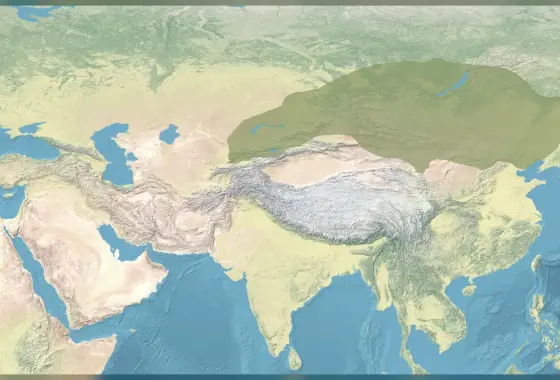
Qapaghan Qaghan was the brother of Ilterish Qutlugh Qaghan, who ended Chinese rule and founded the Second Göktürk Khaganate. When Ilterish died in 692, his sons Bilge and Kül Tegin were still young, so Qapaghan took the throne.
Conquests
Advised by the experienced Tonyukuk, Qapaghan built a powerful army. He campaigned repeatedly against Tang China and obtained silk, seed grain and farming tools from the Chinese court. In 710 he crossed the Sayan Mountains to defeat the Kyrgyz, and in 711 he defeated the Türgesh at Bolchu; the Göktürk army advanced as far as Transoxiana. The Khitans and Tatabi also became subjects.
Last years
His long campaigns and harsh rule provoked revolts among subject tribes. In 716, returning from a campaign against the Bayirku tribe in the north, Qapaghan was ambushed and killed.
His successors
A brief struggle followed his death; Kül Tegin eliminated Qapaghan’s son and his circle and placed his own elder brother, Bilge Qaghan, on the throne. Qapaghan’s campaigns are remembered in the Orkhon inscriptions as part of the revival of the Göktürk state.
The meaning of his name
The title "Kapgan" is considered to derive from the Old Turkic verb "kap-" (to seize, to capture) and is usually explained as "the conqueror, the one who seizes". In Chinese sources the ruler appears under the name Mochuo. In the Orkhon inscriptions, by contrast, his name is mostly not mentioned; Bilge Kagan and Kül Tigin refer to him as "my uncle the kagan". This way of naming him is also a reminder that the inscriptions were written from the point of view of İlteriş's sons and that Kapgan's descendants were removed from power after 716.
The campaign of 698 and the marriage crisis
Kapgan Kagan took a hard line in his relations with Empress Wu Zetian, who at the time had proclaimed her own Zhou dynasty in China in place of the Tang dynasty. When he sought to marry his daughter to a Tang prince, in 698 the empress's relative Wu Yanxiu was sent as the bridegroom. Kapgan refused to accept this, detained the bridegroom and launched a wide raid into northern China on the pretext of restoring the Tang dynasty to the throne. This campaign is one of the strongest examples of the pressure the Göktürks exerted on the Chinese court.
The campaigns in the Tonyukuk Inscription
The campaigns of Kapgan's reign are described in greatest detail in the Tonyukuk Inscription. According to the inscription, the Göktürk army crossed the snow-covered Kögmen (Sayan) mountains with the help of a guide, clearing the snow, to reach the Kyrgyz, and attacked the Kyrgyz while they slept. It then advanced from the direction of the Altai and defeated the Türgesh at Bolchu. The inscription writes that the army crossed the Yinchü River (Syr Darya) and reached as far as the Iron Gate. These accounts show that the Göktürks were influential over a large part of Central Asia in this period.
The upbringing of his nephews Bilge and Kül Tigin
İlteriş's sons Bilge and Kül Tigin grew up under their uncle's rule. According to the Bilge Kagan Inscription, Bilge was made shad over the Tardush people at the age of fourteen during the reign of his uncle the kagan. The Kül Tigin Inscription relates that Kül Tigin took part in a campaign against the Six Chub Sogdians when he was sixteen. In these years the two brothers gained experience as commanders in Kapgan's campaigns. The order they established after 716 was built on the experience gained in these campaigns and on Tonyukuk's support.
The Khitan revolt and the return of Turkic families
In 696 the Khitans launched a major revolt against Zhou rule. Kapgan Kagan took advantage of this opportunity: he offered help to the Chinese court and contributed to the suppression of the revolt by attacking the Khitan homeland from the rear. In return he demanded the return of Turkic families who had been settled in China's northern frontier regions, as well as seed grain and farming tools. According to Chinese sources, a large part of these demands was accepted; these gains increased the population and economic strength of the kaganate.
Sources and further reading
- Orkhon inscriptions (Tonyukuk, Kül Tegin and Bilge Qaghan inscriptions).
- Türkiye Diyanet Vakfı İslâm Ansiklopedisi, “Göktürkler”.
- Encyclopaedia Britannica, “Turk (people)”.
- Talat Tekin, Orhon Yazıtları (Turkish Language Association publications)
- Denis Twitchett (ed.), The Cambridge History of China, Volume 3: Sui and T’ang China, 589–906
- Peter B. Golden, An Introduction to the History of the Turkic Peoples, Otto Harrassowitz, 1992
People also ask
Who was Qapaghan Qaghan? Qapaghan Qaghan, brother of Ilterish Qutlugh Qaghan, founder of the Second Göktürk Khaganate, reigned from 692 to 716.
When did Qapaghan Qaghan reign? Reign: 692 – 716.
When did Qapaghan Qaghan die? Died: 716, returning from a campaign against the Bayirku.


Leave a comment
Your email address will not be published. Required fields are marked *