



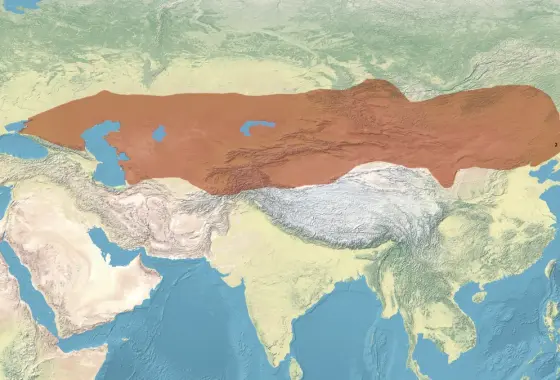
The Göktürks founded a khaganate in the Central Asian steppe in the mid-6th century that soon ruled a vast area from Manchuria to the lands north of the Black Sea. It is regarded as the first political entity to use the name "Turk" as the name of a state.
Founding
The Göktürks originally lived around the Altai Mountains as subjects of the Rouran (Avar) Khaganate and were known as metalworkers. In 552, Bumin Qaghan ended Rouran rule and founded the independent Göktürk Khaganate. After Bumin died soon afterwards, the state kept expanding with a two-winged structure, the khagan ruling in the east and his brother İstemi Yabgu in the west.
A world power
The Göktürks played a key role in Silk Road trade and established diplomatic ties with the Sasanian Empire and Byzantium. Under İstemi Yabgu, envoys were sent to Byzantium and mutual visits took place. These ties were important for controlling the silk trade along the Silk Road.
Interregnum and rebirth
Internal strife and pressure from China's Tang dynasty brought the Eastern Göktürk Khaganate under Chinese rule in 630. After about half a century, independence was regained under Kutluk (İlteriş) Qaghan, and the Second Göktürk Khaganate was founded in 682.
The Orkhon Inscriptions: history carved in stone
Erected during the Second Göktürk Khaganate, the Orkhon Inscriptions are among the oldest and most important written records of the Turkic languages. These monuments, set up in the names of Bilge Qaghan, his brother Kül Tigin and the statesman Tonyukuk, recount the state's history, its hardships and advice to the people. The script used is known as the Old Turkic (Orkhon) alphabet.
End and legacy
In 744 a joint attack by the Uyghurs, Basmyls and Karluks ended the Second Göktürk Khaganate, and the Uyghur Khaganate took its place. The Göktürks' state tradition, titles, script and the name "Turk" left an important legacy for later Turkic states.
State structure: the kaghan, the yabgu and the dual organisation
The Göktürk Khaganate was organised with a dual system of government that was common in steppe states. The eastern wing of the state was ruled by the line of the founder Bumin Kaghan, while the western wing was governed by his brother İstemi Yabgu and his successors. The ruler at the head of the western wing, although subordinate to the kaghan, had wide freedom of action.
- Kaghan: He was the supreme ruler of the state; his authority to rule was believed to come from the "kut" granted by the Sky God.
- Yabgu and shad: These were high titles given to members of the dynasty; they took part in governing the wings and tribes.
- Kurultai: Important decisions were discussed at assemblies attended by tribal leaders.
Silk Road diplomacy: Byzantium and the Sasanians
Soon after their foundation, the Göktürks became an important partner in Silk Road trade. In the middle of the 6th century İstemi Yabgu, together with the Sasanian ruler Khosrow I, defeated the Hephthalites and took control of part of the trade routes in Central Asia.
When no agreement could be reached with the Sasanians on the silk trade, İstemi sent an embassy led by the Sogdian merchant Maniakh to the Byzantine Emperor Justin II around the year 568; shortly afterwards Byzantium sent an envoy named Zemarchus to the Göktürk court. These negotiations have come down to us thanks to fragments preserved by the Byzantine historian Menander, and they show what kind of place the Göktürks had gained among the great powers of the era.
Frequently asked questions
What does "Göktürk" mean?
"Kök" means sky or blue, but historians interpret the name differently. Some link it to the sacredness of the sky, others to a direction system in which blue signified the east.
Where are the Orkhon Inscriptions today?
They stand in the Orkhon River valley in Mongolia, protected as part of the Orkhon Valley Cultural Landscape on the UNESCO World Heritage List.
Sources and further reading
- TDV Encyclopedia of Islam – Göktürks
- Encyclopaedia Britannica – Turk (people)
- R. C. Blockley – The History of Menander the Guardsman (1985)
People also ask
What was the Göktürk Khaganate? The Göktürk Khaganate was founded in 552 when Bumin Qaghan defeated the Rouran (Avars), and it soon became a steppe empire stretching from Manchuria to north of the Black Sea.
When was the Göktürk Khaganate founded? Founded: 552, Bumin Qaghan.
When did the Göktürk Khaganate fall? Fall: 744, Uyghur, Basmyl and Karluk alliance.






Leave a comment
Your email address will not be published. Required fields are marked *