



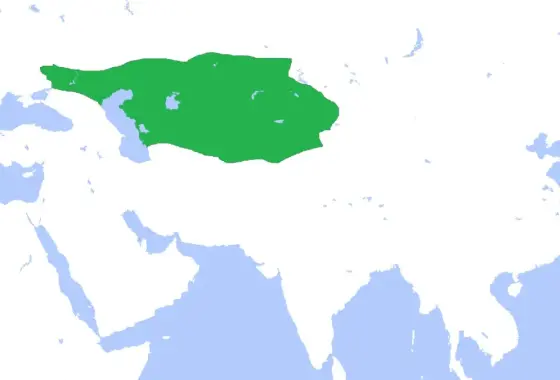
Istämi was the brother of Bumin Qaghan, founder of the Göktürk Khaganate. When the state was founded in 552 he was given the western wing and bore the title “Yabghu”. He is generally identified with Silziboulos of the Byzantine sources.
Victory over the Hephthalites
Allied with the Sasanian king Khosrow I Anushirvan, Istämi defeated the powerful Hephthalites of Central Asia in the 560s, and their lands were divided along the Amu Darya. With this victory the Göktürks gained control of much of the Silk Road trade between China, Iran and Byzantium.
Relations with Byzantium
After falling out with the Sasanians over the silk trade, Istämi turned to Byzantium directly. An embassy led by the Sogdian merchant Maniakh travelled to Constantinople, and in 568 the Byzantine envoy Zemarchus visited Istämi’s camp. The account preserved by the historian Menander offers valuable details about the Göktürk court.
Legacy
Istämi died around 576 and was succeeded by his son Tardu. The western wing later became a separate Western Turkic Khaganate. The Orkhon Inscriptions name “Bumin Qaghan, Istämi Qaghan” together as the founders of the Turkic state.
The Göktürk camp through Zemarchus's eyes
The Byzantine historian Menander relates in detail the account of Zemarchus, the envoy who went to Istämi in 568. Before reaching the camp, the envoys were purified of evil spirits by Göktürk religious specialists, who made them pass over fire. Zemarchus writes that the ruler sat on a two-wheeled golden throne in a tent decorated with silk hangings, and that gold and silver vessels were used at the feasts. This account reveals the wealth of the Göktürk court and the power derived from the Silk Road trade.
The result of the alliance: the Byzantine-Sasanian war of 572
The rapprochement between Istämi and Byzantium aimed to squeeze the Sasanians from two sides. In 572 the Byzantine emperor Justin II went to war with the Sasanians again. Historians note that this decision had many causes and that the Göktürk alliance is counted among the factors that emboldened Byzantium. The two allies, however, never established cooperation close enough to mount a joint campaign. Even so, this relationship is remembered as one of the first periods in which powers at the two ends of Eurasia made direct diplomatic contact.
The embassy of Valentinus and the mourning rite (576)
When the Byzantine envoy Valentinus arrived in Göktürk lands in 576, Istämi had just died. According to Menander, the envoys had to join the mourning and gash their faces in accordance with Göktürk custom. Turxanthus, one of the rulers in the west, was angered that Byzantium had made an agreement with the Avars, whom the Göktürks regarded as enemies, and treated the envoys harshly. Soon afterwards Göktürk forces moved against the Byzantine city of Bosporus in Crimea. With Istämi's death, the friendship established with Byzantium also came to an end.
One ruler, many names
Istämi appears under different names in sources in different languages. The Orkhon inscriptions call him Istämi Qaghan; he is generally accepted to appear as Silziboulos in Byzantine sources, as Sinjibu in Arabic sources and as Shidianmi in Chinese sources. That these names belong to the same person is inferred from the overlap of events in time and place. This is a fine example showing that the Göktürks were known across a vast geography stretching from Byzantium to China.
The later course of the western wing
The western wing ruled by Istämi gradually became independent of the eastern khaganate under his son Tardu and came to be known as the Western Turkic Khaganate. This state broke up in the middle of the 7th century as a result of pressure from Tang China and internal rivalries. In Zhetysu and the surrounding area, peoples such as the Türgesh and the Karluks later came to the fore; in this way the western order founded by Istämi prepared the ground for other Turkic political formations.
Frequently asked questions
What does “yabghu” mean? A Göktürk title ranking below the qaghan, usually held by a dynasty member ruling one wing of the realm.
Sources and further reading
- Menander Protector, History (account of Zemarchus’s embassy).
- Talat Tekin, Orhon Yazıtları.
- Türkiye Diyanet Vakfı İslâm Ansiklopedisi, “Köktürkler”.
- R. C. Blockley – The History of Menander the Guardsman (1985), embassies of Zemarchus and Valentinus
- Denis Sinor (ed.) – The Cambridge History of Early Inner Asia (1990)
People also ask
Who was Istämi Yabghu? Istämi Yabghu, brother of Bumin Qaghan, ruled the western wing of the Göktürk Khaganate from 552 to 576.
When did Istämi Yabghu reign? Reign: 552 – 576.
What was Istämi Yabghu’s greatest victory? Great victory: Defeat of the Hephthalites, 560s.
Who succeeded Istämi Yabghu? Successor: His son Tardu.



Leave a comment
Your email address will not be published. Required fields are marked *