



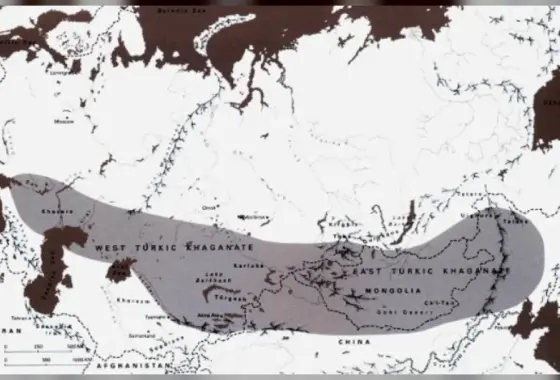
In the early 6th century Bumin led the Göktürks, who lived around the Altai Mountains as subjects of the Rouran (Avar) Khaganate. Chinese sources call him Tumen. At the time the Göktürks were known as ironworkers for the Rouran.
The road to independence
According to Chinese sources, Bumin first defeated the Tiele, who had rebelled against the Rouran, and won their loyalty. He then asked the Rouran ruler for a princess in marriage; when the request was rejected with contempt, he broke with the Rouran and allied with Western Wei China.
552 and the Göktürk Khaganate
In 552 Bumin defeated the Rouran and founded the Göktürk Khaganate with the title “Il Qaghan”. His brother Istämi took charge of the western wing. Bumin died the same year and was succeeded first by his son Issik Qaghan and soon by another son, Muqan Qaghan, under whom the state became a vast empire.
Bumin in the Orkhon Inscriptions
When the Kül Tigin and Bilge Qaghan inscriptions tell of the founding of the Turkic state, they begin: “When the blue sky above and the dark earth below were created, between the two were created the sons of men. Over the sons of men sat my ancestors Bumin Qaghan and Istämi Qaghan.” These words show Bumin’s place as a founder in Turkish history.
The Ashina lineage and the wolf legend
The dynasty to which Bumin belonged is called Ashina (A-shih-na) in Chinese sources. The same sources relate a legend about the origin of the Göktürks: a boy whose entire people had been killed in a war is fed and raised by a she-wolf, and the lineage descends from this wolf. Chinese sources also record that the banners of the Göktürks bore a wolf's head. In later centuries this legend appears in similar forms in the origin stories of other Turkic peoples.
"Our blacksmith slave": the Avar ruler's reply
According to Chinese sources, after serving the Avar ruler Anagui by crushing the revolt of the Tiele, Bumin asked to marry his daughter. Anagui refused the request, insulting Bumin as "our blacksmith slave". This reply shows that the Göktürks were a people subject to the Avars and known for metalworking. Bumin had the envoy killed and broke with the Avars. After the defeat of 552, Anagui is reported to have taken his own life, and the Avar Khaganate's rule over the steppe came to an end.
The marriage tie with the Western Wei
To gain strength against the Avars, Bumin established relations with the Western Wei dynasty in northern China. In 551 the Western Wei court sent one of its princesses to Bumin as a wife. This marriage showed that the Göktürks were now an independent power on the steppe with whom Chinese states dealt directly. The victory over the Avars the following year came after this diplomatic preparation. Bumin thus stands out as a founder who used war and diplomacy together.
"Türk" becomes the name of a state
The khaganate founded by Bumin is regarded as the first political entity to bear the name "Türk" as the name of a state. Chinese sources write this name as T'u-chüeh. In later centuries, when the Orkhon inscriptions name Bumin and Istämi as the founders of the state, they call the people "Türk budun". For this reason, in the writing of Turkic history the year 552 is seen as the beginning not only of a state but also of the political tradition known by the name Türk.
Frequently asked questions
When was the Göktürk state founded? In 552, when Bumin Qaghan defeated the Rouran.
How were Bumin and Istämi related? They were brothers: Bumin headed the state and its eastern wing, Istämi ruled the western wing.
Sources and further reading
- Talat Tekin, Orhon Yazıtları (Kül Tigin inscription, east face).
- Türkiye Diyanet Vakfı İslâm Ansiklopedisi, “Köktürkler”.
- Peter B. Golden, An Introduction to the History of the Turkic Peoples.
- Denis Sinor (ed.) – The Cambridge History of Early Inner Asia (1990), chapter on the Türks
- Türkiye Diyanet Vakfı İslâm Ansiklopedisi – entry “Bumin Kağan” (in Turkish)
People also ask
Who was Bumin Qaghan? Bumin Qaghan founded the Göktürk Khaganate in 552 by defeating the Rouran (Avar) Khaganate and took the title “Il Qaghan”.
When did Bumin Qaghan die? Died: 552.




Leave a comment
Your email address will not be published. Required fields are marked *