



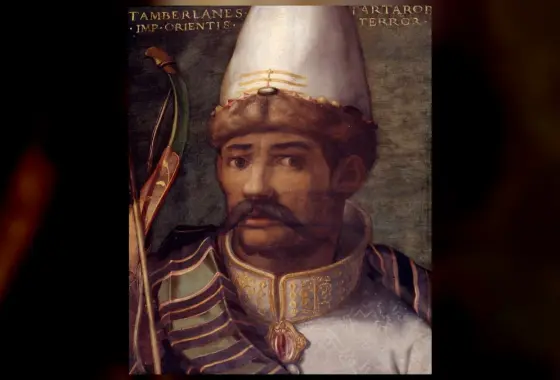
Timur was born near Kesh (Shahrisabz) in today’s Uzbekistan, into the Barlas, a Turkicised tribe of Mongol origin. Wounds received in his youth left his right leg and arm disabled, which is why Persian sources call him “Timur-i Lang” (Timur the Lame), the origin of “Tamerlane”.
Rise to power
As the Chagatai Khanate fragmented, he first allied with Amir Husayn, then eliminated him and declared his rule at Balkh in 1370. Not being descended from Genghis Khan, he did not take the title “khan”; by marrying a princess of Genghisid descent he gained the title Gurkani (son-in-law).
Campaigns
He conquered Iran and Iraq and defeated his former ally, the Golden Horde khan Tokhtamysh, in 1391 and 1395. He took Delhi in 1398 and Aleppo, Damascus and Baghdad in 1400–1401. At the Battle of Ankara on 28 July 1402 he defeated and captured the Ottoman sultan Bayezid I, plunging the Ottomans into the Interregnum.
Samarkand
Using craftsmen brought back from his campaigns, Timur rebuilt Samarkand. The Bibi-Khanym Mosque and his own mausoleum, the Gur-e Amir, are famous works of the period.
Death
Setting out on a campaign against China, Timur fell ill and died at Otrar in February 1405; he was buried in the Gur-e Amir in Samarkand. A succession struggle followed among his sons and grandsons, and his son Shah Rukh eventually restored the state.
Puppet khans and legitimacy
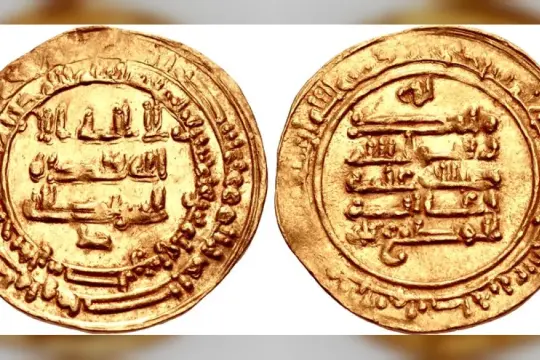
Timur, who did not descend from Genghis Khan, knew that in Mongol tradition he could not become a "khan". He therefore placed puppet khans of Genghisid descent on the throne: first Suyurghatmish Khan and, after his death, his son Sultan Mahmud Khan. Decrees and coins bore the names of these khans, while real power lay with Timur, who used the title "Amir". Timur also presented his campaigns as wars waged in the name of Islam and patronised religious scholars and Sufis. His combined use of Mongol and Islamic legitimacy became a method that later Timurid rulers also relied on.
Contact with Europe: the Clavijo embassy
After the Battle of Ankara, the interest of European courts in Timur grew. Ruy González de Clavijo, the envoy sent by King Henry III of Castile, reached Samarkand in the autumn of 1404. Clavijo's travel account is among the most valuable sources describing, as an eyewitness, Timur's court, the building work in the city, its gardens and its great feasts. The envoy also reports seeing the Bibi Khanym Mosque while it was still under construction. Timur also corresponded with King Charles VI of France.
The Gur-e Amir and the Timurid legacy
Timur was buried in the Gur-e Amir mausoleum, which had been built for his grandson Muhammad Sultan. In June 1941 Soviet scientists opened the grave in the mausoleum; the examination by the anthropologist Mikhail Gerasimov confirmed the disability of the right leg and arm described in the sources, and a facial reconstruction was made from the skull. The state Timur founded broke apart after his death, but under his son Shah Rukh and his grandson Ulugh Beg, Samarkand and Herat enjoyed a brilliant period in art and science known as the "Timurid Renaissance". The Gur-e Amir today lies within the UNESCO site "Samarkand – Crossroad of Cultures".
The sources on Timur
A large part of what we know about Timur comes from Persian histories written at his court or in circles close to him; the Zafarnamas of Nizam al-Din Shami and Sharaf al-Din Ali Yazdi are chief among them. These works aim to praise the ruler. By contrast, the Damascene historian Ibn Arabshah wrote a harsh critique describing the suffering caused by Timur's campaigns. Ibn Khaldun met Timur in person during the siege of Damascus in 1401 and recorded the meeting. Historians compare these different perspectives to build a more balanced picture.
Frequently asked questions
Why did Timur call himself amir and not khan? In steppe tradition the title khan was reserved for descendants of Genghis Khan.
Sources and further reading
- Ibn Arabshah, Aja’ib al-maqdur fi nawa’ib Timur.
- Türkiye Diyanet Vakfı İslâm Ansiklopedisi, “Timur”.
- Encyclopaedia Britannica, “Timur”.
- Beatrice Forbes Manz – The Rise and Rule of Tamerlane (Cambridge University Press, 1989)
- Ruy González de Clavijo – Embassy to Tamerlane 1403–1406 (trans. Guy Le Strange, Routledge, 1928)
- UNESCO World Heritage – "Samarkand – Crossroad of Cultures" (2001)
- Walter J. Fischel – Ibn Khaldūn and Tamerlane: Their Historic Meeting in Damascus, 1401 A.D. (University of California Press, 1952)
People also ask
Who was Timur? Timur ruled the Samarkand-based Timurid Empire from 1370 until his death in 1405.
When and where was Timur born? Born: 1336, near Kesh (Shahrisabz).
When did Timur reign? Reign: 1370 – 1405.
When did Timur die? Died: February 1405, Otrar.

Leave a comment
Your email address will not be published. Required fields are marked *